
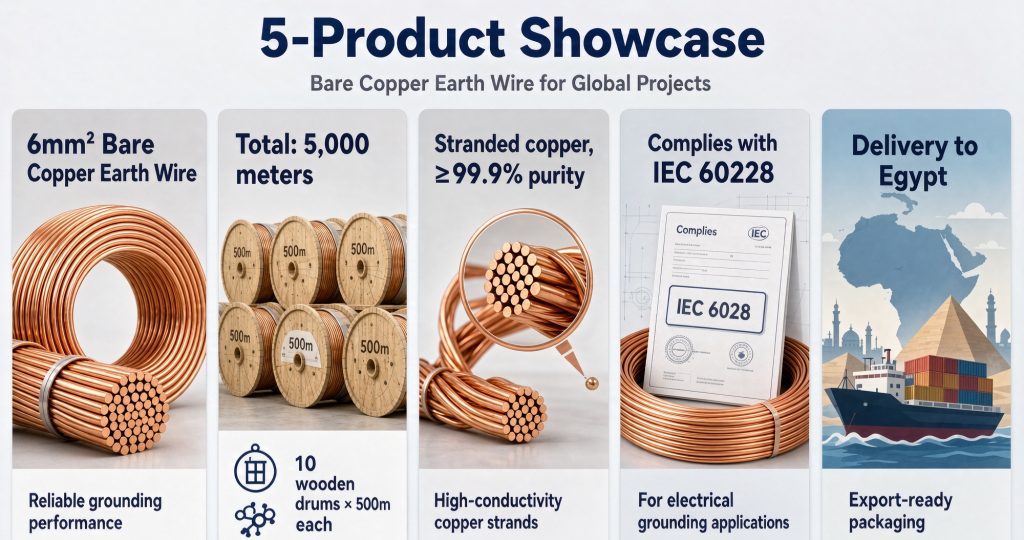
When a project requires 6mm² copper wire, choosing a supplier is not simply a matter of finding the lowest price per meter. The conductor construction, insulation, voltage rating, manufacturing standard, packaging and order quantity can all affect whether the wire is suitable for the intended installation.
For importers, electrical distributors, contractors and project buyers sourcing from China, a clear product specification is especially important. A quotation for “6mm² copper wire” alone does not provide enough information to compare two manufacturers accurately.
This guide explains what buyers should check when sourcing 6mm² copper wire from China, including conductor construction, applications, insulation, standards, purchasing specifications and bulk-order considerations.
What Is 6mm² Copper Wire?
6mm² refers to the nominal cross-sectional area of the copper conductor.
It does not mean that the complete outside diameter of the finished cable is 6mm. The final diameter depends on several factors, including the conductor construction and insulation thickness.
A 6mm² copper wire can therefore have different physical constructions while maintaining the same nominal conductor cross-sectional area.
For example, buyers may encounter:
- Solid copper conductor
- Stranded copper conductor
- PVC-insulated building wire
- Different conductor classes
- Different voltage ratings
- Different manufacturing standards
This is why an international buyer should specify more than simply “6mm² copper wire” when requesting a quotation.
What Is 6mm² Copper Wire Commonly Used For?
6mm² copper building wire is commonly considered for electrical circuits where a larger conductor cross-section is required than typical lighting or small-power circuits.
Depending on the applicable electrical code and installation design, potential applications can include:
- Building electrical installations
- Distribution circuits
- Commercial electrical projects
- Residential electrical systems
- Electrical panels
- Conduit installations
- Trunking systems
- Equipment connections
- Industrial electrical installations
The appropriate wire size should always be determined by the project’s electrical design, installation method, permissible voltage drop, ambient conditions and applicable regulations.
A 6mm² conductor should not be selected simply because another project used the same size.
Solid or Stranded: Which 6mm² Copper Wire Should You Choose?
One of the first questions a buyer should answer is whether the project requires a solid or stranded conductor.
Solid copper wire uses a single conductor, while stranded copper wire is constructed from multiple smaller copper strands.
The practical difference is mainly related to flexibility and conductor construction.
For fixed installations, a solid conductor may be suitable where the project specification calls for a rigid conductor.
A stranded construction can be useful when the installation requires additional flexibility, particularly around bends, panels or equipment connections.
The choice should therefore be based on the actual installation rather than assuming that stranded wire is automatically better.
For a more detailed explanation of the difference, see our guide:
[Solid vs Stranded Copper Wire: Which Is Better for Electrical Installation?]
That comparison explains conductor construction, flexibility, conductor classes and the factors buyers should consider before ordering.
6mm² BV Wire for Building Installation
BV is a commonly used designation for PVC-insulated copper building wire in China.
For buyers sourcing BV wire from China, the quotation should clearly identify the applicable standard, conductor construction, rated voltage, insulation and other required technical specifications.
A buyer should also avoid assuming that every product described as “BV wire” has exactly the same construction or documentation.
For international purchasing, it is better to ask the manufacturer to state the complete technical specification on the quotation and product documentation.
6mm² H07V-U and H07V-R
International buyers may also encounter H07V-U and H07V-R when searching for PVC-insulated single-core copper building wire.
H07V-U is generally associated with a solid Class 1 copper conductor.
H07V-R is associated with a stranded rigid conductor.
This difference can matter when the project specification requires a particular conductor construction.
If you are comparing these products, see our related guide:
[BV Wire vs H07V-U: What Is the Difference and Which One Should You Buy?]
For buyers looking at several single-core copper-wire constructions, our [Wholesale Single Core Copper Wire Factory | BV H07V-U China] article also provides additional information about BV, H07V-U, H07V-R and BVR/H07V-K configurations.
Why the Conductor Class Matters
When buying 6mm² copper wire, “copper” and “6mm²” are not enough to completely describe the product.
The conductor class provides information about the construction.
For example, a buyer may specify:
6mm² copper conductor, Class 1
or:
6mm² copper conductor, Class 2
The manufacturer can then understand that the required conductor construction is different.
This becomes particularly important when comparing quotations from multiple factories.
Two suppliers may both quote “6mm² copper wire,” but their conductor constructions may not be identical.
PVC Insulation for 6mm² Copper Wire
PVC is widely used as an insulation material for building wires.
When buying PVC-insulated 6mm² copper wire, buyers should check:
- Insulation material
- Insulation thickness
- Rated voltage
- Operating temperature requirements
- Applicable standard
- Color
- Printing/marking
- Packaging
- Test documentation
The insulation specification should be considered together with the conductor specification.
For more information about this product category, see:
[PVC Insulated Building Wire Supplier China | BV, H07V-U, 450/750V]
This is particularly useful when comparing different PVC-insulated building-wire products rather than looking at the copper conductor alone.
What Voltage Rating Should 6mm² Wire Have?
The required voltage rating depends on the intended application and destination-market requirements.
For example, some PVC-insulated building wires are manufactured for 450/750V applications.
However, buyers should not assume that every 6mm² copper wire is automatically a 450/750V product.
The purchase specification should clearly state the required voltage rating.
For a quotation request, write the required voltage directly instead of leaving it for the supplier to determine.
6mm² Copper Wire Ampacity
Ampacity, or current-carrying capacity, cannot be determined from the conductor cross-section alone.
The allowable current depends on factors such as:
- Installation method
- Ambient temperature
- Number of loaded conductors
- Conductor material
- Insulation
- Cable grouping
- Permitted conductor temperature
- Local electrical regulations
For this reason, buyers should be careful with online tables that provide one fixed ampacity value for every 6mm² copper wire.
A manufacturer’s technical data should be considered together with the electrical code applicable to the installation.
If your project requires a specific current rating, provide the manufacturer with the complete installation conditions rather than asking only for “6mm² wire.”
What Is the Difference Between 6mm² and 4mm² Copper Wire?
The most obvious difference is conductor cross-sectional area.
6mm² has a larger nominal conductor cross-section than 4mm².
However, a larger conductor does not automatically mean that it should replace a smaller conductor.
The correct size depends on the circuit design, installation conditions, allowable voltage drop, current requirements and applicable regulations.
For a commercial or industrial project, the final conductor size should follow the electrical engineer’s specification.
What Is the Difference Between 6mm² and 10mm² Copper Wire?
The same principle applies when comparing 6mm² and 10mm².
10mm² provides a larger conductor cross-sectional area, but selecting the larger size simply because it appears “safer” is not a substitute for proper circuit design.
When importing wire, the buyer should purchase according to the project’s specified conductor size rather than asking the supplier to decide the size based only on the intended application.
How to Buy 6mm² Copper Wire From China
A professional RFQ should give the manufacturer enough information to quote the exact product.
A basic specification can include:
| Item | Requirement |
|---|---|
| Product | 6mm² copper building wire |
| Conductor | Copper |
| Cross-section | 6mm² |
| Conductor construction | Solid or stranded |
| Conductor class | Specify required class |
| Insulation | PVC |
| Rated voltage | Specify required voltage |
| Standard | Specify required standard |
| Color | Specify required color |
| Quantity | Specify total meters |
| Packing | Coil, roll or drum |
| Destination | Country / port |
| Certification | Specify required documents |
The more complete the specification, the easier it becomes to compare quotations from different Chinese manufacturers.
What Should You Ask a Chinese Copper Wire Supplier?
Before placing a bulk order, buyers can ask the factory several practical questions.
1. What conductor construction is used?
Confirm whether the 6mm² conductor is solid or stranded.
2. What is the conductor class?
Ask the supplier to state the conductor class in the technical specification.
3. What standard is the wire manufactured to?
The answer should match the requirements of the destination market and project.
4. What is the rated voltage?
Do not assume the voltage rating from the product name.
5. What is the maximum DC resistance?
This is a useful technical value when comparing equivalent copper-wire products.
6. What insulation material and thickness are used?
This helps ensure that quotations are actually comparable.
7. What packaging is available?
For export orders, packaging can have a significant effect on transportation and handling.
8. Can the factory provide samples and test documentation?
For larger orders, confirming the product before mass production can reduce purchasing risk.
How to Compare 6mm² Copper Wire Quotations
Imagine three suppliers send you quotations.
Supplier A offers a low price per meter.
Supplier B offers a slightly higher price.
Supplier C offers the highest price.
The cheapest quotation is not necessarily the most economical option if the specifications are different.
Before comparing prices, check:
- Copper conductor
- 6mm² cross-section
- Conductor class
- Solid or stranded construction
- PVC insulation
- Rated voltage
- Manufacturing standard
- DC resistance
- Color
- Packaging
- Certification
- Quantity
- Delivery terms
Only after these points are aligned should the unit prices be compared.
Bulk Packaging for 6mm² Copper Wire
Packaging requirements depend on the buyer’s distribution and installation needs.
Common options can include:
- Coils
- Rolls
- Wooden drums
- Export cartons
- Customized packaging
For a wholesale order, the buyer should specify the preferred length per package.
For example:
100m per coil
is much more useful to a manufacturer than simply saying:
Please pack the wire well.
If the wire will be resold, the buyer can also discuss private-label printing, package markings and product labels with the factory.
Why Buying Directly From a Manufacturer Can Help
When purchasing large quantities, buyers often want to communicate directly with the manufacturing source.
Direct communication can make it easier to discuss:
- Product specifications
- Custom colors
- Printing
- Packaging
- Quantity
- Samples
- Production schedules
- Documentation
- Export requirements
However, buyers should still verify the supplier’s actual manufacturing capability, product specifications and documentation before placing a large order.
A Practical RFQ Example
A buyer could send the following request to a Chinese manufacturer:
We are looking for 6mm² copper building wire for a commercial electrical project.
Conductor: Copper
Size: 6mm²
Construction: Please quote solid and stranded options separately
Insulation: PVC
Voltage: 450/750V
Standard: Please confirm applicable standard
Color: Blue
Quantity: 20,000 meters
Packing: Please quote coil and drum options
Destination: [Country / Port]Please provide the technical datasheet, unit price, MOQ, lead time, packing details and available certifications.
This type of RFQ gives the factory enough information to prepare a meaningful quotation.
Common Mistakes When Buying 6mm² Copper Wire
Choosing only by price
A low price can represent a different specification.
Not specifying conductor construction
“6mm² copper wire” does not tell the manufacturer whether solid or stranded construction is required.
Ignoring the destination market
Electrical standards and documentation requirements can vary between markets.
Comparing different packaging configurations
A quotation based on 100m coils should not automatically be compared with a quotation based on large drums without considering the complete delivered cost.
Ordering a large quantity without checking samples
For a major project, confirming the product before mass production can help identify specification differences early.
FAQ About 6mm² Copper Wire
Is 6mm² copper wire suitable for house wiring?
It can be used for certain building circuits, but suitability depends on the circuit design, installation method, local electrical regulations and required current capacity. The wire size should be selected according to the project’s electrical requirements.
Is 6mm² copper wire better than 4mm²?
A larger conductor cross-section is not automatically “better.” The correct size depends on the electrical design and installation conditions.
Is 6mm² copper wire available in solid and stranded versions?
Yes. Depending on the product family and applicable standard, buyers can encounter different conductor constructions. Always specify the required conductor class when ordering.
What is 6mm² BV wire?
BV is a common designation associated with PVC-insulated copper building wire in China. The exact technical specification should be confirmed with the manufacturer before ordering.
Is H07V-U suitable for 6mm² applications?
H07V-U is associated with a solid copper conductor construction. Whether it is suitable depends on the required standard, installation and destination-market specification.
What is the difference between H07V-U and H07V-R?
H07V-U is generally associated with a solid Class 1 conductor, while H07V-R uses a stranded rigid conductor. Buyers should select according to the required conductor construction and applicable standard.
How many amps can 6mm² copper wire carry?
There is no single current value that applies to every installation. Ampacity depends on installation conditions, temperature, conductor construction, insulation, grouping and the applicable electrical code.
Can I order 6mm² copper wire in custom colors?
Many manufacturers can provide different insulation colors, but the available colors and minimum order quantities should be confirmed with the factory.
What information should I include when asking for a quotation?
At minimum, provide the conductor material, 6mm² cross-section, conductor construction, conductor class, insulation, voltage rating, standard, color, quantity, packaging and destination.
Is China a source for wholesale 6mm² copper wire?
China has a large electrical-wire and cable manufacturing industry, and buyers can source building wire in different sizes and constructions. Before ordering, verify the manufacturer’s technical specifications, production capability, quality documentation and export experience.
Get a 6mm² Copper Wire Quote
For buyers sourcing 6mm² copper wire from China, the most important step is to define the product accurately before comparing prices.
Specify the conductor material, 6mm² cross-section, solid or stranded construction, conductor class, PVC insulation, voltage rating, applicable standard, color, quantity and packaging.
If you are comparing different conductor constructions, our [Solid vs Stranded Copper Wire: Which Is Better for Electrical Installation?] guide provides additional information.
For buyers researching PVC-insulated building wire, see [PVC Insulated Building Wire Supplier China | BV, H07V-U, 450/750V].
For a broader comparison of single-core copper-wire options, see [Wholesale Single Core Copper Wire Factory | BV H07V-U China].
A detailed specification makes it easier to obtain comparable quotations and helps both the buyer and manufacturer understand exactly what product is required.


No reply content