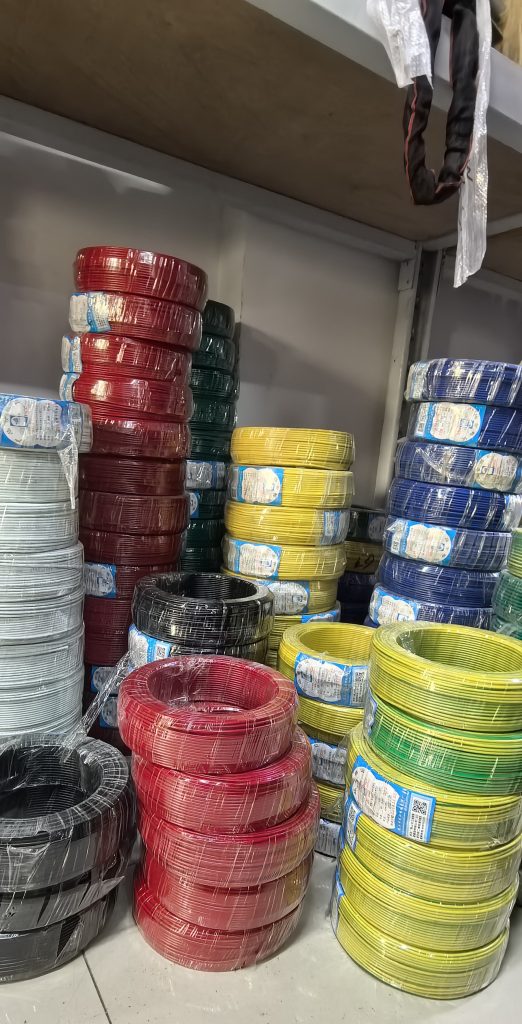
BV Wire Ampacity: How to Choose the Correct Cross-Section for Your Application
Choosing the correct BV wire cross-section is not simply a matter of selecting the largest conductor that fits the budget.
For electrical contractors, distributors, importers and project buyers, the real question is how much current the wire can safely carry under the actual installation conditions.
A 1.5 mm², 2.5 mm², 4 mm², 6 mm² or 10 mm² copper wire can have very different current-carrying capabilities. However, there is no single ampacity value that applies to every installation.
Installation method, ambient temperature, conductor grouping, conduit fill, circuit length and voltage-drop requirements can all affect the final selection.
This guide explains how to evaluate BV wire ampacity and how international buyers can specify the correct cross-section when sourcing PVC-insulated copper building wire from China.
What Does BV Wire Ampacity Mean?
Ampacity refers to the amount of electrical current a conductor can carry under specified conditions without exceeding its permitted operating temperature.
For BV wire, the conductor is generally copper with PVC insulation.
A typical 450/750V BV / 60227 IEC 01 building wire configuration consists of:
- Single-core copper conductor
- PVC insulation
- 450/750V rated voltage
- Fixed-installation application
- Different conductor cross-sections
- Different insulation colors
The term “ampacity” should therefore always be connected to the installation conditions.
A wire may have one reference ampacity when installed individually and another allowable current when several circuits are bundled together.
Typical BV Wire Sizes and Reference Ampacity
For buyers comparing common PVC-insulated building-wire sizes, the following values can be used as a planning reference.
| Copper Cross-Section | Reference Ampacity* | Typical Application |
|---|---|---|
| 1.5 mm² | 15–18 A | Lighting and smaller circuits |
| 2.5 mm² | 20–25 A | General socket and branch circuits |
| 4 mm² | 30–35 A | Higher-load branch circuits |
| 6 mm² | 40–45 A | Higher-load circuits and sub-feeds |
| 10 mm² | 55–65 A | Larger equipment and panel feeds |
*These are reference values rather than universal installation ratings. Actual allowable current depends on installation method, ambient temperature, grouping, conduit conditions and the applicable electrical code.
The current product information for Author 88’s PVC insulated building wire gives the same type of reference ampacity range and explicitly notes that real current capacity changes according to installation conditions.
For buyers who want to compare the available conductor constructions and sizes, the existing [PVC Insulated Building Wire Supplier China | BV, H07V-U, 450/750V] page provides the product specifications.
Why 1.5 mm² BV Wire Has a Lower Ampacity
A 1.5 mm² copper conductor contains less copper than a 2.5 mm² or 4 mm² conductor.
As the conductor cross-sectional area decreases, electrical resistance generally increases.
This means a smaller conductor normally produces more heat for the same current than a larger conductor under equivalent conditions.
1.5 mm² BV wire is therefore commonly associated with lighting and smaller electrical circuits, subject to local electrical requirements.
It should not automatically be used simply because the connected equipment appears to have a relatively small rated power.
The circuit design, protective device and installation method must also be considered.
Is 2.5 mm² BV Wire Suitable for 20A or 25A?
2.5 mm² is one of the most commonly discussed sizes for general building wiring.
Author 88’s current product specification gives a reference ampacity of approximately 20–25 A for 2.5 mm² solid copper PVC building wire.
However, this does not mean that every 2.5 mm² installation can simply be protected by a 25A breaker.
For example, if the wire is installed:
- In a crowded conduit
- With several loaded circuits
- In a high-temperature environment
- In an enclosed installation
- Over a long distance
the allowable current may need to be reduced.
Therefore, buyers should avoid specifying a wire solely by saying:
“2.5 mm² = 25A.”
A more accurate specification is:
2.5 mm² copper PVC-insulated building wire, with the final allowable current determined according to the applicable installation conditions and electrical code.
4 mm² BV Wire and Higher Loads
4 mm² copper wire provides a larger conductor cross-section than 2.5 mm².
The current product information for Author 88 gives a reference ampacity of approximately 30–35 A for 4 mm² PVC-insulated copper building wire.
This size can be relevant to higher-load branch circuits.
Potential applications may include:
- Larger air-conditioning circuits
- Kitchen equipment
- Water-heating equipment
- Dedicated appliance circuits
- Higher-load branch circuits
The actual application depends on the electrical design.
If the circuit is long, voltage drop should also be calculated instead of selecting the wire from ampacity alone.
6 mm² BV Wire for Higher-Load Circuits
6 mm² wire contains substantially more copper than 2.5 mm² and 4 mm² conductors.
The current product reference gives approximately 40–45 A as a planning ampacity range for 6 mm² solid copper PVC building wire.
This size may be considered for:
- Larger air-conditioning systems
- Water heaters
- Sub-feeds
- Higher-load equipment
- Certain distribution circuits
However, a 40–45 A reference value should not be interpreted as permission to use a 45A protective device in every installation.
The electrical designer needs to consider the complete installation.
10 mm² BV Wire
10 mm² is commonly used where a substantially larger conductor is required.
Author 88’s current 10 mm² BV product information specifies a 450/750V single-core PVC-insulated copper conductor with a nominal insulation thickness of 1.0 mm and maximum DC resistance of 1.83 Ω/km at 20°C.
The supplier’s general building-wire specification gives a reference ampacity of approximately 55–65 A for 10 mm² under stated planning conditions.
Typical project applications can include:
- Large air-conditioning branches
- Panel feeds
- Sub-feeds
- EV charging circuits where the electrical design permits
- Higher-load building equipment
Again, the actual breaker size and permitted current must be determined according to the installation and local requirements.
Ampacity Is Not the Same as Breaker Rating
This is an important distinction for buyers.
The ampacity of the conductor and the rating of the protective device are related, but they are not automatically the same number.
The protection system must be designed so that the conductor is adequately protected under the applicable electrical code.
For example, a wire having a reference ampacity of 25A does not automatically mean that a 25A breaker is appropriate under every installation condition.
The designer may need to account for:
- Installation derating
- Continuous loads
- Ambient temperature
- Grouping
- Voltage drop
- Protective-device characteristics
- Local code requirements
For international projects, the destination country’s electrical requirements should be confirmed before finalizing the specification.
How Ambient Temperature Changes Ampacity
PVC-insulated building wire is affected by temperature.
As ambient temperature increases, the conductor has less thermal capacity available before reaching its maximum permitted operating temperature.
This can require a reduction in allowable current.
For example, a wire installed in a cool environment may have more favorable thermal conditions than the same wire installed in a hot equipment room or a poorly ventilated ceiling space.
This is especially important for buyers shipping electrical wire to hot-climate markets.
Do not assume that a current table prepared for one climate automatically applies to another.
Cable Grouping Can Reduce Allowable Current
Another important factor is the number of loaded conductors installed together.
Imagine several circuits running through the same conduit.
Each conductor produces heat.
When multiple loaded conductors are grouped together, heat dissipation becomes more difficult.
The allowable current may therefore need to be reduced.
This means a contractor should not simply look at a product catalog and select the maximum ampacity shown there.
The installation arrangement must be considered.
Conduit Fill Also Matters
BV wire is frequently installed inside conduit or trunking.
The available space inside the conduit affects installation quality and heat dissipation.
A conduit that contains too many conductors can create:
- Higher heat accumulation
- More difficult cable pulling
- Installation problems
- Potential code-compliance issues
For this reason, the wire size and conduit size should be considered together.
The current Author 88 building-wire product information specifically identifies conduit and trunking as common fixed-installation applications.
Voltage Drop: The Problem Ampacity Does Not Solve
A wire can have sufficient ampacity and still have excessive voltage drop over a long circuit.
This is particularly important for:
- Long building runs
- Remote equipment
- Pumps
- Motors
- Air-conditioning equipment
- Large commercial buildings
- Distribution systems
For example, a relatively small circuit may carry a moderate current safely from a thermal perspective, but if the cable run is very long, the voltage at the equipment may fall below the required level.
Therefore, wire selection should consider both:
Current-carrying capacity
and
Voltage drop
The longer the circuit, the more important voltage-drop calculations become.
Copper Resistance Is Important When Comparing Suppliers
International buyers should pay attention to conductor resistance rather than comparing wire prices alone.
Author 88’s current product specification lists maximum DC resistance values at 20°C such as:
- 1.5 mm²: 12.1 Ω/km
- 2.5 mm²: 7.41 Ω/km
- 4 mm²: 4.61 Ω/km
- 6 mm²: 3.08 Ω/km
- 10 mm²: 1.83 Ω/km
These values are useful when comparing quotations for the same conductor specification.
If two suppliers quote the same nominal wire size but provide significantly different technical specifications, the buyer should investigate before comparing prices.
A cheaper price does not necessarily represent a lower total purchasing cost if the product specification is different.
Solid Copper vs. Stranded Copper
Conductor construction also affects the product.
A solid copper conductor is commonly associated with BV and H07V-U configurations.
Stranded rigid and flexible conductors have different construction characteristics.
Author 88’s existing [Wholesale Single Core Copper Wire Factory | BV H07V-U China] page separates BV / 60227 IEC 01, H07V-U, H07V-R and BVR / H07V-K by conductor construction.
For example:
Solid conductor
- More rigid
- Common for fixed installation
- Straightforward termination
- Suitable for many conduit and building-wire applications
Stranded conductor
- More flexible
- Easier to route in certain installations
- Different conductor class
- Different product specification
Buyers should therefore specify conductor class rather than simply asking for “copper wire.”
How to Select the Correct BV Wire Size
A practical selection process can be divided into several steps.
Step 1: Determine the Load
Identify:
- Equipment power
- Operating voltage
- Phase configuration
- Expected operating current
- Continuous or intermittent operation
Step 2: Determine the Circuit Length
Measure the actual cable route rather than simply estimating the distance between two points.
Cable length affects voltage drop.
Step 3: Identify the Installation Method
Determine whether the wire will be installed:
- In conduit
- In trunking
- In a panel
- In a wall
- In a ceiling
- In another fixed-installation arrangement
Step 4: Check Ambient Temperature
Determine the expected operating environment.
Hot locations may require derating.
Step 5: Check Conductor Grouping
Determine how many loaded conductors will share the same conduit or installation space.
Step 6: Calculate Voltage Drop
For longer runs, perform the required voltage-drop calculation.
Step 7: Check the Local Electrical Code
The final wire size should comply with the electrical regulations applicable to the project.
Step 8: Confirm the Complete Product Specification
Once the size has been determined, specify:
- Conductor material
- Cross-section
- Conductor class
- Insulation
- Rated voltage
- Standard
- Color
- Packaging
- Certification
- Quantity
This gives the manufacturer a clear RFQ.
How International Buyers Should Request a BV Wire Quote
Instead of sending:
Please quote 2.5 mm wire.
send a complete specification such as:
Product: BV / 60227 IEC 01
Conductor: Copper
Cross-section: 2.5 mm²
Conductor: Solid Class 1
Insulation: PVC
Voltage: 450/750V
Color: Blue
Length: 100m per coil
Quantity: 20,000m
Destination: [Country]
Certification: According to destination-market requirements
This reduces the risk of receiving quotations for technically different products.
For buyers looking for the complete BV / H07V-U product range, the existing [PVC Insulated Building Wire Supplier China | BV, H07V-U, 450/750V] page provides the relevant product specifications.
How to Compare BV Wire Quotations From Different Factories
Price should be compared only after the technical specifications are matched.
Use the following checklist:
| Specification | Supplier A | Supplier B |
|---|---|---|
| Conductor | Copper | Copper |
| Size | 2.5 mm² | 2.5 mm² |
| Conductor class | Class 1 | Class 1 |
| Voltage | 450/750V | 450/750V |
| Insulation | PVC | PVC |
| Standard | Same required standard | Same required standard |
| Resistance | Confirm | Confirm |
| Color | Same | Same |
| Coil length | Same | Same |
| Certification | Same requirement | Same requirement |
| Quantity | Same | Same |
| Incoterm | Same | Same |
Only after these parameters are aligned does a price comparison become meaningful.
Common Mistakes When Choosing BV Wire Ampacity
Mistake 1: Using a single ampacity number for every installation
A catalog value is not a universal installation rating.
Mistake 2: Choosing wire size only from equipment wattage
Circuit length, voltage, installation conditions and code requirements also matter.
Mistake 3: Ignoring ambient temperature
Hot environments can require derating.
Mistake 4: Ignoring conductor grouping
Multiple loaded circuits in the same conduit can change the allowable current.
Mistake 5: Ignoring voltage drop
Long circuits may require a larger conductor even when ampacity appears sufficient.
Mistake 6: Comparing different standards as though they were identical
BV, 60227 IEC 01 and H07V-U may appear similar, but the buyer should specify the required standard and documentation.
For a detailed comparison, see [BV Wire vs H07V-U: What Is the Difference and Which One Should You Buy?].
Mistake 7: Choosing the cheapest quotation
A low quotation may be based on a different conductor construction, resistance, packaging, certification or copper specification.
Always compare equivalent products.
FAQ
What is the ampacity of 1.5 mm² BV wire?
A common planning reference is approximately 15–18 A, but the actual allowable current depends on installation conditions and the applicable electrical code.
What is the ampacity of 2.5 mm² BV wire?
A common reference range is approximately 20–25 A. It should not be treated as a universal rating because ambient temperature, grouping, conduit conditions and installation method can change the allowable current.
What is the ampacity of 4 mm² BV wire?
A reference range of approximately 30–35 A is provided in Author 88’s current product information for 450/750V PVC-insulated copper building wire.
What is the ampacity of 6 mm² BV wire?
A planning reference is approximately 40–45 A under specified conditions. The final allowable current must be determined for the actual installation.
What is the ampacity of 10 mm² BV wire?
Author 88’s current building-wire specification gives approximately 55–65 A as a reference range for 10 mm² under planning conditions.
Can I use the catalog ampacity directly for a construction project?
Not necessarily. Catalog ampacity is normally based on stated conditions. The project designer must consider the actual installation method, ambient temperature, grouping, voltage drop and local code.
Does a larger wire always carry more current?
Generally, a larger copper cross-section has greater current-carrying capability under comparable conditions. However, the final rating depends on the complete installation.
Does wire length affect ampacity?
Length has a major effect on voltage drop, although it does not simply change the conductor’s thermal ampacity in the same way that temperature and grouping do. Long circuits may require a larger conductor to maintain acceptable voltage at the load.
Is 2.5 mm² always suitable for a 25A circuit?
No. A 2.5 mm² wire may have a reference ampacity around 20–25 A under certain conditions, but the actual permitted current must be determined using the applicable installation requirements.
What information should I provide to a Chinese BV wire manufacturer?
Provide the required wire size, conductor class, voltage, standard, insulation, color, quantity, coil or drum length, destination country and certification requirements.
Request a BV Wire Quotation
Choosing the correct BV wire size starts with the electrical design rather than the supplier’s price list.
If you are purchasing 1.5 mm², 2.5 mm², 4 mm², 6 mm² or 10 mm² copper building wire, provide the manufacturer with the complete project specification.
Author 88 currently supplies PVC-insulated building wire in BV / 60227 IEC 01 and H07V-U configurations, including multiple conductor sizes and packaging options. The current product information also provides reference resistance and ampacity data for common sizes.
For product details, buyers can review the [PVC Insulated Building Wire Supplier China | BV, H07V-U, 450/750V] page or the [Wholesale Single Core Copper Wire Factory | BV H07V-U China] page before preparing an RFQ.
When requesting a quotation, specify the conductor size, installation application, required standard, quantity, packaging and destination market. This gives the manufacturer enough information to provide a quotation based on the actual product rather than a generic “copper wire” price.


No reply content