
China Surfboard and Snowboard Manufacturer Co., Ltd.
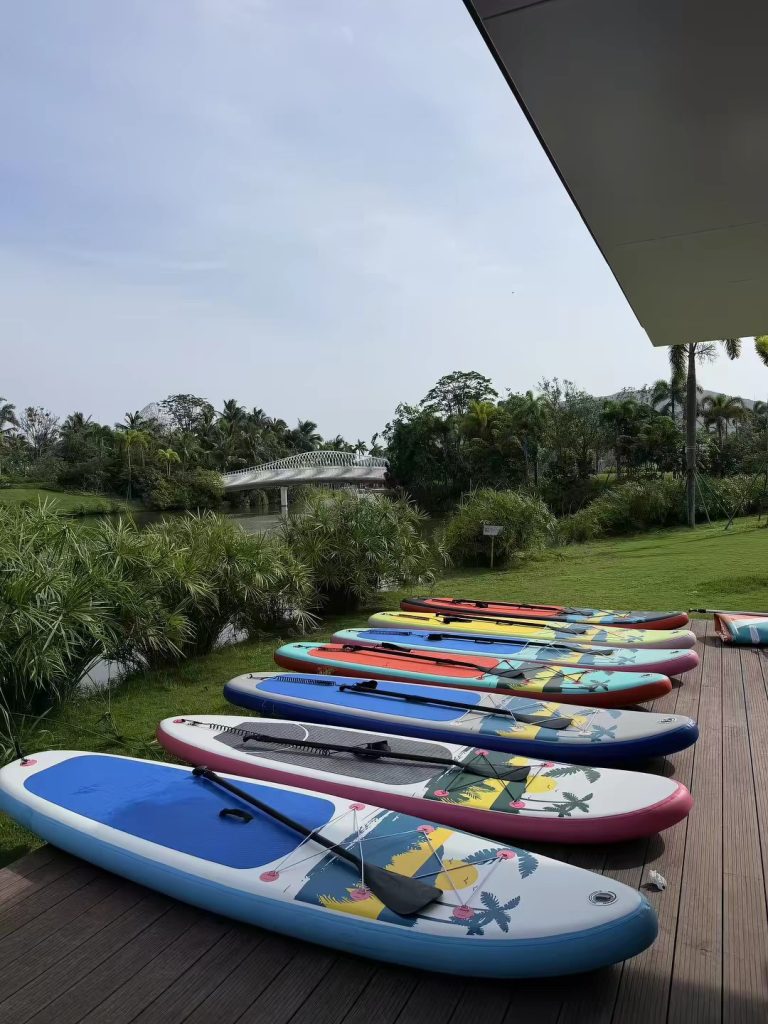
Yes. Chinese surfboard manufacturers can provide OEM and custom surfboard services, but the level of customization varies from one manufacturer to another.
Some factories mainly produce standard models with a customer logo added to the board. Others can develop custom dimensions, shapes, graphics, construction specifications, packaging, and accessories for an entire private-label surfboard brand.
For buyers, the important question is not simply whether a factory offers OEM. It is what level of customization the factory can actually provide.
What Does OEM Surfboard Manufacturing Mean?
OEM means the manufacturer produces a product according to the buyer’s specifications.
For surfboards, OEM production can involve:
-
Custom board dimensions
-
Custom board shapes
-
Custom colors
-
Custom graphics
-
Brand logos
-
Different construction methods
-
Custom fin configurations
-
Custom packaging
-
Product labels
-
Accessories
For example, a buyer may provide a brand logo and artwork while the manufacturer produces the boards according to an agreed specification.
A more advanced OEM project may involve the buyer providing a completely new board design.
What Is the Difference Between OEM and Simple Logo Customization?
This is an important distinction.
Basic Customization
A factory already has a standard surfboard model.
You select:
-
Existing shape
-
Existing construction
-
Existing size
Then customize:
-
Logo
-
Color
-
Graphics
-
Packaging
This is usually the simplest and lowest-risk option.
Advanced OEM
The buyer may provide:
-
New dimensions
-
New shape
-
New volume
-
New construction
-
Custom graphics
-
Custom accessories
-
Custom packaging
The factory then develops the product according to the buyer’s requirements.
This normally requires more communication, sampling, testing, and development.
How Much Does Custom Surfboard Manufacturing Cost?
Custom surfboards can have a wide price range.
As a general planning reference:
Product Type |
Approximate Factory Price |
|---|---|
Standard foam surfboard |
US$45–90 |
Standard epoxy/EPS board |
US$70–140 |
Basic private-label board |
US$80–160 |
Custom OEM board |
US$100–220 |
Premium custom surfboard |
US$180–400+ |
These are indicative ranges rather than fixed quotations.
The actual price depends on:
-
Board size
-
Construction
-
Materials
-
Quantity
-
Shape development
-
Graphics
-
Logo
-
Accessories
-
Packaging
-
Quality requirements
A factory should provide a specific quotation after reviewing your product specifications.
Can Manufacturers Create Custom Surfboard Shapes?
Some manufacturers can.
This is a much more advanced form of OEM compared with adding a logo to an existing model.
You may provide:
-
Dimensions
-
Rocker requirements
-
Outline
-
Thickness
-
Volume
-
Tail shape
-
Nose shape
-
Fin positioning
-
Reference drawings
-
Existing sample
The manufacturer can then produce a prototype for evaluation.
For a completely new shape, you should expect additional development time and potentially additional development costs.
Can You Customize Surfboard Construction?
Yes, depending on the manufacturer’s capabilities.
Potential options may include:
-
EPS construction
-
Epoxy construction
-
Fiberglass configurations
-
Different foam densities
-
Stringers
-
Reinforcement
-
Different resin systems
-
Different deck construction
The buyer should ask for a written construction specification.
Simply saying “high-quality epoxy surfboard” is not enough because different factories may interpret the specification differently.
Can You Add Your Own Logo?
Yes, logo customization is one of the most common private-label requirements.
Depending on the production process, logos may be applied through different methods.
Before production, confirm:
-
Logo position
-
Logo size
-
Logo colors
-
Artwork format
-
Printing method
-
Minimum quantity
-
Additional setup charges
You should approve a visual proof or sample before mass production.
Can Manufacturers Make Custom Packaging?
Yes.
Packaging can include:
-
Individual board bags
-
Printed cartons
-
Brand labels
-
Instruction cards
-
Product stickers
-
Barcodes
-
Protective materials
-
Shipping marks
For international buyers, packaging is particularly important because surfboards are large and can be exposed to handling during transportation.
If you are developing a retail brand, custom packaging can also improve the overall customer experience.
What Is the Typical MOQ for OEM Surfboards?
There is no universal MOQ.
A factory may have different minimum quantities for:
Standard products: lower MOQ
Logo customization: medium MOQ
Custom graphics: higher MOQ
New board shape: potentially higher MOQ
For a new brand, ask the manufacturer whether they can support a small trial order before committing to a large production run.
This can significantly reduce inventory risk.
Should You Order a Sample?
Absolutely.
For custom surfboards, a sample is particularly important.
The sample allows you to verify:
-
Shape
-
Dimensions
-
Volume
-
Weight
-
Construction
-
Surface finish
-
Color
-
Logo
-
Graphics
-
Fin system
-
Accessories
-
Packaging
A custom sample may cost approximately US$100–400+, depending on how much development is required.
Some manufacturers may deduct the sample cost from a future bulk order.
How Long Does OEM Surfboard Production Take?
Production time depends on the product and quantity.
A simple private-label order may be relatively straightforward.
A completely new board design can take longer because it may involve:
Design → prototype → sample testing → modification → final approval → mass production
For planning purposes, buyers should ask the manufacturer separately about:
-
Sample development time
-
Sample shipping time
-
Bulk production time
-
Packaging time
-
Export preparation
Do not assume that sample approval means the bulk order will ship immediately.
What Information Should You Give the Factory?
A detailed specification makes communication much easier.
For example:
Product: Custom shortboard
Length: 6’0″
Width: 20″
Thickness: 2.5″
Volume: 30 L
Construction: EPS + epoxy
Color: Custom
Graphics: Custom
Logo: Private label
Fin system: Customer specification
Quantity: 300 units
Packaging: Individual export packaging
Destination: United States
This gives the manufacturer enough information to prepare a much more meaningful quotation.
How to Compare OEM Surfboard Manufacturers
Don’t compare factories only by unit price.
Compare:
Factor |
What to Check |
|---|---|
Product quality |
Sample construction and finishing |
OEM capability |
Level of customization |
MOQ |
Minimum production quantity |
Price |
Unit manufacturing cost |
Sample |
Development capability |
Lead time |
Production schedule |
Quality control |
Inspection process |
Packaging |
Export protection |
Communication |
Response and technical understanding |
Shipping |
Carton size and logistics support |
A manufacturer with a slightly higher unit price may be more economical if it produces fewer defects and provides better consistency.
How to Protect Your Brand During OEM Production
If you are developing a unique surfboard brand, establish clear documentation before production.
Keep records of:
-
Final board specifications
-
Approved sample
-
Logo artwork
-
Graphics
-
Packaging design
-
Materials
-
Construction details
-
Quality requirements
-
Packaging requirements
You should also clearly discuss ownership and permitted use of your custom designs and branding with the manufacturer.
For important or high-volume projects, consider obtaining appropriate legal advice regarding intellectual property protection and your supply agreement.
What Should You Ask a Chinese Surfboard Manufacturer?
Before placing an OEM order, ask:
-
Do you manufacture surfboards in-house?
-
What types of surfboards do you produce?
-
Do you offer OEM and private-label services?
-
Can you develop custom shapes?
-
Can you work from our technical drawings?
-
Can you produce custom graphics?
-
Can you add our logo?
-
Can you provide custom packaging?
-
What is the MOQ?
-
What is the sample cost?
-
What is the sample development time?
-
What is the bulk production lead time?
-
What construction methods are available?
-
What materials are used?
-
What quality-control process do you use?
-
Can you provide carton dimensions and gross weight?


No reply content