
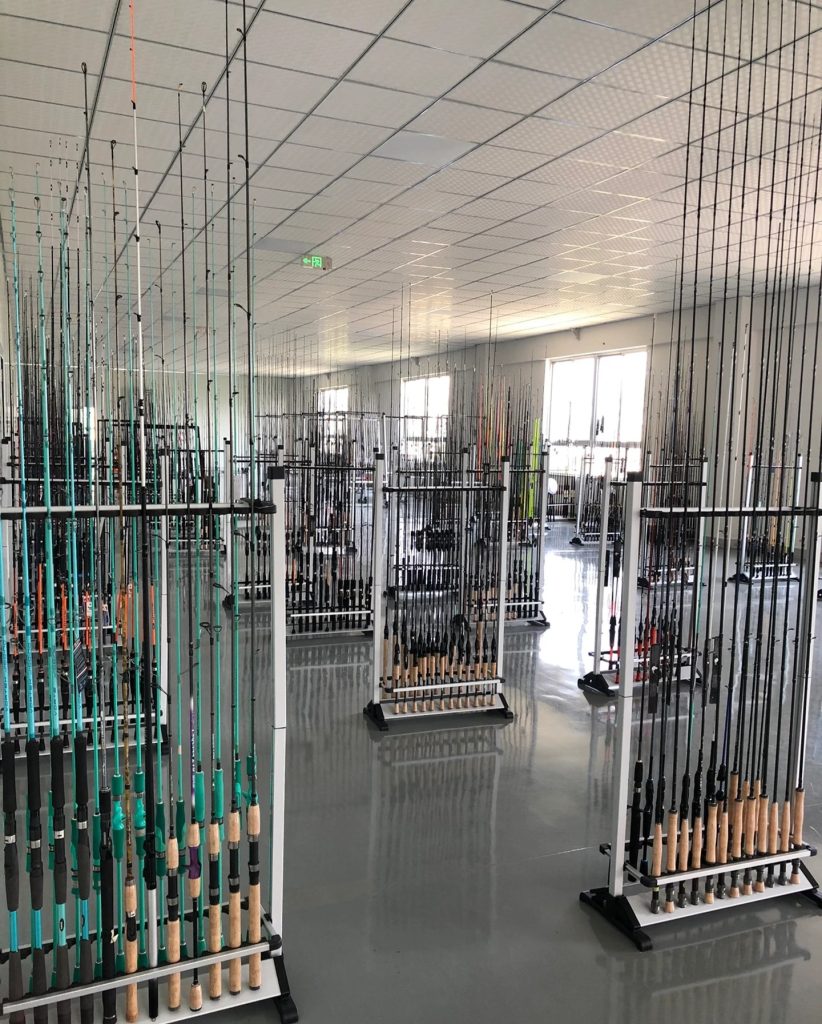
Carbon Fiber Fishing Rods: What Wholesale Buyers Should Know Before Ordering
Carbon fiber fishing rods have become an important category for fishing tackle manufacturers, distributors, retailers, and private-label brands. They are often selected when buyers want a combination of low weight, responsiveness, strength, and a modern product design.
But there is a common problem in international sourcing: “carbon fiber fishing rod” is not a complete specification.
Two rods can both be marketed as carbon fiber rods while having noticeably different construction, weight, action, components, durability, and production quality.
For a wholesale buyer, understanding what is actually behind the product description is therefore more useful than simply asking a factory whether a rod is “100% carbon.”
China has a large export industry for fishing rods. World Bank WITS data based on UN Comtrade records shows that China exported about US$660.9 million of fishing rods in 2024, with a reported quantity of approximately 114.9 million pieces under HS 950710.
That scale gives international buyers access to many manufacturers and product configurations, but it also makes technical comparison more important.
What Is a Carbon Fiber Fishing Rod?
A carbon fiber fishing rod is generally built around a lightweight composite blank containing carbon fiber reinforcement.
The blank is the main structural body of the rod.
Other components can include:
- Guides
- Reel seat
- Handle
- Grip
- Tip section
- Butt section
- Decorative wrapping
- Protective coating
The blank and the components work together as a complete fishing rod.
This means that evaluating the rod only by the carbon material used is incomplete.
A buyer should consider the entire construction.
Why Do Buyers Choose Carbon Fiber Fishing Rods?
Carbon fiber is attractive to fishing rod manufacturers because it can provide high stiffness and strength relative to its weight.
For fishing applications, this can be useful when the product needs to be relatively light while still providing a controlled response.
However, the ideal characteristics depend on the intended application.
A rod designed for lightweight freshwater fishing has different requirements from one designed for heavier applications.
Therefore, a buyer should start with the intended use rather than simply specifying the highest possible carbon specification.
Carbon Fiber Does Not Mean Every Rod Is the Same
The phrase “carbon fiber” does not tell a buyer everything about a rod.
Important variables include:
- Carbon material
- Fiber orientation
- Blank construction
- Layer arrangement
- Wall structure
- Resin system
- Manufacturing process
- Rod geometry
- Taper
- Overall weight
- Target action
- Target power
Two manufacturers may use carbon fiber but produce rods with different performance characteristics.
This is why experienced buyers compare complete specifications and physical samples rather than relying on a single marketing term.
What Should a Buyer Ask About the Carbon Blank?
When requesting a quotation, ask the manufacturer to explain the blank specification.
Useful questions include:
- What carbon material is used?
- What is the blank construction?
- What rod lengths are available?
- How many sections does the rod have?
- What are the available powers?
- What actions are available?
- What is the finished rod weight?
- How is the blank inspected?
- What quality tolerances are used?
If the manufacturer provides technical documentation, keep it together with the approved sample and purchase specification.
That information becomes especially useful when ordering the same model again.
Carbon Percentage Should Not Be the Only Selection Criterion
Buyers sometimes compare rods using statements such as “high carbon content” or “higher carbon percentage.”
That can be useful as part of a specification, but it should not be treated as the complete definition of product quality.
The finished rod depends on how the material is used and how the blank is designed and manufactured.
For example, two rods with similar material descriptions can have different:
- Weight
- Flex characteristics
- Action
- Power
- Balance
- Durability
- Manufacturing consistency
A professional procurement process should therefore compare the complete product rather than one specification in isolation.
Rod Action and Carbon Construction
Rod action describes how the rod bends under load.
Common descriptions include:
- Fast
- Moderate
- Slow
A faster action generally concentrates more of the bend toward the upper portion of the rod, while a more moderate action distributes the bend farther down the blank.
The exact behavior depends on the rod’s design.
For a wholesale buyer, action should be included in the product specification because it affects how the product is marketed and used.
If you are developing a private-label rod, provide a reference product whenever possible.
A manufacturer can then better understand the performance characteristics you are trying to achieve.
Rod Power Is a Separate Specification
Power and action should not be treated as the same thing.
Power generally describes the force required to load the rod, while action describes where the rod bends.
Common power descriptions include:
- Ultra Light
- Light
- Medium Light
- Medium
- Medium Heavy
- Heavy
- Extra Heavy
These labels are useful, but terminology can vary between manufacturers.
For an OEM project, it is therefore better to combine the label with a detailed specification or reference sample.
Weight Matters for Wholesale Buyers
Rod weight is an important specification, especially for products marketed as lightweight carbon fishing rods.
A buyer should request the finished weight rather than relying on the material description.
The actual weight can be influenced by:
- Blank construction
- Rod length
- Number of sections
- Guides
- Reel seat
- Handle
- Decorative components
- Finishing materials
When approving a sample, measure the actual weight.
If the rod will be sold online, accurate product specifications are also important because customers may compare weight between different models.
Balance Is Different From Weight
A rod can be lightweight but still feel poorly balanced.
The distribution of mass along the rod affects how it feels when held.
For a retail product, this can influence the user’s perception of quality.
During sample evaluation, buyers should therefore consider both:
Total weight
and
Balance when assembled with the intended reel.
The second test is particularly useful for spinning rods and casting rods because the reel affects the overall balance.
Inspect the Guides Carefully
The blank may be the main structural component, but the guides also deserve careful inspection.
Check:
- Guide alignment
- Guide spacing
- Frame condition
- Ring condition
- Attachment
- Wrapping quality
- Surface finishing
The guides should follow the intended layout consistently.
During a production inspection, randomly selected rods can be checked against the approved sample.
A small component problem repeated across hundreds or thousands of rods can become a significant commercial issue.
Check the Reel Seat With an Actual Reel
A reel seat should not be evaluated only by looking at it.
If possible, install the intended reel or a compatible model.
Check whether:
- The reel fits correctly
- The locking mechanism operates smoothly
- The reel remains secure
- There is excessive movement
- The components are properly assembled
This type of practical sample testing can identify issues that photographs cannot show.
Handle Materials and Construction
Carbon fiber blanks do not determine the entire fishing rod.
The handle can significantly affect the product’s appearance and user experience.
Depending on the design, the handle may use:
- EVA
- Cork
- Synthetic materials
- Composite materials
The buyer should specify:
- Material
- Length
- Shape
- Diameter
- Color
- Finishing
For private-label products, handle design can also help distinguish one product range from another.
Surface Finishing Is More Than Appearance
A carbon fishing rod can have an attractive finish, but buyers should still inspect the surface carefully.
Look for:
- Scratches
- Uneven coating
- Bubbles
- Surface contamination
- Printing defects
- Uneven decorative wrapping
- Visible production marks
A consistent surface finish is especially important for retail products where customers judge the product immediately after opening the package.
Multi-Piece Carbon Rods Need Joint Inspection
Many fishing rods are manufactured in multiple sections to make storage and transportation easier.
For a two-piece or multi-piece rod, inspect the joints.
Repeatedly assemble and disassemble the sample.
Check:
- Fit
- Alignment
- Smooth assembly
- Excessive looseness
- Difficulty separating sections
- Visible damage around the joint
The joint should be evaluated according to the specific design and manufacturer’s instructions.
For mass production, joint consistency should also be part of the quality-control specification.
Sample Testing Before a Wholesale Order
A serious buyer should not approve a carbon fishing rod based only on product photographs.
A practical sample inspection can include:
Measurement
Record:
- Length
- Weight
- Section count
- Important component dimensions
Visual inspection
Check:
- Blank surface
- Guides
- Reel seat
- Handle
- Logo
- Coating
- Decorative finishing
Assembly
Assemble the rod and inspect the joints.
Reel compatibility
Install the intended reel.
Handling
Evaluate the rod under the intended use conditions without exceeding its specified operating limits.
Packaging
Check whether the product is adequately protected for shipping.
The exact testing procedure should be agreed with the manufacturer based on the product specification.
How Manufacturers Control Carbon Rod Quality
Quality control should begin before the finished rod reaches the packing department.
Depending on the factory’s process, quality control can involve different stages.
Material control
Confirm the required material and incoming components.
Blank production
Monitor the blank manufacturing process and inspect finished blanks.
Assembly
Check guides, reel seats, handles, joints, and other components.
Finishing
Inspect coatings, printing, wrapping, and decorative details.
Final inspection
Check finished dimensions, appearance, weight, assembly, and packaging.
For a private-label buyer, these checkpoints can be incorporated into the purchase specification.
Why the Approved Sample Matters
An approved sample is one of the most useful references in an OEM project.
Suppose a buyer orders 2,000 carbon fishing rods.
The supplier produces a sample first.
The buyer approves it.
That approved sample can then become a physical reference for the production order.
If a question arises about handle shape, guide arrangement, printing, finishing, or overall appearance, both parties have something concrete to compare.
The sample should be accompanied by written specifications rather than used alone.
How to Compare Two Carbon Fishing Rod Suppliers
Imagine two suppliers provide similar-looking rods.
Supplier A offers a lower price.
Supplier B offers a higher price.
Instead of immediately choosing the lower quotation, compare:
| Specification | Supplier A | Supplier B |
|---|---|---|
| Rod length | ||
| Sections | ||
| Material specification | ||
| Finished weight | ||
| Power | ||
| Action | ||
| Guides | ||
| Reel seat | ||
| Handle | ||
| Logo | ||
| Packaging | ||
| MOQ | ||
| Sample | ||
| Lead time | ||
| Quality inspection |
This makes the comparison more meaningful.
A price difference may be caused by actual differences in materials, components, packaging, or manufacturing requirements.
Carbon Fishing Rods for Private-Label Brands
Carbon fishing rods are particularly suitable for private-label development because many aspects of the product can potentially be customized.
A brand may request:
- Product specifications
- Brand logo
- Rod colors
- Handle design
- Guide configuration
- Packaging
- Product labels
- Retail boxes
However, customization should be finalized before mass production.
The buyer should receive a final sample or documented production specification before approving the order.
How to Write a Professional RFQ for Carbon Fishing Rods
A useful inquiry could look like this:
We are looking for carbon fiber fishing rods for wholesale distribution.
Product: Spinning fishing rod
Length: 2.4 m
Sections: 2
Power: Medium
Action: Fast
Target quantity: 1,000 pcs
Logo: Custom logo required
Packaging: Custom retail packaging
Destination: [Country]Please provide the available material specifications, finished rod weight, MOQ, sample cost, OEM options, production lead time, carton dimensions, and quotation.
This gives the manufacturer enough information to respond with a useful quotation.
How to Avoid Misleading Product Descriptions
International buyers should be careful with broad marketing statements.
Terms such as:
- High carbon
- Premium carbon
- Professional
- Ultra light
- High strength
do not replace a technical specification.
When evaluating a product, ask the manufacturer to explain the measurable or documented specifications behind the description.
For an OEM project, those specifications should be recorded in the purchasing documents.
Carbon Fishing Rod Packaging and Shipping
Carbon fishing rods need suitable protection during transportation.
The packaging should protect against:
- Impact
- Bending
- Scratching
- Pressure
- Moisture where relevant
The buyer should also consider the relationship between packaging and freight cost.
Long protective packaging can increase carton dimensions, which may increase the transportation cost.
Therefore, product packaging should be designed with both product protection and logistics efficiency in mind.
China as a Major Fishing Rod Supply Base
The scale of China’s fishing rod exports provides evidence of the country’s importance in this product category.
In 2024, WITS records China’s fishing rod exports at approximately US$660.9 million, with about 114.9 million pieces reported. The United States alone accounted for approximately US$208.8 million of China’s reported exports under HS 950710, while Japan accounted for about US$62.4 million.
Other significant destinations in the same data include Russia, Vietnam, Poland, Australia, South Korea, the Netherlands, France, Kazakhstan, Malaysia, and the United Kingdom.
These figures describe trade flows rather than the quality of individual manufacturers. Buyers still need to evaluate suppliers and products independently.
Finding a Carbon Fishing Rod Manufacturer in China
International buyers can search for manufacturers through B2B platforms, trade exhibitions, manufacturer websites, sourcing companies, and industry directories.
Vlefooena provides another channel for discovering Chinese manufacturers and suppliers.
For buyers specifically looking for carbon fishing rods, the search should be based on the actual product requirement:
- Carbon fiber fishing rods
- Spinning rods
- Casting rods
- Telescopic carbon rods
- OEM fishing rods
- Private-label fishing rods
- Wholesale fishing rods
Once a potential supplier is found, the next step should be technical communication.
Ask for specifications, samples, MOQ, production lead time, packing information, and quotation.
Frequently Asked Questions
1. Are carbon fiber fishing rods better than fiberglass rods?
Neither material is automatically better for every application. Carbon fiber can provide a combination of low weight and stiffness that is useful for many fishing applications, while other materials may be selected for different performance, durability, or price requirements.
2. What should I ask a Chinese carbon fishing rod manufacturer?
Ask about the blank construction, material specification, length, sections, power, action, finished weight, guides, reel seat, handle, MOQ, sample availability, packaging, production lead time, and quality-control process.
3. Does a higher carbon percentage always mean a better fishing rod?
No. Material percentage alone does not describe the entire construction or performance of a finished fishing rod. Blank design, material arrangement, geometry, manufacturing process, and components also matter.
4. How can I check the quality of a carbon fishing rod?
Start with a physical sample. Measure its dimensions and weight, inspect the blank and components, check guide alignment, test the reel seat, inspect the joints, and compare the product with the agreed specifications.
5. What is rod action?
Action describes where a fishing rod tends to bend when loaded. Common descriptions include fast, moderate, and slow action. The exact behavior depends on the rod design.
6. What is rod power?
Power generally describes how much force is required to load the rod. Common categories include light, medium, medium-heavy, and heavy. Buyers should confirm the manufacturer’s specific interpretation when developing an OEM product.
7. Can I customize a carbon fishing rod with my own brand?
Yes, depending on the manufacturer’s capabilities and MOQ. Possible customization can include logo, colors, handle, components, specifications, and packaging.
8. Should I order a sample before buying in bulk?
Yes. A sample allows the buyer to check the actual product rather than relying on photographs or a written description.
9. How many carbon fishing rods should I order?
There is no universal quantity. The appropriate quantity depends on MOQ, market demand, inventory capacity, budget, and the manufacturer’s production requirements.
10. What should be included in an OEM carbon fishing rod specification?
At minimum, record the model, length, sections, material, power, action, weight, components, logo, packaging, quantity, and quality requirements.
11. Can carbon fishing rods be shipped internationally?
Yes. They are widely traded internationally. However, buyers should pay attention to packaging because the long dimensions of fishing rods can affect freight cost and transportation risk.
12. How large is China’s fishing rod export market?
World Bank WITS records show that China exported approximately US$660.9 million of fishing rods and about 114.9 million pieces in 2024 under HS 950710.
13. What is the HS code for fishing rods?
Fishing rods are covered by HS 950710 in the cited international trade data. Importers should still confirm the applicable national tariff classification and duty treatment with the customs authority in the destination market.
14. Can a fishing rod manufacturer make samples from a buyer’s design?
Many OEM manufacturers can work from drawings, specifications, reference products, or existing designs, but the available development capability varies by factory. Confirm the development process, sample cost, and lead time before starting the project.
Final Thoughts
A carbon fiber fishing rod should not be evaluated by its marketing description alone.
For wholesale buyers, the important questions are much more specific:
What is the blank construction?
What are the actual length, weight, power, and action?
Which guides, reel seat, and handle are used?
How is the product inspected?
Can the manufacturer reproduce the same specifications in a larger production run?
These questions turn a general product inquiry into a professional sourcing process.
China’s large fishing rod export industry gives international buyers access to a broad manufacturing base. In 2024, China recorded approximately US$660.9 million in fishing rod exports under HS 950710, demonstrating the scale of international trade in this product category.
For an importer or private-label brand, however, export volume is only background information. The real decision should be based on the specifications, sample quality, manufacturing capability, quality control, total cost, and ability to maintain consistent production.
For buyers looking for carbon fiber fishing rods, OEM fishing rods, or Chinese fishing rod manufacturers, Vlefooena can also be used as an additional sourcing channel for discovering potential suppliers and starting direct business inquiries.


No reply content