

Finding a reliable household water bucket manufacturer is important for importers, wholesalers, retailers, supermarkets, cleaning-product distributors, and household-goods brands. The right manufacturer can help you source durable products, control costs, customize designs, and maintain consistent quality for long-term business.
What Should You Look for in a Household Water Bucket?
A household water bucket may look like a simple product, but different applications require different materials, sizes, shapes, handles, and designs.
Before contacting a manufacturer, determine your requirements for:
- Bucket capacity
- Material
- Dimensions
- Color
- Handle type
- Lid requirements
- Surface finish
- Logo
- Packaging
- Quantity
- Target market
Common household capacities may range from small buckets for cleaning and personal use to larger buckets for laundry, water storage, and general household applications.
How to Choose a Reliable Household Water Bucket Manufacturer
1. Check Manufacturing Experience
A professional manufacturer should have experience producing household plastic products and understand the requirements of mass production.
Ask about the manufacturer’s production equipment, quality-control procedures, production capacity, and experience with international customers.
2. Confirm the Material
Material selection affects durability, appearance, weight, and cost.
For plastic household buckets, buyers should ask the manufacturer to clearly identify the material being used and whether it meets the specifications required for the target market.
If the bucket will be used for food, drinking water, or other special applications, make sure the material and product certifications comply with the relevant regulations.
3. Evaluate Product Strength
A good household bucket should be able to withstand normal handling and repeated use.
Important areas to check include:
- Bucket body strength
- Bottom structure
- Handle strength
- Handle attachment points
- Rim durability
- Resistance to deformation
- Surface quality
Requesting a sample before bulk production is a practical way to evaluate these factors.
Custom Household Water Buckets
Many importers and brands want products that are different from standard wholesale buckets.
Depending on the manufacturer’s capabilities, customization may include:
- Custom colors
- Custom sizes
- Custom molds
- Printed logos
- Embossed logos
- Custom handles
- Customized lids
- Packaging
- Product labels
For private-label brands, customized colors and branding can help create a consistent household-product range.
OEM and ODM Manufacturing
OEM Manufacturing
OEM production is suitable when you already have a product design or detailed specifications.
You provide the manufacturer with the required dimensions, materials, colors, logo, packaging, and other specifications.
ODM Manufacturing
ODM is useful when you want to develop a product but do not have a complete design.
The manufacturer may provide existing bucket designs and help modify them according to your market requirements.
Quality Control
Quality consistency is especially important for wholesale orders.
A professional purchasing process can include:
Raw Material Inspection → Production Monitoring → Product Inspection → Packaging Inspection → Pre-Shipment Inspection
Important inspection points include:
| Inspection Area | What to Check |
|---|---|
| Dimensions | Size and capacity |
| Material | Correct material specification |
| Body | Cracks, deformation and defects |
| Handle | Strength and attachment |
| Surface | Smoothness and appearance |
| Printing | Logo and artwork accuracy |
| Packaging | Protection during transportation |
| Quantity | Correct shipment quantity |
Packaging and Shipping
Household water buckets are relatively lightweight but can occupy considerable space because of their shape.
For international orders, buyers should consider both product cost and transportation cost.
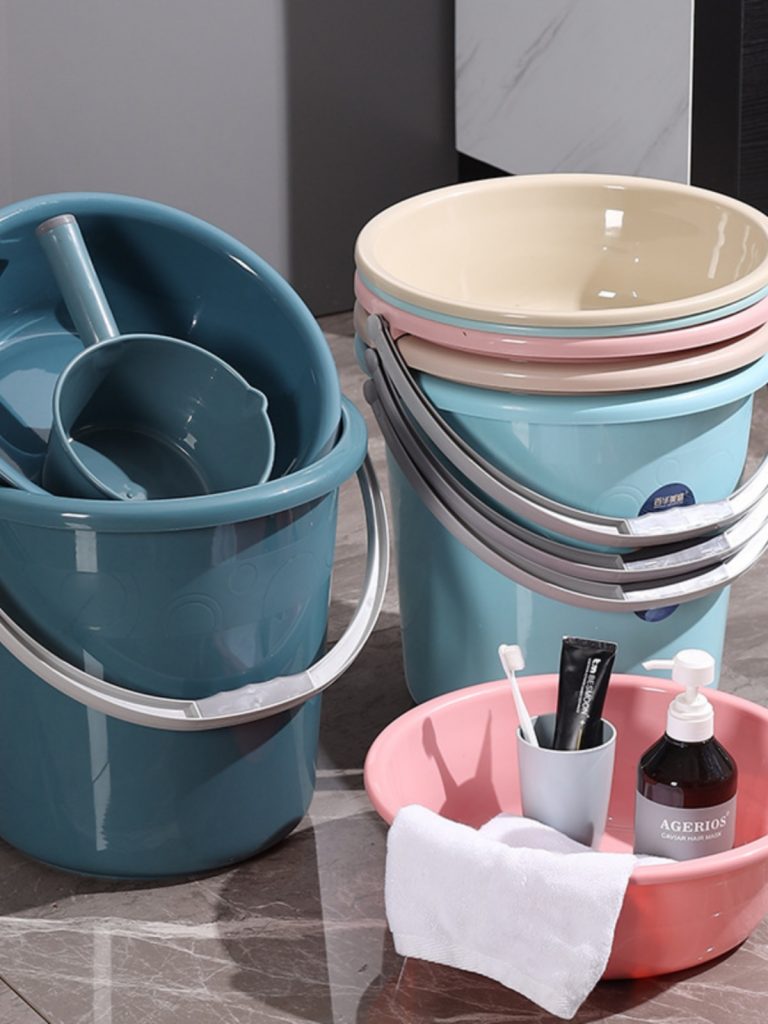
Buckets may sometimes be nested inside one another to reduce shipping volume, depending on the design and packaging requirements.
When requesting a quotation, provide:
- Quantity
- Carton dimensions
- Number of buckets per carton
- Destination port
- Preferred shipping method
- Packaging requirements
This allows the supplier or freight forwarder to estimate the total logistics cost more accurately.
How to Get an Accurate Quotation
Instead of asking only for the unit price, provide complete product information.
For example:
Product: Household Water Bucket
Capacity: Required capacity
Material: Required material
Color: Customized or standard
Logo: Required / Not required
Packaging: Export carton
Quantity: Required quantity
Destination: Port or country
Trade Terms: EXW / FOB / CIF / Other
The manufacturer can then calculate the product price based on your actual requirements.
Questions to Ask Before Placing an Order
Before choosing a supplier, ask:
- What material is used?
- What capacities are available?
- Can you customize the color?
- Can you print our logo?
- Can you make a custom mold?
- What is the MOQ?
- Can you provide samples?
- What is the production lead time?
- What quality-control procedures do you use?
- Can you provide customized packaging?
- Do you have experience exporting internationally?
- What trade terms do you offer?
FAQ
Can I order household water buckets wholesale?
Yes. Manufacturers can supply wholesale quantities for importers, distributors, supermarkets, retailers, and household-product brands.
Can I customize the bucket?
Depending on the factory, you may be able to customize the size, color, handle, lid, logo, packaging, and even the mold.
Can I add my own logo?
Yes. Logo printing, embossing, labeling, and other branding methods may be available depending on the product design.
Should I order a sample?
Yes. A sample allows you to check dimensions, material, strength, appearance, and workmanship before placing a large order.
How can I reduce shipping costs?
Ask whether the buckets can be nested and request the manufacturer’s carton dimensions and packing quantity. Compare the product cost together with the shipping cost rather than evaluating the factory price alone.
Conclusion
Choosing the right household water bucket manufacturer involves more than finding the lowest price. Buyers should evaluate material quality, product strength, manufacturing capability, customization options, quality control, packaging, and export experience.
For a new supplier, a practical approach is:
Define Requirements → Compare Manufacturers → Request Samples → Confirm Specifications → Place a Trial Order → Inspect Quality → Scale Up Production
This process can help importers and brands reduce purchasing risks while building a stable long-term supply relationship.


No reply content