
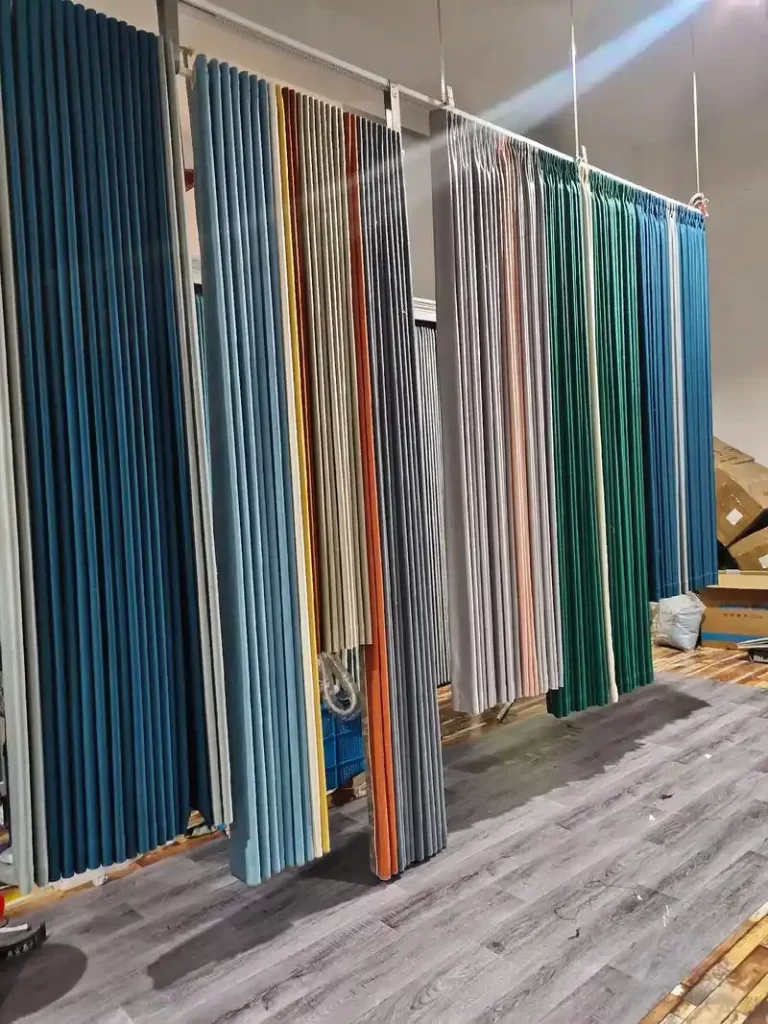
When purchasing custom curtains from China, price is important, but delivery time can be just as important.
This is especially true for hotel projects, apartment developments, villas, offices, and other projects with a fixed installation schedule.
A buyer may find a suitable fabric and approve the price, but the curtains still need to go through sampling, material preparation, cutting, sewing, inspection, packaging, and international transportation before they arrive at the final destination.
So how long does it actually take to manufacture custom curtains in China?
There is no single production time for every order. The lead time depends on the product specification, quantity, fabric availability, customization requirements, and factory production schedule.
A Typical Custom Curtain Production Process
A custom curtain order normally involves several stages:
- Requirement confirmation
- Quotation
- Sample production
- Sample approval
- Fabric and material preparation
- Cutting
- Sewing
- Quality inspection
- Packaging
- Shipment
Each stage can affect the final delivery date.
For this reason, buyers should not calculate the project schedule based only on the sewing time.
1. Requirement Confirmation
The first step is to confirm exactly what needs to be produced.
The supplier may need:
- Curtain dimensions
- Fabric
- Color
- Fullness
- Heading
- Lining
- Quantity
- Hardware
- Packaging
- Delivery destination
If the specifications are incomplete, the quotation and production schedule may need to be revised later.
Providing a complete specification at the beginning can help reduce unnecessary delays.
2. Quotation and Order Confirmation
After receiving the specifications, the supplier normally prepares a quotation.
The buyer and supplier may then confirm:
- Product price
- Quantity
- Fabric
- Dimensions
- Sample requirements
- Packaging
- Shipping method
- Payment terms
- Production schedule
The production schedule normally starts after the required order conditions have been confirmed.
3. Sample Production
For customized curtains, a sample may be produced before bulk manufacturing.
The sample can be used to check:
- Fabric
- Color
- Curtain construction
- Dimensions
- Fullness
- Heading
- Stitching
- Blackout performance
- Overall appearance
A simple fabric sample can be prepared relatively quickly, while a finished curtain prototype may require more time.
If the project has detailed customization requirements, allow additional time for sample development and approval.
4. Sample Approval
Sample approval is an important point in the project schedule.
Production should not proceed based on an unclear or incomplete approval.
The buyer should confirm:
- Approved fabric
- Approved color
- Finished dimensions
- Fullness
- Heading
- Lining
- Hardware
- Packaging
If changes are requested after the sample has been produced, the supplier may need to make another sample.
This can extend the project schedule.
5. Fabric Availability
Fabric availability can have a major impact on production time.
Existing Stock Fabric
If the selected fabric and color are already available, production may be able to start sooner.
Custom Fabric
If the buyer requires:
- Custom color
- Custom pattern
- Custom weaving
- Special finishing
additional production time may be required.
This is why buyers should ask the supplier:
“Is this fabric currently in stock?”
and:
“If not, how long will fabric production take?”
These questions are particularly important for large hotel projects.
6. Cutting and Sewing
Once the required materials are available, the factory can begin curtain production.
The process may include:
- Fabric inspection
- Fabric cutting
- Overlocking
- Sewing
- Heading construction
- Lining attachment
- Hemming
- Finishing
The production time depends heavily on order quantity.
A small order and a large hotel project cannot necessarily use the same production schedule.
7. Quality Inspection
Before packaging, the curtains should be checked against the approved specifications.
Typical inspection points can include:
- Quantity
- Finished dimensions
- Fabric color
- Stitching
- Curtain heading
- Lining
- Appearance
- Accessories
For larger projects, buyers may also establish specific inspection requirements before production begins.
An approved sample can be used as a visual reference for the finished products.
8. Packaging
After inspection, the curtains need to be packed for transportation.
Packaging may include:
- Individual polybags
- Individual cartons
- Sets packed together
- Room-by-room packaging
- Custom labels
- Export cartons
Hotel projects can benefit from organized packaging because the installation team may need to identify curtains for different rooms quickly.
9. Shipping From China
Manufacturing is only part of the total delivery time.
After production, the goods still need to be transported to the destination.
Depending on the project, shipping may involve:
- Air freight
- Sea freight
- Express delivery
- Door-to-door logistics
The transportation time depends on the destination, shipping method, customs clearance, and local delivery.
For this reason, buyers should separate:
Production Lead Time
from
Shipping Transit Time
when planning the project.
What Can Cause Delays?
Several factors can increase the delivery time of a custom curtain order.
1. Changes to the Design
If the buyer changes the fabric, size, color, or curtain style after production begins, the schedule may need to be adjusted.
2. Custom Fabric
Special fabrics or custom colors may require additional preparation.
3. Large Quantities
Large hotel and commercial projects naturally require more production capacity.
4. Multiple Specifications
An order containing many sizes, fabrics, and designs can require more preparation than a simple order.
5. Hardware
If curtain tracks or other accessories are customized, they may require additional production time.
6. Sample Revisions
Multiple rounds of sample changes can extend the schedule.
7. Packaging Requirements
Room-by-room packaging, custom labels, and special cartons can add additional work.
How to Reduce Production Delays
Buyers can take several practical steps to keep the project moving.
Provide Complete Specifications
Send the supplier all important information at the beginning.
This can include:
- Sizes
- Quantities
- Fabric
- Colors
- Fullness
- Heading
- Lining
- Hardware
- Packaging
Approve Samples Quickly
If a sample is required, review it as soon as possible.
Long approval periods can delay the entire production schedule.
Confirm Fabric Availability Early
Ask about fabric stock before finalizing the order.
If the fabric is unavailable, you can discuss alternatives or adjust the schedule.
Avoid Major Changes After Approval
Once the final sample is approved, changes should be minimized.
Changes made after production starts can affect both cost and delivery time.
Confirm the Delivery Deadline
Tell the supplier the required arrival date, not just the desired production date.
This gives the supplier a better understanding of the complete project schedule.
How Early Should a Hotel Buyer Order Curtains?
For a hotel project, it is safer to plan the curtain order around the installation date rather than waiting until the building is nearly finished.
A basic project schedule can look like this:
| Stage | Main Task |
|---|---|
| Stage 1 | Send project specifications |
| Stage 2 | Receive quotation |
| Stage 3 | Confirm fabric and design |
| Stage 4 | Produce sample |
| Stage 5 | Approve sample |
| Stage 6 | Confirm bulk order |
| Stage 7 | Bulk production |
| Stage 8 | Inspection |
| Stage 9 | Packaging |
| Stage 10 | International shipping |
| Stage 11 | Local delivery |
| Stage 12 | Installation |
The exact time required for each stage depends on the project.
For a large development, buyers should create a schedule with the supplier rather than relying on a general production estimate.
Should You Ask for an Exact Delivery Date?
It is better to ask for a production lead time and estimated shipping schedule rather than assuming a single date is guaranteed.
For example, ask:
How many days are required for bulk production after sample approval and deposit confirmation?
Then ask:
What is the estimated transit time to our destination?
This separates factory production from transportation.
Example of a Project Timeline
Imagine a hotel project requiring 300 sets of custom curtains.
The buyer may plan the project as follows:
Week 1
- Send specifications
- Receive quotation
- Confirm fabric
Week 2
- Produce and review sample
- Make final adjustments
Week 3
- Approve sample
- Confirm bulk order
Weeks 4–7
- Bulk production
Week 8
- Inspection and packaging
After production
- International shipping
- Customs clearance
- Local delivery
This is only an example. The actual schedule should be confirmed with the supplier based on the specific project.
What Should You Ask the Curtain Manufacturer?
Before placing an order, ask:
- Is the fabric in stock?
- How long does sample production take?
- How long does bulk production take?
- When does the production lead time start?
- Is the production time based on receiving the deposit?
- Does custom fabric require additional time?
- How long does packaging take?
- When can quality inspection be completed?
- What shipping options are available?
- What is the estimated transit time?
- Can the supplier meet the required delivery schedule?
- What could cause a production delay?
These questions can give you a much clearer project timeline.
FAQ
How long does it take to make custom curtains in China?
The production time depends on the quantity, fabric availability, customization, and factory schedule. A simple order can be faster than a large hotel project with multiple specifications.
Does custom curtain production include shipping time?
Usually, production lead time and shipping transit time should be considered separately. Ask the supplier to provide both estimates.
Does custom fabric increase production time?
It can. Custom colors, patterns, weaving, or special finishes may require additional material preparation before curtain production begins.
How long does a curtain sample take?
The time depends on whether you need a fabric sample or a finished curtain prototype. A customized finished sample may require more time than a standard fabric swatch.
Can I speed up a custom curtain order?
Sometimes the schedule can be shortened by selecting available fabrics, simplifying customization, approving samples quickly, and confirming specifications early. The supplier should confirm whether an accelerated schedule is actually possible.
What causes the biggest delays in hotel curtain projects?
Common causes can include incomplete specifications, fabric shortages, sample revisions, design changes, large quantities, custom hardware, and transportation delays.
Should I order curtains before the hotel is finished?
For projects with a fixed opening or installation date, curtain procurement should be planned well in advance. The exact timing depends on the construction schedule, final measurements, production requirements, and shipping time.
Final Thoughts
The delivery time for custom curtains from China depends on much more than sewing.
Specification confirmation, sampling, fabric availability, bulk production, inspection, packaging, and international shipping all contribute to the final project schedule.
For a hotel, apartment, villa, or commercial project, the best approach is to work backward from the required installation date.
Give the supplier the complete specifications, confirm the sample, check fabric availability, establish the bulk production lead time, and allow sufficient time for international transportation.
A clear schedule agreed upon before production begins can make the entire custom curtain purchasing process much easier to manage.


No reply content