China Professional Hair Clipper Manufacturing Co., Ltd.
If you are planning to import rechargeable hair clippers from China, one of the first questions is simple: how much does a rechargeable hair clipper cost?
The answer depends on much more than the appearance of the product. Motor performance, battery capacity, blade material, housing quality, accessories, packaging, order quantity, customization, and shipping can all affect the final cost.
For importers, wholesalers, barbershop suppliers, retailers, and private-label brands, understanding these cost factors can help you choose the right product without paying for specifications you do not need.
This guide explains the typical price ranges, major cost factors, and additional expenses you should consider when purchasing rechargeable hair clippers from a Chinese manufacturer.
Rechargeable Hair Clipper Price Range
For international B2B buyers, a practical factory purchasing range is approximately:
Product Type |
Typical Factory Price |
|---|---|
Basic rechargeable hair clipper |
US$5–10 |
Entry-level professional model |
US$8–15 |
Mid-range cordless hair clipper |
US$10–20 |
Professional barber clipper |
US$15–30 |
Premium metal-body model |
US$25–50+ |
Highly customized/OEM model |
US$30–60+ |
These figures are general reference ranges rather than fixed quotations.
A large-volume order for a standard model can sometimes achieve a lower unit price, while small quantities, customized packaging, special colors, upgraded batteries, premium motors, and custom molds can significantly increase the price.
What Determines the Price of a Rechargeable Hair Clipper?
Two hair clippers may look similar but have very different manufacturing costs.
The main factors include:
-
Motor
-
Battery
-
Blade
-
Housing material
-
Electronics
-
Charging system
-
Guide combs
-
Accessories
-
Packaging
-
Customization
-
Order quantity
-
Quality-control requirements
Let’s examine each factor.
1. Motor Quality
The motor is one of the most important components.
A basic home-use clipper may use a relatively simple motor, while professional models generally require stronger and more stable performance.
A better motor can provide:
-
More consistent cutting
-
Better performance on thick hair
-
Lower vibration
-
More stable operation
-
Longer service life
Higher-performance motors usually increase the factory cost.
However, buyers should not simply choose a product because it has a higher advertised RPM.
Motor torque, blade design, battery output, heat management, and electronic control are also important.
2. Battery Capacity
Battery capacity directly affects cordless operating time.
A basic model may use a smaller rechargeable battery, while professional models may use a larger battery to provide longer working time.
When comparing suppliers, ask about:
-
Battery type
-
Battery capacity
-
Voltage
-
Charging time
-
Operating time
-
Battery protection
-
Expected cycle life
For example, two products may have similar appearances but different batteries and therefore different prices.
For private-label products, battery specifications should be included clearly in the product specification sheet.
3. Blade Material
Blade quality is another major pricing factor.
Common materials include stainless steel and other hardened metal alloys. Some higher-end models use ceramic or specially coated blades.
Higher-quality blades can offer:
-
Better cutting performance
-
Improved durability
-
Better corrosion resistance
-
More consistent cutting
-
Reduced need for replacement
If your target customers are professional barbers, spending more on blade quality may be worthwhile.
For budget retail products, a standard stainless-steel blade may be sufficient.
4. Housing Material
The body of the clipper can also influence the price.
Common materials include:
-
ABS plastic
-
PC plastic
-
Aluminum alloy
-
Zinc alloy
-
Stainless-steel components
Plastic models are generally less expensive and lighter.
Metal-body models usually cost more but can provide a more premium appearance and stronger positioning in the professional market.
If you are selling through e-commerce, the appearance and hand feel of the housing can significantly influence the perceived value of the product.
5. Accessories
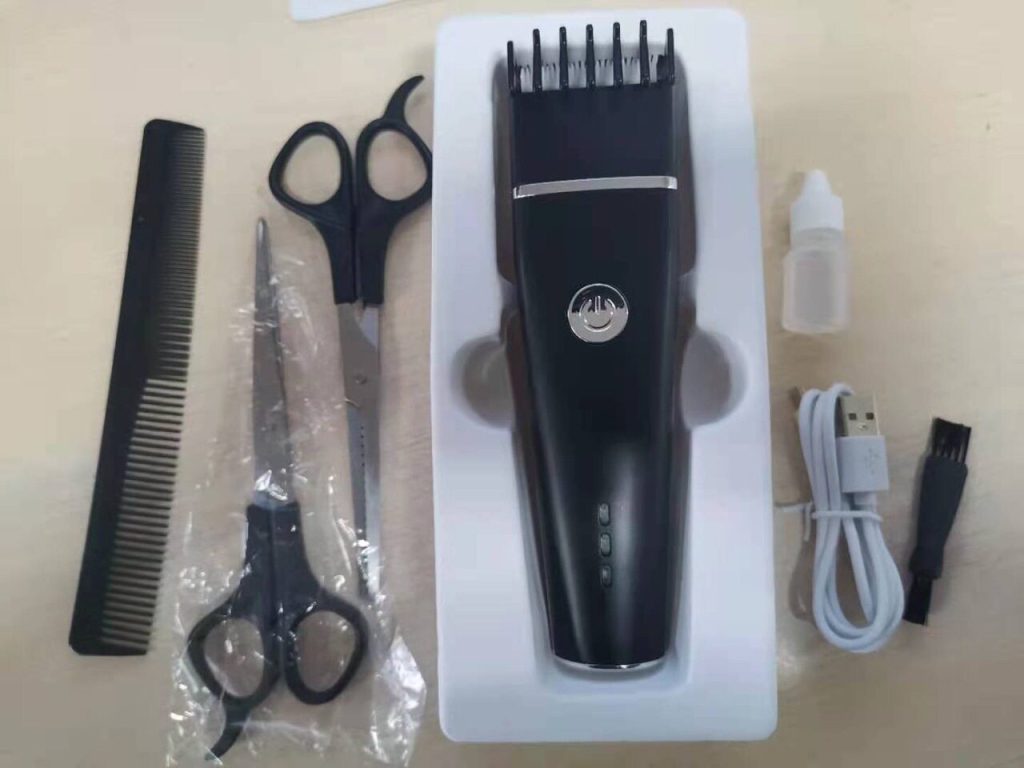
The standard product may include:
-
Guide combs
-
Cleaning brush
-
Lubricating oil
-
Charging cable
-
Charger
-
Protective cap
-
User manual
-
Storage case
Adding more accessories increases the total cost.
For example, a basic retail package may contain only several guide combs and a charging cable, while a professional kit may include a larger accessory set and carrying case.
Before comparing quotations, make sure all suppliers are quoting the same accessory configuration.
Otherwise, a lower quotation may simply reflect a smaller package.
6. Charging System
The charging method can also affect product cost.
Common options include:
-
USB charging
-
USB-C charging
-
Dedicated charging cable
-
Charging stand
-
Wall charger
-
Multi-voltage charger
USB-C is increasingly attractive for international consumer products because customers may already have compatible chargers and cables.
However, the exact charging configuration should be selected according to your target market.
7. Packaging
Packaging costs are often overlooked.
A standard export carton with a simple product box may have a relatively low cost.
Custom retail packaging can require additional expenses for:
-
Artwork
-
Printing
-
Special paper
-
Inserts
-
Custom dimensions
-
Color printing
-
Foil stamping
-
Embossing
-
Protective materials
If you are launching a private-label brand, packaging can become a meaningful part of your total product cost.
Standard Product vs. Private Label
There can be a substantial difference between purchasing a standard product and developing a private-label product.
Standard Product
A standard product normally requires:
-
Product selection
-
Sample confirmation
-
Logo application, if available
-
Standard packaging
-
Bulk production
This is usually the simplest and lowest-cost option.
Private Label
A private-label order may include:
-
Custom logo
-
Custom product color
-
Custom packaging
-
Custom manual
-
Custom labels
-
Custom accessories
-
Product modifications
The more customization you request, the higher the development and production cost can become.
How Order Quantity Affects the Price
Quantity is one of the biggest factors in factory pricing.
For example, a supplier might quote different prices for:
Quantity |
Possible Price Level |
|---|---|
100–300 units |
Higher |
500 units |
Medium-high |
1,000 units |
More competitive |
3,000 units |
Lower |
5,000+ units |
Potentially significantly lower |
These quantities are examples rather than universal MOQ requirements.
The exact MOQ depends on the factory and product.
For custom products, the supplier may require a higher MOQ because custom packaging, colors, components, or production arrangements create additional costs.
Sample Cost
Before placing a bulk order, it is advisable to purchase samples.
A sample may cost more per unit than the eventual bulk price because of:
-
Sample handling
-
Individual packaging
-
Express shipping
-
Special preparation
-
Small-quantity production
For international buyers, the sample cost should be considered separately from the bulk unit price.
The purpose of the sample is to verify the product before committing to a large order.
Shipping Cost
The factory price is not your final landed cost.
Your actual purchasing cost can be calculated approximately as:
Product Cost + Packaging + Inspection + Shipping + Customs/Taxes + Other Import Costs
For small samples, express shipping may be relatively expensive compared with the product itself.
For commercial shipments, sea freight, air freight, or other transportation methods may be more economical depending on the shipment volume, destination, urgency, and product requirements.
Because rechargeable hair clippers contain batteries, buyers should also confirm the transportation requirements before arranging shipment.
How to Calculate a Simple Import Budget
Suppose you purchase 1,000 mid-range rechargeable hair clippers at an estimated factory price of US$12 per unit.
The product value would be:
1,000 × US$12 = US$12,000
You would then need to add other expenses such as:
-
Customized packaging
-
Inspection
-
Domestic transportation
-
International freight
-
Customs-related costs
-
Destination taxes
-
Local delivery
Therefore, the actual landed cost will be higher than US$12 per unit.
For accurate budgeting, calculate all major costs before confirming the purchase order.
Which Price Level Should You Choose?
The correct price depends on your target market.
For Budget Retailers
A US$5–10 factory product may be appropriate if the priority is affordability.
The focus should be on:
-
Basic functionality
-
Acceptable battery performance
-
Reliable cutting
-
Simple packaging
-
Competitive retail price
For Mid-Range Brands
A US$10–20 product can provide a better balance between cost and performance.
Potential features include:
-
Better motor
-
Improved battery
-
Better blades
-
More accessories
-
More attractive housing
-
Better packaging
For Professional Barbers
A US$15–30 or higher product may be more suitable.
Important features may include:
-
Strong motor
-
Durable blades
-
Longer battery life
-
Stable performance
-
Ergonomic design
-
Better heat management
-
Premium construction
For Premium Private Labels
A US$25–50+ product may be suitable when the goal is to create a premium brand.
Additional investment may go into:
-
Metal housing
-
Advanced motor
-
Premium battery
-
Custom design
-
High-end packaging
-
Specialized accessories
-
Product development
How to Avoid Overpaying
The easiest way to avoid overpaying is to compare suppliers using identical specifications.
For example, send every manufacturer the same requirements:
Motor: specified performance
Battery: specified capacity
Blade: specified material
Charging: specified interface
Guide combs: specified quantity
Logo: required
Packaging: required
Quantity: 1,000 units
Then compare the quotations.
This is much more accurate than asking several suppliers for their “best hair clipper price.”
Do Not Choose the Cheapest Supplier Automatically
A low factory price can be attractive, but it should not be the only selection criterion.
A supplier offering a US$7 clipper may use different components from a supplier offering a US$12 clipper.
You should compare:
-
Product performance
-
Battery
-
Motor
-
Blade
-
Materials
-
Accessories
-
Packaging
-
Quality control
-
Production capacity
-
Lead time
-
After-sales support
A slightly higher purchase price can be worthwhile if it produces fewer defective units and better customer satisfaction.
Questions to Ask a Manufacturer
Before placing an order, ask the manufacturer:
-
What is the factory price at my required quantity?
-
What is the MOQ?
-
What battery capacity does the product use?
-
What is the actual operating time?
-
What motor is installed?
-
What material is used for the blade?
-
How long does charging take?
-
What accessories are included?
-
Can you provide OEM/private-label services?
-
What is the cost of custom packaging?
-
What is the production lead time?
-
Can you provide samples?
-
What quality-control procedures are used?
-
What spare parts are available?
-
What documents and certifications are available for my target market?


No reply content