
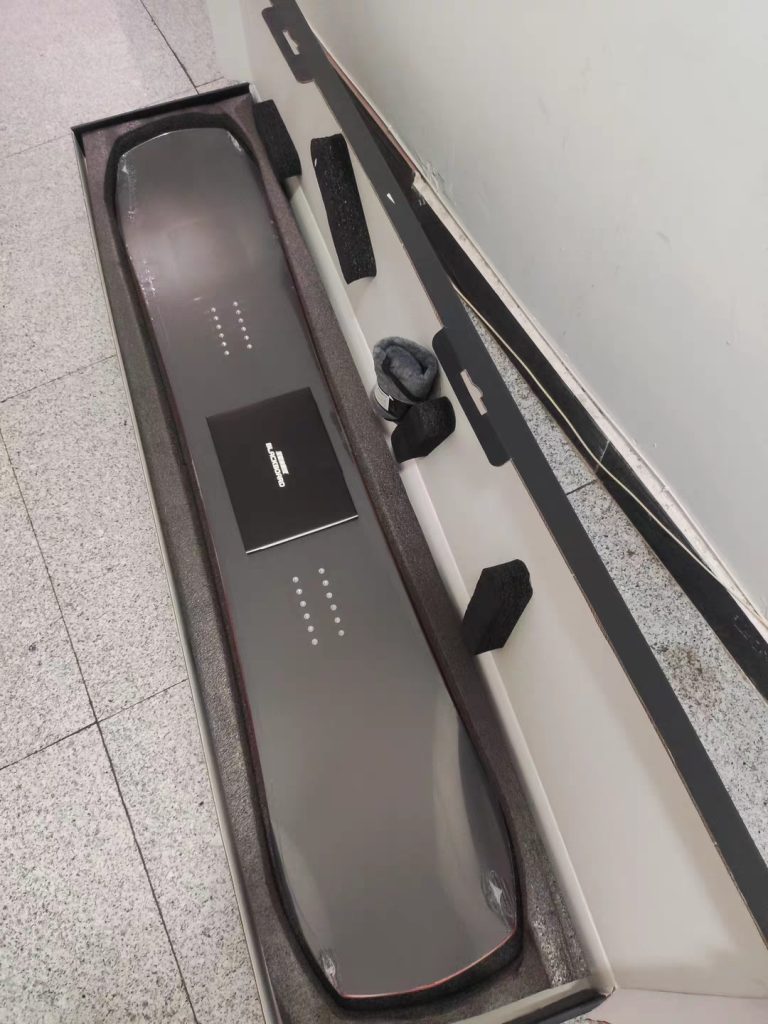
If you are planning to source snowboards from China, one of the first questions is usually: How much does a snowboard cost to manufacture?
The answer depends on the board construction, materials, order quantity, customization, packaging, tooling, and quality requirements.
For B2B buyers, the factory price is only one part of the total purchasing cost. You also need to consider sampling, inspection, shipping, customs duties, taxes, and other import expenses.
This guide explains the typical China snowboard manufacturing price range and the factors that influence the final quotation.
Typical Snowboard Factory Price in China
For general B2B planning, indicative factory price ranges may look like this:
| Snowboard Type | Approximate Factory Price |
|---|---|
| Basic snowboard | US$35–60 |
| Standard snowboard | US$50–90 |
| Freestyle snowboard | US$55–100 |
| All-mountain snowboard | US$60–110 |
| Premium snowboard | US$80–150+ |
| Private-label snowboard | US$50–120+ |
| Custom OEM snowboard | US$60–150+ |
These figures are general planning ranges rather than fixed quotations.
A factory may quote significantly higher or lower depending on the specifications and order quantity.
For example, a 2,000-piece order using an existing factory design can have a much lower unit cost than a 100-piece order requiring custom construction.
What Determines the Manufacturing Cost?
1. Snowboard Core
The core is one of the most important cost components.
Different core constructions can affect:
- Weight
- Flex
- Strength
- Durability
- Riding characteristics
- Manufacturing cost
A basic snowboard may use a relatively simple construction, while a premium snowboard can require a more carefully engineered core profile.
When requesting a quotation, ask the factory to specify the core construction rather than simply writing “wood core.”
2. Base Material
The snowboard base also affects the price.
Two common construction categories are:
- Extruded base
- Sintered base
A sintered base is generally associated with higher-performance snowboard construction and can increase manufacturing cost.
When comparing two quotations, make sure the base specifications are equivalent.
3. Fiberglass
Fiberglass reinforces the snowboard and influences its flex and structural performance.
The cost can vary according to:
- Fiberglass type
- Weight
- Number of layers
- Construction method
- Resin system
A premium snowboard may use a more sophisticated reinforcement configuration than a basic model.
4. Board Dimensions
Larger boards require more material.
The following can affect cost:
- Length
- Width
- Shape
- Thickness
- Profile
A custom board shape may also require additional tooling or engineering work.
5. Edge Construction
The quality and configuration of the metal edges can affect both manufacturing cost and durability.
For professional products, buyers should evaluate:
- Edge material
- Edge thickness
- Installation
- Grinding
- Finishing
- Corrosion resistance
Do not compare prices without confirming the edge specification.
6. Graphics and Topsheet
If you purchase an existing snowboard design, the graphics may already be included in the manufacturer’s standard configuration.
For private-label production, you may want:
- Custom graphics
- Custom logo
- Custom topsheet
- Custom base graphics
- Special finishes
More complicated artwork or special materials can increase the cost.
7. Custom Mold and Tooling
If you want a completely new snowboard shape, the factory may need to create new tooling.
Potential costs include:
- Mold
- Cutting tools
- Prototype tooling
- Engineering
- Testing
Ask the manufacturer:
Who owns the mold after payment?
This should be clearly stated in the purchase agreement.
8. Order Quantity
Quantity is one of the biggest factors affecting unit price.
For example, a factory might quote approximately:
| Order Quantity | Possible Price Level |
|---|---|
| 50–100 pcs | Higher |
| 200–500 pcs | Moderate-high |
| 1,000 pcs | More competitive |
| 2,000–5,000 pcs | More competitive |
| 10,000+ pcs | Potentially lower |
These are only general purchasing patterns.
The actual MOQ and price depend on the factory and product.
A small order may have higher unit costs because the factory must distribute setup, materials, packaging, and production costs over fewer units.
9. Private Label vs. Custom OEM
The production model has a major effect on cost.
Private Label
You use an existing factory model and add your branding.
Possible costs include:
- Logo
- Packaging
- Labels
- User manual
- Custom graphics
This is usually simpler and faster.
OEM
You customize the actual product.
Possible customization includes:
- Shape
- Flex
- Core
- Base
- Fiberglass
- Graphics
- Inserts
- Topsheet
- Packaging
OEM production usually requires more development work and therefore can cost more.
10. Sample Cost
Before bulk production, you should normally test a sample.
Sample pricing can vary considerably.
A basic existing model may have a relatively low sample cost, while a custom OEM prototype can be significantly more expensive because it may require:
- New graphics
- Engineering
- Special materials
- Custom tooling
- Prototype production
Ask whether the sample fee can be credited toward a future bulk order.
11. Packaging Costs
Packaging is another cost that is often overlooked.
A basic export package may include:
- Protective film
- Cardboard
- Edge protection
- Individual packaging
A private-label brand may require:
- Custom printed box
- Custom snowboard bag
- Color artwork
- Brand labels
- Barcode
- Product information
Premium packaging can increase the unit cost.
12. Quality Control Costs
If you require additional inspections, the total purchasing cost may increase.
Possible quality-control activities include:
- Raw-material inspection
- Dimensional inspection
- Flex testing
- Base inspection
- Edge inspection
- Insert inspection
- Graphic inspection
- Final inspection
For a large OEM order, independent pre-shipment inspection can be worth considering.
13. Production Lead Time
Price should also be evaluated together with delivery time.
As a general planning range:
- Existing standard model: 15–30 days
- Private-label production: 20–40 days
- Custom graphics: 25–45 days
- Custom OEM: 45–90+ days
- New tooling and development: 60–120+ days
These are approximate planning ranges. The actual schedule depends on the factory, season, materials, order quantity, and product complexity.
If you are purchasing before the winter season, order planning should start well in advance.
14. Calculate Your Landed Cost
Do not calculate profitability using the factory price alone.
Your landed cost may include:
Factory price + packaging + inspection + domestic transportation + international freight + insurance + customs duty + import tax + destination charges
For example:
Suppose the factory price is:
US$70 per snowboard
Order quantity:
1,000 boards
Product value:
US$70,000
Your final landed cost will be higher after adding logistics and import-related expenses.
For snowboards, freight can be especially important because the boards are relatively large compared with their weight.
15. Ask for an FOB or EXW Quotation
When comparing Chinese factories, clarify the Incoterm.
For example:
EXW
The buyer generally handles transportation from the factory onward.
FOB
The supplier generally handles the goods to the agreed Chinese port and export procedures according to the agreed FOB terms.
CIF
The supplier arranges transportation and insurance to the destination port under the agreed CIF terms.
Do not compare quotations from different Incoterms without adjusting the costs.
16. Example of a Snowboard Cost Calculation
Imagine you are buying 1,000 standard private-label snowboards.
Example planning cost:
Factory price: US$65/board
Product cost:
1,000 × US$65 = US$65,000
Then you may need to add:
- Custom packaging
- Inspection
- Inland transportation
- Ocean freight
- Insurance
- Customs duty
- Import tax
- Destination handling
If these costs total another US$15,000, the approximate landed purchasing cost would be:
US$80,000
That means the approximate landed cost would be:
US$80 per snowboard
This is only an example. Actual logistics and tax costs vary by destination.
17. How to Get a More Accurate Factory Quote
Send the manufacturer a detailed RFQ instead of asking:
“How much is a snowboard?”
A better inquiry would include:
Product: All-mountain snowboard
Length: 155 cm
Target market: United States
Core: Wood core
Base: Specify required type
Flex: Medium
Graphics: Custom
Logo: Private label
Packaging: Custom retail packaging
Quantity: 1,000 pcs
Accessories: As required
Shipping: FOB China
Then ask the factory to provide:
- Unit price
- MOQ
- Sample cost
- Tooling cost
- Packaging cost
- Production lead time
- Payment terms
- Inspection options
This allows you to compare different manufacturers more accurately.
18. How to Reduce Snowboard Manufacturing Costs
There are several ways to control costs without simply asking the factory to lower its price.
Use an Existing Factory Mold
If the existing shape meets your requirements, you may avoid new tooling.
Increase Order Quantity
Larger production quantities can reduce setup and material costs per unit.
Simplify Packaging
Premium packaging may not always be necessary for a budget product.
Standardize Components
Using standard materials and components can reduce development complexity.
Start With Private Label
A proven existing model can reduce development risk for a new brand.
Compare Several Manufacturers
Obtain quotations from several factories using the same specification.
19. Don’t Sacrifice Critical Quality to Save Money
Some cost reductions can create significant quality problems.
Be cautious about reducing costs by changing:
- Core quality
- Base material
- Fiberglass
- Resin
- Edge construction
- Insert quality
- Manufacturing tolerances
A cheaper snowboard that produces more warranty claims may ultimately cost more than a higher-quality product.
For commercial brands, consistency is often more valuable than the lowest possible factory price.
FAQ
How much does a snowboard cost to manufacture in China?
A broad factory-level planning range is approximately US$35–150+ per snowboard.
Basic models may fall around US$35–60, standard models around US$50–90, while premium or customized OEM models can reach US$100–150+.
Actual prices depend on specifications and quantity.
What is the cheapest way to manufacture snowboards in China?
Using an existing factory model with standard materials, standard construction, simple private labeling, and a larger order quantity is generally more cost-efficient than developing a completely new snowboard.
What MOQ should I expect?
MOQ varies by factory and customization level.
Existing models may support relatively small orders, while custom OEM products normally require larger quantities.
Ask the manufacturer for several quantity tiers, such as 100, 500, 1,000, and 5,000 units.
Is private-label snowboard production cheaper than OEM?
Usually, yes.
Private label generally uses an existing product design, while OEM can involve new engineering, tooling, materials, prototypes, and testing.
However, the actual cost depends on the scope of customization.
How long does snowboard production take?
A standard product may take approximately 15–30 days, while private-label production can take around 20–40 days.
A new OEM snowboard may require 45–90 days or more, especially when tooling and product development are involved.
Does the factory price include shipping?
Not necessarily.
Always ask whether the quotation is EXW, FOB, CIF, or another Incoterm.
The factory price and your final landed cost are two different figures.
What should I check before choosing a snowboard factory?
Check:
- Factory identity
- Manufacturing experience
- Core construction
- Base material
- Fiberglass
- Edge quality
- Sample performance
- OEM capability
- MOQ
- Pricing
- Quality control
- Production lead time
- Packaging
- Export experience
- After-sales support
Conclusion
The cost of manufacturing snowboards in China can vary considerably. For preliminary B2B planning, buyers may encounter factory prices from roughly US$35 to US$150+ per board, depending on product level and customization.
The most important point is not to choose a manufacturer based solely on the lowest quotation.
Instead, compare equivalent specifications and evaluate the complete cost:
Product + customization + packaging + inspection + shipping + duties + taxes = real landed cost.
For brands entering the snowboard market, starting with a proven private-label model can reduce development costs and market risk. For established brands seeking differentiation, OEM production can provide greater control over board shape, materials, flex, graphics, and overall product performance.


No reply content