
China Surfboard and Snowboard Manufacturer Co., Ltd.


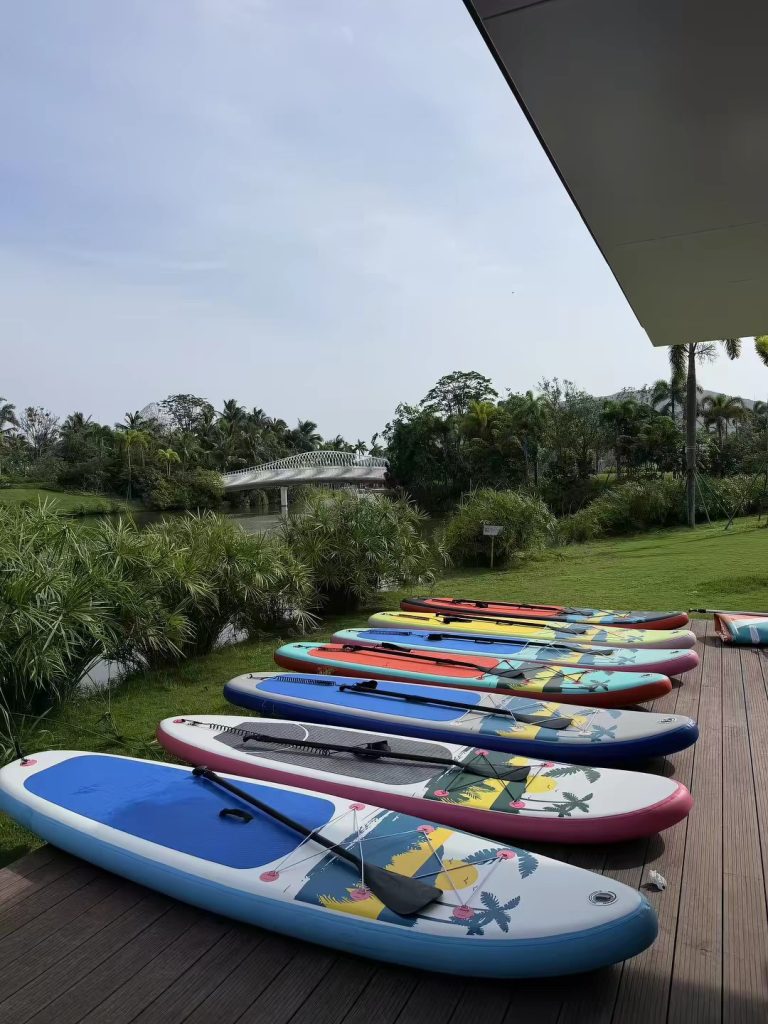
If you are planning to source surfboards from China, one of the first questions is usually: How much does it cost to manufacture a surfboard in China?
There is no single factory price because surfboard costs depend on the board type, size, construction, materials, customization, order quantity, packaging, and shipping requirements.
For buyers planning to develop a surfboard brand, the most useful approach is to understand the approximate manufacturing price range and the factors that make the price go up or down.
Typical China Surfboard Manufacturing Price Range
For reference, a reasonable factory-level range for many standard and customized surfboards is approximately:
Surfboard Type |
Approximate Manufacturing Price |
|---|---|
Basic foam surfboard |
US$45–90 |
Standard epoxy/EPS surfboard |
US$70–140 |
Performance shortboard |
US$90–180 |
Mid-length surfboard |
US$100–220 |
Longboard |
US$120–280 |
Premium/custom surfboard |
US$180–400+ |
These are indicative manufacturing ranges rather than fixed quotations. A specific order can be lower or higher depending on specifications and quantity.
The final quotation should always be based on the exact product specification.
What Determines the Price of a Surfboard?
1. Board Construction
Construction is one of the biggest factors affecting manufacturing cost.
A basic foam board generally requires fewer expensive materials and simpler production processes.
EPS/epoxy boards, performance boards, reinforced boards, and premium constructions can require more materials and additional production work.
For example, a basic board may be suitable for beginners and rental businesses, while a higher-end board designed for experienced surfers may require more precise shaping and stronger materials.
2. Surfboard Size
Larger boards normally require more foam, fiberglass, resin, packaging materials, and storage space.
A shortboard and a longboard with similar construction can therefore have significantly different manufacturing costs.
If you are ordering multiple sizes, ask the manufacturer to quote each size separately.
3. Materials
Material selection has a direct impact on the final price.
Common cost factors include:
-
Foam core
-
EPS density
-
Fiberglass
-
Epoxy resin
-
Polyester resin
-
Carbon reinforcement
-
Stringers
-
Fin boxes
-
Leash plugs
-
Deck materials
-
Surface finishing
A buyer should not compare two quotations simply by looking at the final price.
If one factory uses different materials or construction methods, the two products may not actually be comparable.
4. Custom Shape and Design
Standard models are normally less expensive than completely customized boards.
If you provide your own dimensions and design requirements, the factory may need additional shaping, design preparation, tooling, or sample-development work.
For private-label brands, customization can include:
-
Custom board shape
-
Custom dimensions
-
Custom artwork
-
Brand logo
-
Color combinations
-
Fin configuration
-
Deck graphics
-
Packaging
-
Product labels
A simple logo may have a relatively small additional cost, while a completely new board design can require considerably more development work.
5. Order Quantity
Quantity has a major effect on the unit price.
For example, a factory may quote approximately:
-
10–30 boards: US$120–220 per board
-
50–100 boards: US$90–180 per board
-
200–500 boards: US$70–150 per board
-
1,000+ boards: potentially US$50–130+ per board
These figures are examples of how volume can affect unit economics, not guaranteed market quotations.
Small orders usually have higher unit costs because the manufacturer has fewer units over which to distribute setup, labor, packaging, and production costs.
Larger orders can provide better pricing, but buyers should not order thousands of boards simply to obtain a lower unit price.
The correct quantity should be based on expected sales and inventory turnover.
6. OEM and Private-Label Costs
If you are building your own surfboard brand, you may need additional services.
For example:
Standard board
Board + standard graphics + standard packaging
may have a lower manufacturing cost.
A private-label order could require:
Custom shape + custom artwork + logo + custom packaging + labels + accessories
This can increase the total development and manufacturing cost.
Before placing an order, ask the factory to separate:
-
Product price
-
Sample cost
-
Customization cost
-
Packaging cost
-
Tooling/development cost
-
Shipping cost
This makes supplier quotations easier to compare.
7. Sample Cost
A custom sample may cost approximately US$100–400+, depending on the design and construction.
Some manufacturers may refund or deduct the sample cost after a buyer places a sufficiently large production order.
For a new brand, paying for a sample can be much cheaper than discovering a problem after producing hundreds of boards.
The sample should be checked for:
-
Dimensions
-
Weight
-
Volume
-
Shape
-
Flexibility
-
Surface finish
-
Graphics
-
Fin configuration
-
Hardware
-
Packaging
Once the sample is approved, use it as a reference for mass production.
8. Packaging Costs
Surfboards are large products, so packaging should not be ignored.
Depending on the packaging requirements, additional costs may include:
-
Protective film
-
Foam
-
Bubble protection
-
Individual bags
-
Cartons
-
Corner protection
-
Pallets
-
Custom printed packaging
Basic export packaging may add approximately US$5–20+ per board, while customized or reinforced packaging can cost more.
For international shipping, stronger packaging may be worthwhile because damage during transportation can be much more expensive than the packaging itself.
9. Manufacturing Cost Is Not Your Final Landed Cost
This is one of the most important points for importers.
If a Chinese factory quotes:
US$100 per surfboard
your actual cost is not necessarily US$100.
Your landed cost may include:
Manufacturing price + packaging + inland transportation + export charges + freight + insurance + customs duties/taxes + destination charges
For example:
Cost Item |
Example |
|---|---|
Surfboard manufacturing |
US$100 |
Export packaging |
US$10 |
China inland transportation |
US$5 |
International freight |
US$25 |
Other logistics costs |
US$10 |
Estimated landed cost |
US$150 |
This is only an example. Actual logistics costs depend heavily on destination, shipping method, shipment volume, season, and product dimensions.
Because surfboards are relatively large, volumetric weight and container utilization can have a significant effect on logistics costs.
10. Air Freight vs. Sea Freight
For larger surfboard orders, sea freight is often worth comparing with air freight because surfboards occupy considerable space.
Air Freight
Air freight can be useful when:
-
The order is small
-
Delivery is urgent
-
The buyer needs samples
-
Inventory is urgently required
However, the transportation cost can be relatively high for large-volume boards.
Sea Freight
Sea freight is generally more suitable when:
-
The order is large
-
Delivery is not urgent
-
The buyer can plan inventory in advance
-
Several boards can be shipped together
When requesting a freight quotation, provide the manufacturer or freight forwarder with the carton dimensions, quantity, gross weight, pickup location, and destination.
11. Why Two Factories May Quote Very Different Prices
Suppose one supplier offers a surfboard for US$65 and another quotes US$130.
It does not automatically mean the second manufacturer is expensive.
The difference could come from:
-
Different foam
-
Different fiberglass
-
Different resin
-
Different board thickness
-
Different construction
-
Different accessories
-
Different finishing
-
Different packaging
-
Different quality-control standards
-
Different production quantities
Always compare the same specification.
A useful way to request quotations is to send every manufacturer exactly the same product specification.
This gives you a much more meaningful price comparison.
12. How to Get an Accurate Surfboard Factory Quotation
When contacting a Chinese manufacturer, provide as much information as possible.
For example:
Product: Performance shortboard
Length: 6’0″
Construction: EPS + epoxy
Volume: 30 L
Color: Custom
Logo: Private label
Fin system: Custom requirement
Quantity: 300 units
Packaging: Individual export packaging
Destination: Your target country and city
With these details, the manufacturer can provide a much more accurate quotation.
If you only ask:
“How much is a surfboard?”
the factory may give you a broad price that is difficult to use for purchasing decisions.
13. How to Reduce Manufacturing Costs
There are several practical ways to control your cost without simply choosing the cheapest supplier.
Increase Order Quantity Carefully
Higher volume can reduce the unit price, but only if you can sell the inventory.
Standardize Components
Using the same fin boxes, accessories, packaging, and construction across multiple models can simplify production.
Reduce Unnecessary Customization
A completely new design can increase development costs.
If you are testing a new market, starting with an existing factory design and adding your branding can sometimes reduce initial investment.
Improve Packaging Efficiency
Better carton dimensions and loading methods can reduce transportation costs.
For large orders, ask the factory how many boards can be loaded efficiently into a container.
14. What Price Should a Buyer Target?
There is no universal “correct” surfboard price.
A beginner board for a rental business may need a completely different cost structure from a premium surfboard sold under a professional brand.
For example:
Entry-level project:
Target manufacturing cost around US$50–100
Mid-range private-label brand:
Approximately US$80–180
Premium/custom product:
Approximately US$150–400+
The important thing is to match the manufacturing cost with your target retail price, expected shipping costs, import taxes, marketing expenses, and desired profit margin.
15. Questions to Ask Before Accepting a Quotation
Before placing an order, ask the manufacturer:
-
What materials are included in the quotation?
-
What construction method is used?
-
Is the quoted price for a standard or customized board?
-
Is the logo included?
-
Is custom artwork included?
-
Is packaging included?
-
What is the MOQ?
-
What is the sample cost?
-
What is the production lead time?
-
What are the carton dimensions?
-
What is the gross weight?
-
How many boards can fit in a container?
-
What quality-control process is used?
-
What payment terms are available?
-
Can the manufacturer provide OEM/private-label production?


No reply content