
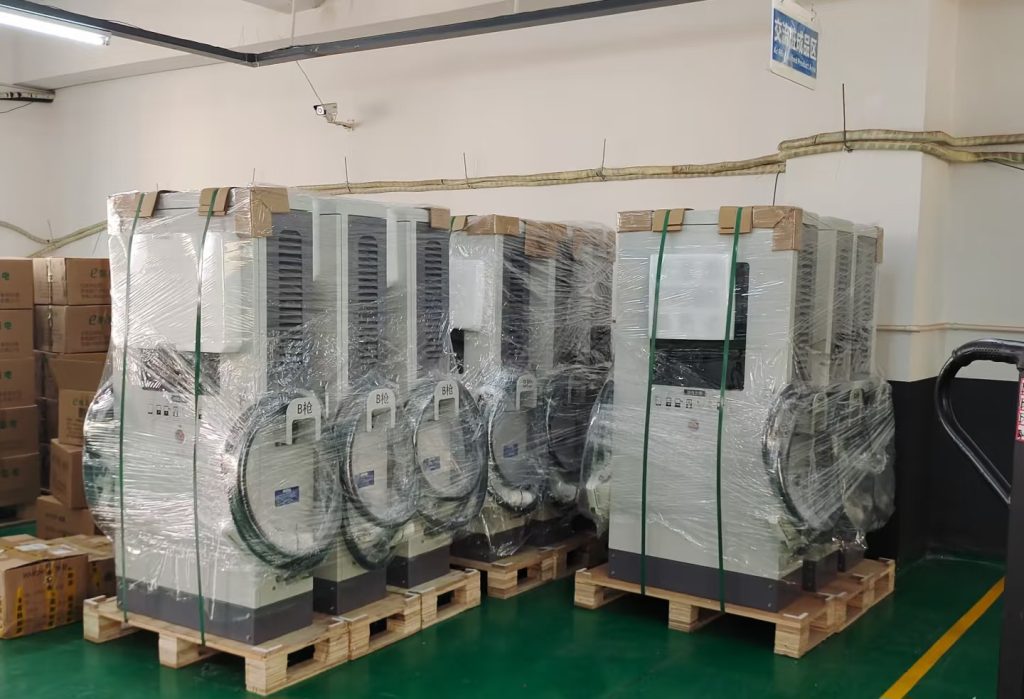
How to Choose a China EV Charger Manufacturer for Wholesale and OEM Projects
Choosing a China EV charger manufacturer is not simply about finding the lowest quotation. For importers, distributors, charging operators, contractors, and EV brands, the manufacturer needs to match the required charging power, electrical standards, product configuration, quality requirements, customization needs, and target market.
China has a large manufacturing base for electric vehicle charging equipment, including AC wall-mounted chargers, commercial AC charging stations, DC fast chargers, portable EV chargers, and customized charging solutions. However, manufacturers can differ significantly in product design, production capabilities, testing procedures, certifications, and OEM support.
This guide explains what international buyers should evaluate before selecting a China EV charger manufacturer for wholesale or OEM projects.
1. Define the EV Charger You Need
Before contacting manufacturers, prepare a clear product specification.
Important requirements may include:
- Charger type: AC or DC
- Charging power
- Input voltage
- Output voltage
- Output current
- Connector type
- Single-phase or three-phase
- Charging standard
- Communication protocol
- Installation method
- Indoor or outdoor application
- Protection requirements
- Display and user interface
- Networking requirements
- Quantity
- Destination market
For example, an AC project may require 7kW, 11kW or 22kW chargers, while a commercial DC charging project may require substantially higher charging power.
Providing these specifications helps manufacturers prepare comparable quotations.
2. Compare AC and DC Charging Solutions
AC and DC chargers serve different applications.
AC EV chargers are commonly used for residential properties, offices, hotels, apartment buildings, parking facilities and other locations where vehicles can remain connected for longer periods.
DC fast chargers are generally designed for applications where faster charging is important, such as commercial charging stations, fleet operations, highway service areas and public charging networks.
The correct solution depends on the charging demand, available electrical capacity, installation environment and project budget.
3. Check the Manufacturer’s Production Capability
A professional buyer should look beyond product photographs.
Ask the manufacturer about:
- Manufacturing location
- Main product categories
- Production capacity
- Testing equipment
- Quality-control procedures
- Engineering capabilities
- Product development
- OEM/ODM experience
- Export experience
- Packaging capabilities
- Spare-parts support
If the project involves a large quantity, production capacity and quality consistency become particularly important.
A manufacturer that can provide technical documentation and clear product specifications is generally easier for an international buyer to evaluate.
4. Confirm Technical Specifications
Two EV chargers may look similar but have different electrical and functional specifications.
Before placing an order, confirm the exact:
- Rated power
- Input voltage range
- Output voltage range
- Maximum current
- Charging connector
- Protection functions
- Operating temperature
- Enclosure rating
- Communication functions
- Networking options
- Installation requirements
The final specification should be written into the quotation, technical agreement or purchase documentation.
This reduces the possibility of receiving a product that differs from the approved sample or original quotation.
5. Check Certifications for the Target Market
Certification requirements depend on the destination country and application.
International buyers should tell the manufacturer the target market before requesting a final quotation.
The buyer should then verify which certifications, test reports and technical documents are actually required for that market.
Do not simply assume that a general statement such as “CE certified” means the product automatically meets every requirement in every destination country.
The applicable standards and documentation should be checked according to the actual product and destination market.
6. Evaluate OEM and ODM Capabilities
For EV charging brands and distributors, OEM and ODM support can be important.
OEM projects may involve:
- Brand logo
- Product labeling
- Packaging
- User manuals
- Color and appearance
- Cable configuration
- Connector configuration
- Software interface
- Communication functions
ODM projects can involve deeper product customization, including hardware design, software functions, enclosure design and other engineering requirements.
Before starting an OEM project, ask the manufacturer which parts can actually be customized and what technical information is required.
7. Request a Sample Before a Bulk Order
A sample allows the buyer to evaluate the actual product rather than relying only on photographs or specifications.
Depending on the project, the buyer may test:
- Charging performance
- Connector compatibility
- Display and controls
- Cable quality
- Housing quality
- Protection functions
- Communication functions
- Installation method
- Packaging
For a large order, the approved sample should become the reference for mass production.
8. Compare Quotations Using the Same Specification
The cheapest quotation is not always the lowest total purchasing cost.
When comparing China EV charger manufacturers, use the same specification for every supplier.
Compare:
- Product configuration
- Charging power
- Components
- Certifications
- Packaging
- Warranty
- OEM requirements
- Spare parts
- Production lead time
- Shipping terms
This makes supplier comparison much more meaningful.
9. Plan Quality Control Before Production
For bulk orders, quality control should not begin only after the products arrive.
Buyers can establish quality checkpoints such as:
- Pre-production confirmation
- Sample approval
- Incoming component inspection
- Production inspection
- Functional testing
- Final inspection
- Packaging inspection
The inspection requirements should be agreed with the manufacturer before mass production starts.
10. Choose a Manufacturer Based on the Entire Supply Chain
Selecting an EV charger manufacturer is ultimately a supply-chain decision.
The right supplier should be able to provide a suitable product specification, consistent manufacturing quality, required documentation, customization support and communication throughout the order process.
For international buyers sourcing from China, it is useful to evaluate several manufacturers using the same technical and commercial requirements before making a decision.
Frequently Asked Questions
What types of EV chargers can buyers source from China?
Common products include AC wall-mounted chargers, AC charging stations, DC fast chargers, portable EV chargers and customized EV charging equipment.
Can China EV charger manufacturers provide OEM services?
Many manufacturers support OEM projects involving branding, packaging, labeling, product configuration and other customized requirements. Buyers should confirm the actual customization scope with each manufacturer.
Should I order a sample before a bulk order?
Yes. A sample can help verify product specifications, charging performance, construction quality and compatibility before mass production.
How do I compare different EV charger manufacturers?
Use the same technical specification when requesting quotations and compare product configuration, certifications, quality control, OEM capability, warranty, lead time and total purchasing requirements rather than comparing price alone.
What information should I send when requesting an EV charger quotation?
Provide the charger type, power rating, electrical requirements, connector, quantity, destination market, customization requirements and any applicable certification or documentation requirements.
Conclusion
Choosing a China EV charger manufacturer requires more than finding a competitive price. International buyers should evaluate technical specifications, production capability, quality control, certifications, OEM support, samples and long-term supply capability.
A structured supplier-selection process can help importers, distributors, charging operators and EV brands reduce purchasing risks and identify manufacturers that are better suited to their specific projects.


No reply content