China Professional Hair Clipper Manufacturing Co., Ltd.
Finding a reliable cordless hair clipper manufacturer in China is an important decision for importers, wholesalers, barbershop suppliers, retailers, and private-label brands. The right manufacturer can provide competitive pricing, stable quality, flexible customization, reliable production capacity, and consistent delivery.
However, choosing a factory based only on the lowest quotation can create problems later. Battery quality, motor performance, blade durability, charging systems, product consistency, packaging, and after-sales support can all affect your final costs and customer satisfaction.
This guide explains what international buyers should check before selecting a Chinese cordless hair clipper manufacturer.
1. Understand What Type of Hair Clipper You Need
Before contacting manufacturers, clearly define your product requirements.
Cordless hair clippers can differ considerably in design and application. Some are designed for home users, while others are intended for professional barbers and salons.
Important specifications include:
-
Cordless or cord-and-cordless operation
-
Rechargeable battery
-
Motor speed
-
Blade material
-
Adjustable blade design
-
Cutting length
-
Guide comb options
-
Charging method
-
Battery capacity
-
Operating time
-
Charging time
-
Product weight
-
Housing material
-
Noise and vibration
-
Waterproof or washable design
-
LED battery indicator
-
Packaging requirements
For example, a basic rechargeable hair clipper may be suitable for home use, while professional buyers may require a stronger motor, longer operating time, more durable blades, and a higher-quality metal housing.
The clearer your requirements are, the easier it is for a manufacturer to provide an accurate quotation.
2. Check Whether the Manufacturer Is a Real Factory
One of the first things to verify is whether the supplier is actually a manufacturer or primarily a trading company.
A real factory should normally be able to explain its:
-
Production location
-
Manufacturing process
-
Production equipment
-
Quality-control procedures
-
R&D capabilities
-
Assembly capacity
-
Monthly production capacity
-
Main product categories
-
Export experience
-
OEM and ODM capabilities
You can ask the supplier for factory photographs, production-line videos, product-development information, and relevant business documentation.
For larger orders, a factory audit or third-party inspection can provide additional confidence.
This is particularly important if you plan to build a long-term private-label hair clipper business.
3. Evaluate Motor Performance
The motor is one of the most important components of a cordless hair clipper.
A weak motor may struggle with thick or coarse hair. It can also cause inconsistent cutting performance, excessive vibration, or overheating.
When comparing manufacturers, ask about:
-
Motor type
-
Motor speed
-
Torque
-
Noise level
-
Operating temperature
-
Expected service life
-
Motor supplier
-
Performance under continuous operation
Do not evaluate the motor based only on the advertised RPM.
A higher RPM does not automatically mean a better clipper. Torque, blade design, motor efficiency, battery output, and overall mechanical design all affect cutting performance.
For professional products, ask the manufacturer to provide actual performance data and test samples rather than relying only on marketing specifications.
4. Pay Close Attention to Battery Quality
Because the product is cordless, battery performance directly affects the customer experience.
A good cordless hair clipper should provide reasonable operating time while maintaining stable power during use.
Ask the manufacturer about:
-
Battery chemistry
-
Battery capacity
-
Rated voltage
-
Operating time
-
Charging time
-
Battery protection system
-
Battery cycle life
-
Charger specifications
-
Charging interface
For example, a manufacturer may advertise a large battery capacity, but the actual operating time can depend on motor efficiency and electronic control.
Ask for sample testing before placing a large order.
You should test how long the clipper operates under realistic conditions rather than relying only on the factory specification sheet.
5. Inspect the Blade System
The blade determines how smoothly and accurately the clipper cuts hair.
Common blade materials include stainless steel and other hardened metal alloys. Some higher-end products may use ceramic or specialized coated blades.
When evaluating the blade, consider:
-
Blade material
-
Sharpness
-
Corrosion resistance
-
Blade alignment
-
Cutting consistency
-
Replaceability
-
Adjustable cutting range
-
Blade service life
A reliable manufacturer should be able to explain how the blade is manufactured and tested.
You should also test the product on different hair types if your target market includes professional barbers.
6. Check the Guide Combs and Accessories
Guide combs may appear inexpensive, but they can have a major impact on the user experience.
Poor-quality guide combs can break, deform, fit loosely, or become difficult to attach and remove.
Ask about:
-
Number of guide combs
-
Cutting lengths
-
Material
-
Attachment method
-
Compatibility
-
Dimensional consistency
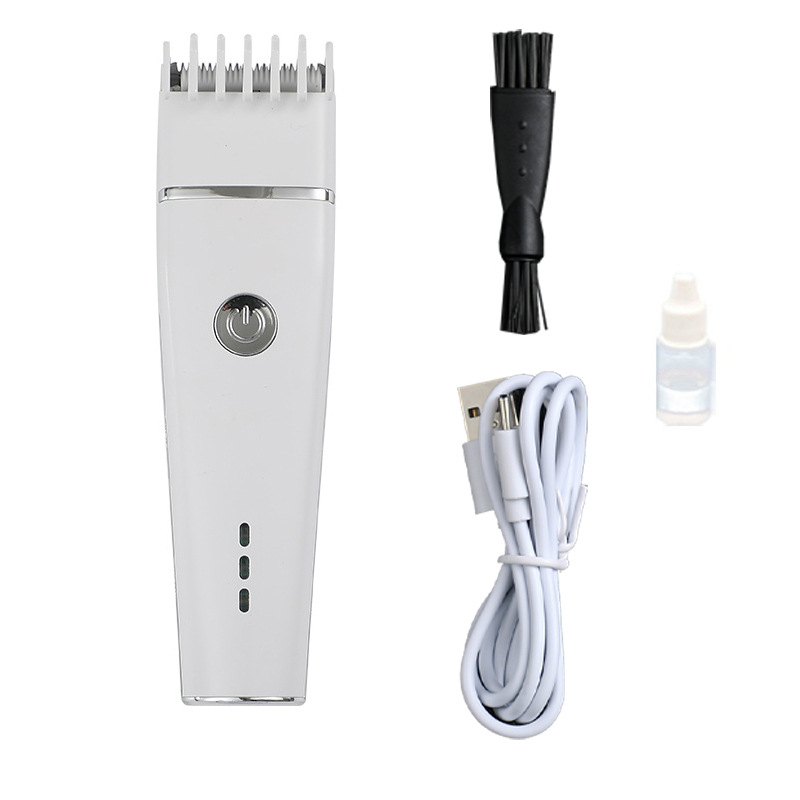
Typical accessory packages may include guide combs, a cleaning brush, lubricating oil, charging cable, protective cap, and user manual.
The exact package can be customized according to your market and retail positioning.
7. Test Samples Before Mass Production
Never place a large order based solely on photographs or product descriptions.
Request samples from the manufacturer first.
A sample evaluation should include:
Cutting Performance
Test the clipper on different hair thicknesses and lengths.
Battery Performance
Fully charge the device and measure actual operating time.
Charging
Check whether the charging system works normally and whether the device becomes unusually hot.
Noise and Vibration
Use the clipper continuously and evaluate motor noise and vibration.
Blade Performance
Check whether the blades cut smoothly without pulling hair.
Housing Quality
Inspect the plastic or metal housing for scratches, gaps, uneven assembly, and loose components.
Accessories
Check whether guide combs, brushes, cables, and other accessories match the agreed specifications.
A sample is not just a product demonstration. It is an opportunity to evaluate the manufacturer’s engineering and quality-control capabilities.
8. Ask About OEM and Private Label Services
If you are building your own brand, look for a manufacturer that can support OEM or private-label production.
Potential customization options include:
-
Brand logo
-
Product color
-
Housing design
-
Button design
-
Packaging
-
User manual
-
Product labels
-
Guide comb colors
-
Charging accessories
-
Retail box
-
Gift box
-
Barcode labels
Some manufacturers can also provide ODM services, allowing buyers to develop a product based on an existing platform or create a substantially customized design.
Before choosing a supplier, ask for its MOQ for customized products.
9. Understand MOQ Requirements
Minimum order quantity can vary considerably depending on the level of customization.
A standard stock product may have a relatively low MOQ, while customized housing, packaging, color, or electronic components may require a higher order quantity.
Ask the manufacturer to separate the MOQ for:
-
Standard products
-
Custom colors
-
Custom logos
-
Custom packaging
-
Custom molds
-
Custom electronics
-
Fully customized products
This helps you calculate the actual investment required for launching your product.
10. Compare the Total Cost, Not Just the Factory Price
The cheapest quotation is not always the cheapest purchasing solution.
Your total cost may include:
Product Cost + Packaging + Customization + Inspection + Shipping + Taxes + Import Costs
For example, a supplier offering a lower unit price may use weaker batteries, cheaper blades, thinner packaging, or lower-quality accessories.
If these components lead to higher return rates, warranty claims, or negative reviews, the apparent savings can disappear quickly.
A better approach is to compare suppliers based on total landed cost and expected product performance.
11. Typical Price Range for Cordless Hair Clippers
The price of cordless hair clippers from Chinese manufacturers varies according to motor quality, battery capacity, blade material, housing design, accessories, packaging, and order quantity.
As a general purchasing reference:
Product Level |
Approximate Factory Price |
|---|---|
Basic entry-level model |
US$5–10 |
Mid-range rechargeable model |
US$8–18 |
Professional model |
US$15–30 |
Premium/customized model |
US$25–50+ |
These are indicative ranges rather than fixed quotations. Actual pricing can change according to specifications, MOQ, customization, packaging, exchange rates, and order volume.
For a new buyer, it is usually better to compare three to five manufacturers using the same technical specification.
12. Check Production Capacity
Production capacity becomes particularly important when your sales volume increases.
Ask the manufacturer:
-
How many units can you produce per month?
-
What is the normal production lead time?
-
How many production lines are available?
-
How much stock is normally maintained?
-
What is the maximum capacity during peak seasons?
-
Can production be increased for large orders?
A manufacturer that can produce a small sample order successfully may still have difficulty handling tens of thousands of units.
If you expect rapid growth, choose a supplier that can scale with your business.
13. Examine Quality-Control Procedures
A professional manufacturer should have a systematic quality-control process.
Typical inspection stages may include:
-
Incoming component inspection
-
Battery inspection
-
Motor inspection
-
Assembly inspection
-
Functional testing
-
Charging testing
-
Appearance inspection
-
Packaging inspection
-
Random sampling
-
Final inspection
Ask the manufacturer what percentage of products are tested before shipment.
For battery-powered products, electrical and charging safety should receive particular attention.
14. Ask About Certifications for Your Target Market
Certification requirements depend on the destination country and the exact product configuration.
Depending on your target market, you may need documentation related to electrical safety, electromagnetic compatibility, battery transportation, or other applicable requirements.
Instead of assuming that a certificate automatically applies to every version of a product, ask the manufacturer to confirm:
-
Certificate number
-
Product model covered
-
Certification scope
-
Test report
-
Certification date
-
Whether the certificate belongs to the manufacturer or another company
If you are importing into multiple countries, check the requirements of each destination market before production.
15. Evaluate Packaging
Good packaging protects the product during international transportation and also affects retail presentation.
For e-commerce and retail products, consider:
-
Individual retail box
-
Protective inserts
-
Product labels
-
Barcode
-
User manual
-
Outer carton
-
Carton dimensions
-
Gross weight
-
Units per carton
For international shipping, packaging should be strong enough to withstand handling, stacking, and transportation.
Ask the factory for carton dimensions and packing quantities so you can calculate shipping costs accurately.
16. Check Lead Time
Production lead time depends on product availability, order quantity, customization, and factory workload.
Typical manufacturing timelines may look like:
-
Existing standard product: approximately 7–20 days
-
Logo and packaging customization: approximately 15–30 days
-
More extensive customization: approximately 30–60+ days
These are general planning ranges. Your supplier should provide a specific production schedule after confirming the order specifications.
If you are preparing for a major sales season, place orders early enough to allow time for production, inspection, shipping, customs clearance, and warehouse receiving.
17. Consider Communication and After-Sales Support
A good manufacturer should communicate clearly before and after the order.
Pay attention to how the supplier responds to technical questions.
A reliable supplier should be able to provide clear answers regarding:
-
Product specifications
-
Sample arrangements
-
Customization
-
Production schedules
-
Quality control
-
Packaging
-
Shipping
-
Warranty
-
Spare parts
Poor communication during the quotation stage can become a much bigger problem after you place a large order.
18. Ask About Spare Parts
For professional hair clippers, spare parts can be important for long-term customer support.
Potential spare parts include:
-
Replacement blades
-
Guide combs
-
Batteries
-
Charging cables
-
Chargers
-
Switches
-
Motor components
-
Protective caps
If you sell under your own brand, maintaining access to replacement parts can reduce customer complaints and improve your after-sales service.
19. Compare Several Manufacturers
Instead of selecting the first supplier you contact, create a simple comparison sheet.
Evaluate each factory according to:
Evaluation Factor |
Supplier A |
Supplier B |
Supplier C |
|---|---|---|---|
Product quality |
|||
Sample performance |
|||
Factory capability |
|||
MOQ |
|||
Price |
|||
Battery quality |
|||
Blade quality |
|||
OEM capability |
|||
Packaging |
|||
Lead time |
|||
Certifications |
|||
After-sales service |
This makes it easier to identify the supplier offering the best overall value.
20. Red Flags to Watch For
Be cautious if a supplier:
-
Refuses to provide samples
-
Cannot explain basic product specifications
-
Changes specifications after quotation
-
Offers an unusually low price without explanation
-
Cannot provide clear production information
-
Avoids discussing quality control
-
Provides certificates that do not match the product model
-
Has inconsistent answers from different sales representatives
-
Demands large payment before confirming specifications
-
Cannot provide a clear production schedule
One warning sign does not necessarily mean a supplier is unreliable, but several warning signs together deserve careful investigation.
Final Checklist for Choosing a Chinese Hair Clipper Manufacturer
Before placing an order, confirm the following:
-
Manufacturer identity has been verified
-
Product specifications are clearly documented
-
Samples have been tested
-
Motor performance is acceptable
-
Battery performance has been tested
-
Blade quality has been checked
-
Accessories meet requirements
-
MOQ is acceptable
-
Factory price is competitive
-
Packaging has been confirmed
-
Production lead time is acceptable
-
Required certifications have been checked
-
OEM/private-label requirements are clear
-
Quality-control standards are documented
-
Spare-parts availability has been discussed
-
Payment terms are clear
-
Shipping arrangements have been confirmed


No reply content