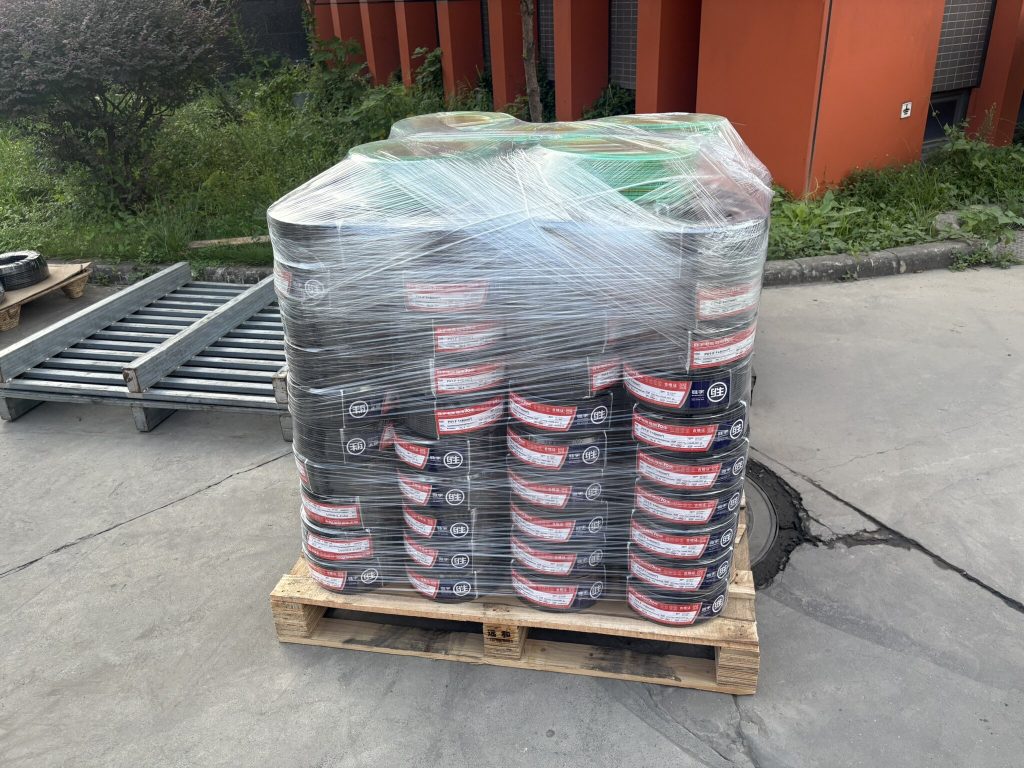
How to Choose a Reliable Electrical Cable and Wire Manufacturer in China
Finding an electrical cable and wire manufacturer in China is relatively easy. Finding one that can consistently deliver the correct conductor size, insulation thickness, electrical performance, documentation, packaging, and production quality is much more important.
For importers, electrical distributors, contractors, wholesalers, and project buyers, the biggest mistake is often comparing suppliers mainly by price. Two quotations may appear to describe the same 450/750V copper wire, but the actual products can differ in conductor construction, resistance, insulation thickness, testing, packaging, certification, and production consistency.
This is particularly important for products such as BV wire, 60227 IEC 01, H07V-U, H07V-R, and other PVC insulated building wires.
If you are sourcing electrical wire from China, the right supplier should be evaluated as a manufacturing partner rather than simply as a low-cost seller.
What Makes a Reliable Electrical Cable and Wire Manufacturer?
A reliable manufacturer should be able to explain exactly what it is producing.
A professional quotation should not simply say:
“450/750V copper wire, good quality.”
That description is too vague for a serious B2B purchase.
A useful specification normally includes:
- Product designation
- Applicable standard
- Conductor material
- Conductor class
- Cross-sectional area
- Number of cores
- Insulation material
- Insulation thickness
- Rated voltage
- Conductor resistance
- Outer diameter
- Color
- Coil or drum length
- Packaging
- Testing requirements
- Certification requirements
- Quantity
- Delivery terms
For example, a buyer asking for 2.5mm² BV wire should know whether the requested product is solid or stranded, which standard applies, what resistance limit is required, what insulation construction is being used, and how the finished wire will be packed.
This level of detail separates a manufacturing quotation from a simple trading quotation.
1. Start With the Exact Wire You Need
Before comparing Chinese manufacturers, define the product.
“Electrical cable” is a very broad category. A building-wire buyer, solar-project buyer, industrial equipment manufacturer, and electrical distributor may require completely different constructions.
For fixed building installations, one common purchasing category is single-core copper PVC insulated wire.
For example, this supplier’s [PVC Insulated Building Wire Supplier China | BV, H07V-U, 450/750V]PVC Insulated Building Wire Supplier China | BV, H07V-U, 450/750V covers BV / 60227 IEC 01 and H07V-U products, including different conductor constructions and sizes.
Before requesting a quotation, prepare at least:
Product: BV / H07V-U / 60227 IEC 01
Conductor: Copper
Size: 1.5mm² / 2.5mm² / 4mm² / 6mm² / 10mm², etc.
Voltage: 450/750V
Insulation: PVC
Color: Required colors
Packing: Coil or drum
Length: 100m / 500m / 1,000m or project requirement
Quantity: Total meters or number of coils
Destination: Port or country
Required certification: Based on the target market
The more precise the inquiry, the more useful the supplier’s quotation will be.
2. Do Not Treat BV, 60227 IEC 01 and H07V-U as Just Different Names
One of the most common sourcing mistakes is assuming that all single-core 450/750V PVC wires are automatically interchangeable.
They belong to closely related application categories, but their designation systems and applicable standards can differ.
BV / 60227 IEC 01
BV is commonly used for PVC insulated copper building wire in China, while 60227 IEC 01 identifies a specific IEC product category.
H07V-U
H07V-U is a harmonized designation commonly encountered in European-oriented specifications and other markets using related harmonized cable systems.
H07V-R
H07V-R uses a stranded rigid conductor rather than the solid conductor normally associated with H07V-U.
This distinction matters when the wire will be installed through long conduits, bends, distribution panels, or other areas where flexibility affects installation.
A useful comparison resource is the supplier’s [Wholesale Single Core Copper Wire Factory | BV H07V-U China]Wholesale Single Core Copper Wire Factory | BV H07V-U China page, which separates BV / 60227 IEC 01, H07V-U, H07V-R and flexible alternatives by conductor construction and application.
Do not ask a manufacturer simply:
“Do you have H07V-U?”
Ask:
“Can you manufacture this exact conductor construction according to the required standard and provide the corresponding test documentation?”
That is a much better supplier-verification question.
3. Check the Copper Conductor Before Looking at the Price
For copper electrical wire, the conductor is one of the most important cost and performance components.
Copper accounts for a substantial portion of the material value of a cable, so an unusually low quotation deserves investigation.
A buyer should ask the manufacturer to confirm:
- Copper conductor material
- Conductor class
- Cross-sectional area
- Conductor diameter
- DC resistance at 20°C
- Copper purity or raw-material specification where relevant
- Production and testing records
For example, if you purchase 10mm² wire, you should not judge quality only by measuring the outside diameter.
A thick PVC layer can make an inexpensive conductor look like a larger cable.
Electrical resistance provides another important verification point.
A manufacturer that understands its products should be able to explain the relationship between conductor size and resistance rather than simply promising that the wire is “high quality.”
4. Verify Insulation Thickness
The PVC insulation has two jobs that buyers should not overlook.
First, it provides electrical insulation.
Second, it must provide sufficient mechanical and environmental protection for the intended installation.
Ask for:
- Nominal insulation thickness
- Minimum insulation thickness
- PVC material type
- Temperature rating
- Flame performance
- Applicable test standard
- Finished outer diameter
The supplier’s [H07V-U Solid Copper Cable: Complete Technical and Pricing Guide]H07V-U Solid Copper Cable: Complete Technical and Pricing Guide provides a useful example of how a professional product specification can be presented, including conductor construction, insulation parameters, electrical data, pricing factors, and quality-control considerations.
This type of information is much more useful to an importer than a generic statement such as “premium PVC insulation.”
5. Ask How the Factory Controls Conductor Resistance
A professional cable factory should have a defined method for controlling conductor resistance.
Resistance is not merely a laboratory number. It can reveal problems involving conductor size, material quality, manufacturing consistency, or incorrect construction.
For example, when buying repeated production lots, a buyer can request:
- DC resistance test results
- Conductor diameter measurements
- Insulation thickness records
- Finished-product test reports
- Batch or production numbers
If the manufacturer cannot explain how these parameters are checked during production, the supplier deserves additional scrutiny.
For large orders, it is better to agree on measurable specifications before production rather than argue about quality after the goods arrive.
6. Examine the Factory’s Production Process
You do not necessarily need to visit China before placing every order, but you should understand how the manufacturer produces the wire.
For copper building wire, a typical process may include:
- Copper rod preparation
- Drawing
- Conductor forming
- Annealing where applicable
- Insulation extrusion
- Online electrical testing
- Diameter and insulation checks
- Printing and marking
- Finished-length measurement
- Coiling or drum winding
- Final inspection
- Packing
Ask the supplier which steps are performed in-house.
This is particularly important when comparing a manufacturer with a trading company.
A trading company may be able to provide a competitive price, but a factory should be able to discuss production details, testing procedures, production capacity, material controls, and lead times with considerably more technical depth.
7. Look at Existing Product Specifications
One useful way to evaluate a manufacturer is to study how it presents its existing products.
For example, the supplier currently lists [PVC Building Wire for House Wiring | 10mm² BV Cable Supply]PVC Building Wire for House Wiring | 10mm² BV Cable Supply.
A product page that identifies the conductor size, voltage, insulation type, standard, application and supply format gives buyers much more information than a page containing only marketing phrases.
For procurement purposes, look for consistency between:
Product page → Technical specification → Quotation → Sample → Mass production → Test report
If these five stages describe different products, stop and clarify the specification before paying a deposit.
8. Ask for a Sample Before a Large Order
A sample is not only for checking appearance.
It should be used to verify whether the supplier actually produces the specification that was quoted.
Depending on the product and project, a buyer may check:
- Marking
- Conductor construction
- Approximate conductor dimensions
- Insulation thickness
- Outer diameter
- Color
- Flexibility
- Coil length
- Packaging
- Test documentation
For larger commercial orders, laboratory or third-party testing can provide additional confidence.
The purpose of sampling is not necessarily to prove that the supplier is perfect.
It is to discover discrepancies while the order is still small.
9. Compare Suppliers Using the Same Specification
Suppose three factories quote:
Supplier A: USD X per meter
Supplier B: USD Y per meter
Supplier C: USD Z per meter
That comparison means very little if the specifications are not identical.
Use a comparison sheet such as:
| Item | Supplier A | Supplier B | Supplier C |
|---|---|---|---|
| Product designation | |||
| Standard | |||
| Conductor | |||
| Conductor class | |||
| Cross-section | |||
| Insulation | |||
| Insulation thickness | |||
| Voltage | |||
| Resistance | |||
| Coil length | |||
| Packing | |||
| Certification | |||
| MOQ | |||
| Lead time | |||
| Incoterm | |||
| Test report | |||
| Warranty |
This prevents a low quotation from appearing attractive simply because important specifications were omitted.
10. Understand Why Cable Prices Change
Electrical wire prices are heavily affected by copper.
Therefore, asking:
“What is your price for one year?”
may not produce a meaningful answer.
A better commercial arrangement may define:
- Copper pricing reference
- Pricing date
- Processing cost
- Manufacturing margin
- Packaging cost
- Certification cost
- Freight
- Incoterm
- Price validity period
For distributors buying repeatedly, a copper-index mechanism can sometimes make long-term purchasing easier than constantly negotiating a completely new price.
The supplier’s existing [BV Wire 60227 IEC 01 Manufacturer China | 450/750V Single Core]BV Wire 60227 IEC 01 Manufacturer China | 450/750V Single Core content also provides a useful reference for understanding BV construction, voltage, standards, applications and buying considerations.
11. Check Certification for Your Actual Market
Certification should be determined by the destination market and project requirements.
Do not assume that one certificate automatically makes a cable acceptable everywhere.
Depending on the destination and application, buyers may encounter requirements related to:
- IEC standards
- National standards
- CE-related requirements
- RoHS
- VDE or HAR-related specifications
- Local electrical regulations
- Project-specific testing
- Third-party inspection
The important question is not:
“Do you have certificates?”
Instead ask:
“Which exact product construction, size range, standard and production site does this certificate cover?”
A certificate that applies to one cable construction should not automatically be treated as approval for every cable produced by the factory.
12. Verify Whether the Manufacturer Can Handle Your Packaging
Packaging is often ignored during technical discussions, but it can have a direct effect on your selling price.
A distributor may need:
- 100m retail coils
- 200m coils
- 500m coils
- 1,000m drums
- Private-label printing
- Barcode labels
- Carton packaging
- Pallet packaging
- Sequential meter marking
- Customized reel dimensions
A project buyer may prefer drums because they reduce handling during installation.
A retail distributor may prefer smaller coils because they are easier to sell.
Therefore, tell the manufacturer how the product will be sold rather than asking only for a price per meter.
13. Check OEM Capability Carefully
OEM does not always mean simply printing your logo on the cable.
For electrical wire, OEM requirements can include:
- Cable marking
- Brand name
- Technical designation
- Color
- Coil length
- Packaging design
- Carton labels
- Reel labels
- Barcode
- Private-label documentation
- Production quantity
Before ordering, request a digital proof of the printing and packaging.
Check every character.
A mistake in cable marking can create problems after the shipment has already reached your warehouse.
14. Evaluate MOQ and Production Capacity Together
A low MOQ can be attractive for a new importer, but it is not necessarily the most important factor.
For example, if you require:
- 1.5mm²
- 2.5mm²
- 4mm²
- 6mm²
- 10mm²
in multiple colors, the total number of production combinations can become large.
Ask the manufacturer whether it can supply mixed sizes and colors within one shipment.
Also ask:
- Minimum order per size
- Minimum order per color
- Production lead time
- Standard stock availability
- Monthly production capacity
- Peak-season capacity
- OEM MOQ
- Packaging MOQ
A supplier that accepts your first order but cannot maintain the same specifications for repeat orders is not necessarily a good long-term supplier.
15. Check the Manufacturer’s Quality-Control Documents
A professional buyer should establish the documents required before production begins.
Depending on the order, this may include:
- Technical datasheet
- Material specification
- Test report
- Mill test certificate
- Certificate of conformity
- Packing list
- Commercial invoice
- Certificate of origin
- Third-party inspection report
Do not wait until the shipment is ready to ask for documentation.
Documentation requirements should be agreed before the purchase order.
16. Pay Attention to the Difference Between Factory Claims and Verification
A supplier profile may say:
“Professional manufacturer.”
That statement alone does not prove manufacturing capability.
Better evidence includes:
- Clear technical specifications
- Consistent product information
- Production photographs or video
- Factory address
- Company information
- Testing records
- Sample consistency
- Repeat-order performance
- Clear quotation
- Transparent communication
- Ability to answer technical questions
The goal is not to find the supplier with the largest number of marketing claims.
The goal is to find the supplier whose claims can be checked.
17. Questions to Ask a Chinese Electrical Wire Manufacturer
Before requesting a formal quotation, send a structured inquiry.
For example:
Product: BV / H07V-U
Standard: Required standard
Voltage: 450/750V
Conductor: Copper
Size: 1.5 / 2.5 / 4 / 6 / 10mm²
Color: Brown / Blue / Green-Yellow / Black
Quantity: Total meters per size
Packing: 100m coils or drums
Marking: OEM or standard marking
Destination: Destination port
Certification: Required documents
Trade term: EXW / FOB / CIF
Then ask the manufacturer to confirm:
- Conductor construction
- Maximum DC resistance
- Insulation thickness
- Outer diameter
- Production lead time
- MOQ
- Packaging
- Available certifications
- Testing documents
- Payment terms
This produces a quotation that can actually be compared with other factories.
18. Red Flags When Choosing a Chinese Cable Manufacturer
Be cautious if a supplier:
- Gives an extremely low price without explaining the specification
- Refuses to provide technical data
- Cannot explain conductor class
- Avoids questions about resistance
- Cannot provide a sample
- Sends certificates unrelated to the requested product
- Changes specifications after the quotation
- Uses different company names on invoices and certificates without explanation
- Cannot explain production lead time
- Refuses reasonable pre-shipment inspection
- Cannot confirm packaging dimensions
- Promises every international certification without qualification
One red flag may not be enough to reject a supplier.
Several together should trigger deeper verification.
19. A Practical Supplier-Selection Scorecard
For a serious B2B purchase, you can score each manufacturer from 1 to 5.
| Evaluation Area | Weight |
|---|---|
| Product specification accuracy | 20% |
| Manufacturing capability | 15% |
| Quality control | 15% |
| Testing and documentation | 15% |
| Price competitiveness | 10% |
| MOQ flexibility | 5% |
| Lead time | 5% |
| OEM capability | 5% |
| Packaging capability | 5% |
| Communication and technical support | 5% |
This approach prevents price from becoming the only deciding factor.
A supplier offering the cheapest meter price may score poorly in quality control, documentation, packaging, or production consistency.
For imported electrical products, the cheapest initial quotation is not always the cheapest overall purchasing solution.
20. What Should a First Order Look Like?
For a new buyer, it is generally safer to divide sourcing into stages.
Stage 1: Technical confirmation
Confirm:
- Product
- Standard
- Size
- Conductor
- Insulation
- Voltage
- Color
- Marking
Stage 2: Sample
Check the physical sample and documents.
Stage 3: Trial order
Use a manageable quantity to evaluate:
- Production consistency
- Packaging
- Delivery
- Documentation
- Communication
Stage 4: Larger order
Once the first shipment performs as expected, increase purchasing volume.
Stage 5: Long-term supply agreement
For recurring demand, discuss:
- Copper pricing mechanism
- Annual volume
- Delivery schedule
- Quality standards
- Inspection
- Warranty
- Packaging
- OEM requirements
This is generally more controlled than moving directly from a low-price quotation to a large container order.
How to Choose Between Two Chinese Cable Manufacturers
If two manufacturers have similar prices, compare the details that are easy to overlook.
Manufacturer A may offer a slightly lower price but provide generic documentation.
Manufacturer B may cost slightly more but provide:
- Exact technical specifications
- Batch test reports
- Better packaging
- More consistent production
- Better OEM support
- Clearer delivery schedules
- Better communication
- More reliable after-sales handling
For an importer selling electrical products repeatedly, these differences can be worth considerably more than a small difference in the initial unit price.
Frequently Asked Questions
Is China a good place to source electrical wire?
China has a large manufacturing base for electrical wire and cable, but the quality and capability of individual suppliers can vary significantly. Buyers should evaluate the exact product specification, manufacturing capability, testing, certification, and quality controls rather than selecting a supplier based only on country of origin.
How do I know if a Chinese cable supplier is a real manufacturer?
Ask for company information, production capability, factory evidence, technical specifications, samples, testing documents, and production details. A factory should normally be able to answer detailed manufacturing questions that a general trading seller may not be able to answer.
What information should I send when asking for a cable quotation?
At minimum, provide product type, standard, conductor material, size, voltage, color, quantity, packaging, destination port, certification requirements, and Incoterm.
Is the cheapest electrical wire quotation the best option?
Not necessarily. A lower price can result from different conductor construction, thinner materials, different packaging, different standards, or different certification requirements. Compare equivalent specifications before comparing prices.
Should I request a sample before placing a bulk order?
For a new supplier, a sample is strongly recommended. It allows you to verify physical construction, marking, packaging, documentation, and other requirements before committing to a larger order.
What is the difference between BV and H07V-U?
They are related single-core PVC insulated building-wire categories, but the designations and applicable standards differ. Buyers should specify the exact standard and construction required by their target market rather than treating the two names as automatically interchangeable.
Can Chinese cable manufacturers provide OEM products?
Many manufacturers can support customized marking, packaging, colors, coil lengths, and other OEM requirements. However, MOQ, production setup, certification, and packaging requirements should be confirmed before ordering.
What should I check before paying a deposit?
Confirm the legal supplier identity, product specification, quotation, payment terms, technical documents, certification, packaging, delivery schedule, inspection requirements, and purchase-contract details.
Final Checklist for Choosing a Reliable Electrical Cable and Wire Manufacturer
Before placing your first substantial order, make sure you can answer these questions:
- Is the supplier actually capable of manufacturing the required product?
- Is the exact standard clearly defined?
- Is the conductor construction confirmed?
- Is the copper specification clear?
- Is the cross-sectional area confirmed?
- Is the insulation thickness specified?
- Is the voltage rating correct?
- Is conductor resistance specified?
- Are testing requirements agreed?
- Are certification requirements appropriate for the destination market?
- Has a sample been checked?
- Are packaging and coil lengths confirmed?
- Is the OEM marking approved?
- Is the MOQ acceptable?
- Is the production lead time realistic?
- Is the quotation based on the same specification as competing suppliers?
- Are inspection requirements included in the purchase agreement?
- Are all required documents confirmed before production?
If the answer to these questions is yes, you are in a much stronger position to select a Chinese electrical cable and wire manufacturer.
The most reliable sourcing decision is rarely based on a single factor such as price. It comes from matching the right product specification with a manufacturer that can reproduce that specification consistently, document the quality, package it correctly, and support the order after production.
For buyers currently comparing Chinese suppliers, the existing product resources from this manufacturer can also be used to review specific product categories, including [PVC Insulated Building Wire]PVC Insulated Building Wire, [Single Core Copper Wire]Single Core Copper Wire, [H07V-U Solid Copper Cable]H07V-U Solid Copper Cable, [10mm² BV Building Wire]10mm² BV Building Wire, and [BV Wire 60227 IEC 01]BV Wire 60227 IEC 01.
For a first inquiry, provide the required wire type, size, standard, quantity, packaging, destination, and certification requirements. This gives the manufacturer enough information to prepare a meaningful quotation rather than a generic price.


No reply content