
China Surfboard and Snowboard Manufacturer Co., Ltd.
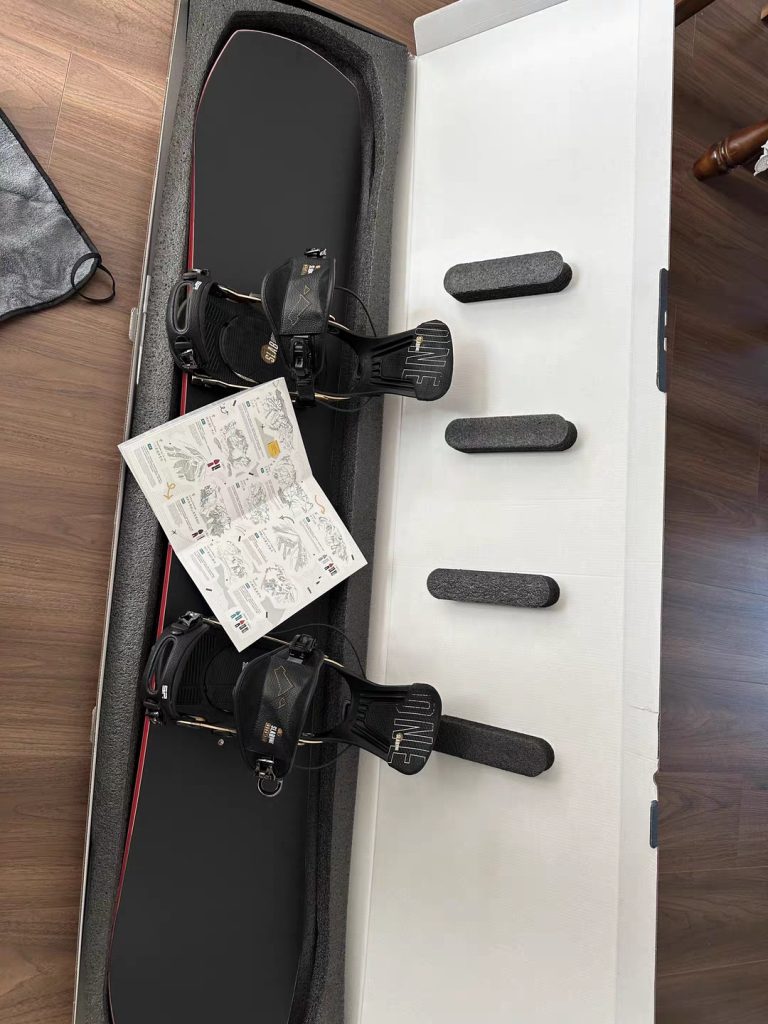
Finding a snowboard manufacturer in China is relatively easy. Finding a factory that can consistently produce the right snowboard quality, meet your specifications, maintain stable production, and communicate clearly is much more difficult.
For ski and snowboard brands, the wrong manufacturing partner can create problems far beyond a single defective shipment. Inconsistent flex, poor base finishing, weak bonding, inaccurate graphics, damaged edges, or missed delivery dates can affect customer reviews and your entire winter sales season.
China has a large manufacturing base for sporting goods, including snowboards, ski equipment, protective gear, and related accessories. However, not every company advertising itself as a China snowboard manufacturer has the same production capabilities.
If you are sourcing snowboards for a new brand, retail business, rental operation, or existing sports equipment company, the following checklist can help you evaluate manufacturers more effectively.
1. Decide What You Actually Need Before Contacting a Factory
The first mistake many buyers make is asking manufacturers only for a price.
A manufacturer cannot give you a meaningful quotation if the product specifications are unclear.
Before contacting factories, prepare as much information as possible about your intended snowboard.
Important specifications may include:
-
Snowboard type
-
Intended riding style
-
Board length
-
Width
-
Shape
-
Camber profile
-
Flex rating
-
Core material
-
Fiberglass construction
-
Base material
-
Edge specification
-
Topsheet material
-
Graphic requirements
-
Logo requirements
-
Binding compatibility
-
Packaging requirements
-
Target quantity
-
Target market
For example, a beginner-oriented all-mountain snowboard and a high-performance freestyle board may require completely different construction and flex characteristics.
The more specific your requirements are, the easier it becomes to compare manufacturers on the same basis.
2. Check Whether the Company Is a Real Manufacturer
A company website alone does not prove that a business operates its own production facility.
This is particularly important when searching for an OEM snowboard manufacturer in China.
Ask potential suppliers directly:
-
Where is your production facility?
-
What snowboard products do you manufacture?
-
Which processes are completed in-house?
-
Which processes are outsourced?
-
How many production lines do you operate?
-
What is your normal monthly capacity?
-
Can you provide factory photos or a factory video?
-
Can you arrange a video factory inspection?
-
Do you manufacture for international brands?
-
Can you produce according to customer specifications?
You should also distinguish between a factory, a trading company, and a manufacturer with outsourced production.
A trading company is not automatically a bad supplier. In some cases, a trading company can provide useful sourcing and export services. However, if your project requires extensive technical development, custom construction, or long-term production, knowing who actually controls manufacturing is important.
3. Do Not Judge a Snowboard Factory Only by Its Website
A professional-looking website can be useful, but it should not be the main reason you select a supplier.
Look for evidence that the manufacturer understands snowboard production rather than simply listing generic phrases such as “high quality” or “competitive price.”
A stronger supplier should be able to discuss technical details such as:
-
Wood core construction
-
Fiberglass layup
-
Base material
-
Edge installation
-
Pressing process
-
Camber control
-
Flex consistency
-
Sidewall construction
-
Topsheet bonding
-
Graphic application
-
Final grinding and finishing
When you ask technical questions, pay attention to the quality of the answers.
A supplier that immediately gives you a low price but cannot clearly explain how your requested construction will be produced may create problems later.
4. Evaluate the Materials, Not Just the Finished Appearance
Two snowboards can look almost identical while having very different construction and performance.
For this reason, buyers should ask manufacturers for detailed material information.
Snowboard Core
The core has a major influence on weight, flex, durability, and riding characteristics.
Common snowboard cores use wood constructions, with different wood species and layouts affecting the final characteristics of the board.
Ask the manufacturer:
-
What type of wood is used?
-
Is the core vertically laminated?
-
How is the core profiled?
-
How is moisture controlled?
-
Can the core construction be customized?
Fiberglass
Fiberglass contributes significantly to the strength and flex characteristics of the board.
The manufacturer should be able to explain the fiberglass specification and layup used for your product rather than simply saying that the board contains “high-quality fiberglass.”
Base
The base directly affects glide performance and maintenance requirements.
Ask whether the manufacturer offers different base options and what specifications are available for your target price range.
Edges
Edge quality is particularly important for snowboard performance and durability.
The manufacturer should have a controlled process for edge installation, bending, joining, and finishing.
5. Pay Attention to Flex Consistency
One of the most important quality issues for a snowboard brand is consistency between production batches.
Imagine ordering 500 boards with the same model specification.
If some boards are noticeably softer and others significantly stiffer, your customers may experience different riding characteristics despite purchasing the same model.
Ask the factory how it controls:
-
Core thickness
-
Core profiling
-
Material placement
-
Pressing conditions
-
Temperature
-
Pressing time
-
Final flex
-
Dimensional tolerances
A good manufacturer should have a repeatable production process rather than relying entirely on individual workers’ experience.
For a serious brand, it can also be useful to establish a reference sample.
The approved sample becomes the physical benchmark for future production.
6. Always Order Samples Before Mass Production
Never choose a snowboard manufacturer based only on a quotation.
A sample allows you to evaluate the actual product.
For an OEM project, the first sample should be checked carefully for:
-
Dimensions
-
Weight
-
Shape
-
Camber
-
Flex
-
Base finish
-
Edge finish
-
Topsheet quality
-
Graphic accuracy
-
Logo placement
-
Binding hole position
-
Surface defects
-
Bonding quality
-
Packaging
Do not rush directly from the first quotation to a large production order.
If changes are required, communicate them clearly and request another sample when necessary.
The goal is not simply to receive a beautiful prototype. The goal is to establish a specification that can be reproduced consistently in mass production.
7. Understand OEM and ODM Capabilities
Different brands have different requirements.
Some buyers already have complete snowboard designs and only need a factory to manufacture them.
Others know their target market but need help developing the product.
These are two different manufacturing relationships.
OEM
With OEM production, you provide your own specifications, design, branding, and other requirements.
The factory manufactures the snowboard according to your specifications.
ODM
With ODM production, the manufacturer may provide existing designs or help develop a product that can then be customized for your brand.
ODM can be useful for smaller brands that do not have a complete engineering or product-development team.
When discussing customization, ask what the factory can actually modify.
For example:
-
Length
-
Shape
-
Flex
-
Camber
-
Graphic
-
Topsheet
-
Base graphic
-
Logo
-
Packaging
-
Accessories
Do not assume every factory can customize every part of a snowboard.
8. Compare MOQ Carefully
Minimum order quantity is another major consideration for new snowboard brands.
Some factories may quote attractive prices but require a large MOQ.
Others may accept smaller orders but charge more per unit.
There is no universally “best” MOQ.
For a new brand, placing a huge order simply to obtain the lowest unit price can be risky.
A better approach may be to start with a manageable quantity, test the market, collect customer feedback, and increase production after demand becomes clearer.
When discussing MOQ, ask whether the minimum quantity applies to:
-
One model
-
One size
-
One graphic
-
One color
-
The entire order
Also ask whether mixed sizes or designs can be combined within one production order.
9. Look Beyond the Unit Price
The lowest quotation is not necessarily the lowest total cost.
Suppose Factory A quotes a snowboard at $80 and Factory B quotes $88.
At first glance, Factory A looks cheaper.
But if Factory A has:
-
Higher defect rates
-
Longer production time
-
Poor packaging
-
Higher sample costs
-
Expensive mold charges
-
Limited customization
-
Inconsistent quality
the final cost may actually be higher.
A proper sourcing comparison should consider the total landed cost.
This may include:
Product price + tooling + sampling + packaging + inspection + freight + customs-related costs + potential defect/replacement costs
This is especially important for international brands.
10. Ask About Production Lead Time
Snowboard production is highly seasonal.
If your products are intended for winter sales, a delayed shipment can be much more expensive than a slightly higher manufacturing price.
Ask the manufacturer for realistic lead times for:
-
Initial sample
-
Sample modification
-
Production preparation
-
Mass production
-
Packaging
-
Final inspection
Avoid accepting an unrealistically short delivery promise simply because you want the order completed quickly.
Instead, ask what the normal production schedule is and whether production capacity changes during the peak season.
11. Check Quality Control Before Shipment
A professional snowboard manufacturing process should include quality checks at different stages rather than inspecting everything only after production is finished.
Depending on the product and factory, quality control may include:
Incoming Material Inspection
Materials should be checked before they enter production.
Production Inspection
The factory should monitor important manufacturing processes such as material placement, pressing, bonding, cutting, and finishing.
Finished Product Inspection
Completed boards should be checked for dimensions, appearance, graphics, flex-related specifications, edge condition, base quality, and other agreed requirements.
For larger orders, an independent pre-shipment inspection can provide an additional layer of protection.
12. Create a Clear Product Specification Sheet
One of the easiest ways to reduce misunderstandings is to create a detailed product specification sheet.
Instead of saying:
“Make a high-quality snowboard.”
provide measurable requirements.
For example:
Item |
Requirement |
|---|---|
Board length |
Specified by model |
Width |
Specified by model |
Flex |
Agreed reference |
Camber |
Agreed specification |
Core |
Agreed material/construction |
Base |
Agreed material |
Edge |
Agreed specification |
Topsheet |
Approved design |
Logo |
Approved artwork |
Packaging |
Agreed packaging standard |
Inspection |
Agreed QC requirements |
This document can become the reference point for samples and mass production.
It also makes supplier comparisons much more accurate.
13. Protect Your Brand Design
If you are developing a private-label snowboard, branding and intellectual property should be considered from the beginning.
Provide clear instructions about:
-
Logo usage
-
Graphic files
-
Packaging artwork
-
Product names
-
Confidential designs
-
Mold ownership
-
Tooling ownership
If you pay for custom tooling or molds, clarify who owns them and what happens if you stop working with the manufacturer.
Do not rely only on verbal agreements for important ownership issues.
14. Communication Is a Manufacturing Capability
Good communication is often underestimated.
A manufacturer may have excellent machinery but still be difficult to work with if specifications are repeatedly misunderstood.
During the sampling stage, pay attention to how the supplier handles changes.
For example, if you ask:
“Please reduce the flex slightly while maintaining the same overall shape.”
A capable technical team should ask relevant follow-up questions rather than simply replying “OK.”
The best supplier is not necessarily the one that agrees with everything.
Sometimes a manufacturer should explain why a requested specification may affect durability, production cost, or lead time.
That type of technical communication is valuable for long-term OEM cooperation.
15. Red Flags When Choosing a China Snowboard Manufacturer
You should be cautious if a supplier:
-
Refuses to provide basic company information
-
Cannot explain its production process
-
Gives dramatically different answers from one salesperson to another
-
Offers an unusually low price without explaining the specifications
-
Avoids sending samples
-
Promises extremely short production times without conditions
-
Cannot provide consistent product specifications
-
Changes important terms after the quotation
-
Refuses reasonable quality inspections
-
Cannot clearly explain who owns custom tooling
-
Uses identical product photos for many unrelated models
None of these points automatically proves that a supplier is unreliable, but several warning signs together should trigger additional verification.
16. A Practical Supplier Comparison Method
Instead of contacting ten factories and choosing the cheapest quotation, create a simple supplier evaluation system.
You can score each manufacturer across several categories:
Category |
Suggested Focus |
|---|---|
Manufacturing capability |
Production equipment and experience |
Product quality |
Sample performance and finishing |
Customization |
OEM/ODM flexibility |
MOQ |
Suitable for your business |
Price |
Overall landed cost |
Lead time |
Ability to meet seasonal schedule |
Communication |
Response quality and technical understanding |
QC |
Inspection and production controls |
Packaging |
Protection during international shipping |
After-sales |
Handling defects and claims |
This approach helps prevent price from becoming the only deciding factor.
17. Questions to Ask Before Placing an Order
Before making a purchase order, ask the manufacturer these questions:
-
Are you the actual snowboard manufacturer?
-
Where is your production facility located?
-
What snowboard types do you currently produce?
-
What customization options are available?
-
What is your MOQ?
-
What is the sample cost?
-
How long does sampling normally take?
-
What is the mass-production lead time?
-
What materials are included in the quotation?
-
What packaging is included?
-
How do you control flex consistency?
-
What quality inspections are performed?
-
Can an independent inspection be arranged?
-
Who owns custom molds or tooling?
-
What happens if products fail the agreed specifications?
A serious manufacturer should be able to answer these questions clearly.
18. Why China Can Be a Practical Manufacturing Option for Snowboard Brands
China’s manufacturing ecosystem allows buyers to source not only snowboards but also many related products and services.
Depending on the supplier, buyers may be able to combine:
-
Snowboard manufacturing
-
Custom graphics
-
Private labeling
-
Packaging
-
Accessories
-
Protective equipment
-
Product development
-
Export services
This can simplify supply-chain management for brands that want to develop a complete winter sports product line.
However, China’s large manufacturing base also means that supplier selection matters.
The objective should not be to find simply “a cheap snowboard factory in China.”
The objective is to find a manufacturer whose product quality, production capability, MOQ, price, communication, and delivery schedule match your business model.
19. Final Checklist Before Your First Production Order
Before confirming a factory, make sure you have:
-
Approved the manufacturer
-
Verified the production capability
-
Confirmed the product specifications
-
Received and evaluated samples
-
Approved the final artwork
-
Confirmed MOQ
-
Confirmed unit price
-
Confirmed tooling costs
-
Confirmed packaging
-
Confirmed production lead time
-
Agreed on quality standards
-
Clarified inspection requirements
-
Confirmed payment terms
-
Confirmed shipping arrangements
-
Confirmed responsibility for defective products


No reply content