
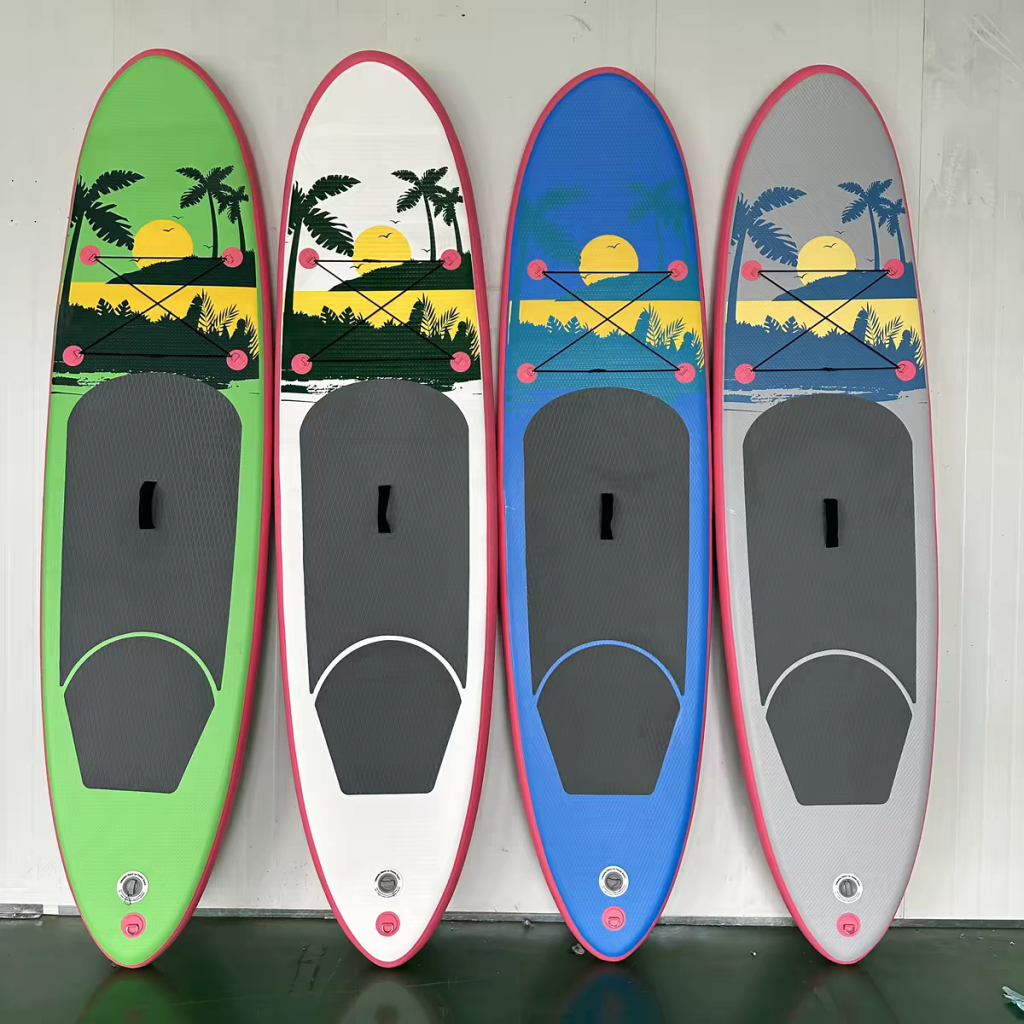
Finding a reliable surfboard manufacturer in China can help distributors, surf shops, sports brands, and private-label businesses reduce production costs while maintaining consistent product quality. However, choosing the right factory is not simply about finding the lowest quotation.
A professional surfboard manufacturer should be able to demonstrate manufacturing experience, stable material sourcing, quality-control procedures, OEM/ODM capabilities, production capacity, packaging solutions, and reliable export experience.
This guide explains what international buyers should check before selecting a Chinese surfboard manufacturer.
Why Choose a Chinese Surfboard Manufacturer?
China has a large manufacturing supply chain for water sports equipment and related products. Buyers can often find factories offering different surfboard constructions, sizes, shapes, colors, accessories, and customization options.
Working directly with a manufacturer can provide several advantages:
- Competitive production costs
- OEM and private-label services
- Custom colors and graphics
- Multiple surfboard constructions
- Flexible packaging options
- Accessories and component sourcing
- Large-volume production capabilities
- Export-oriented packaging
- Custom product development
For established brands, direct factory sourcing can also make it easier to develop a product that matches a specific market position.
However, not every supplier calling itself a “factory” is a genuine manufacturer. This is why proper supplier verification is important.
1. Check the Manufacturer’s Actual Factory Experience
The first step is determining whether the supplier has genuine experience manufacturing surfboards.
Ask the manufacturer:
- How many years have you produced surfboards?
- What types of surfboards do you manufacture?
- What materials and construction methods do you use?
- What is your monthly production capacity?
- Which markets do you export to?
- Can you provide factory photos or videos?
- Can you provide product samples?
A supplier that specializes in surfboards should be able to explain its manufacturing process clearly.
Be cautious if a supplier cannot answer basic technical questions or only provides generic product pictures.
Factory vs. Trading Company
A trading company may still be useful, particularly when you need multiple products from different factories. However, if your main requirement is customized surfboards, working directly with an experienced manufacturer can provide better communication during product development.
A good manufacturer should be transparent about whether it operates its own production facility or works with partner factories.
2. Understand the Different Surfboard Construction Methods
Before comparing manufacturers, understand what type of surfboard you actually need.
Common construction options include:
EPS / Epoxy Surfboards
EPS foam combined with epoxy resin is widely used for lightweight surfboards.
Typical advantages include:
- Lightweight construction
- Good durability
- Good impact resistance
- Suitable for various board designs
- Potentially long service life when properly manufactured
PU / Fiberglass Surfboards
Polyurethane foam with fiberglass and resin is a traditional surfboard construction.
It can provide a different flex and riding feel compared with EPS/epoxy boards.
Soft-Top Surfboards
Soft-top boards generally feature a softer outer surface and are popular for:
- Beginners
- Surf schools
- Rental businesses
- Family use
- Recreational markets
They can be particularly attractive for businesses targeting beginner surfers.
Inflatable Boards
Inflatable products use an entirely different construction method and are often designed around portability and storage.
When contacting a manufacturer, clearly specify the construction you require rather than simply asking for “a surfboard.”
3. Ask About OEM and Private Label Services
If you are building your own surf brand, OEM capability is one of the most important factors.
A reliable manufacturer may provide customization such as:
- Brand logo
- Board graphics
- Colors
- Board dimensions
- Board shape
- Materials
- Packaging
- Accessories
- Labels
- User manuals
- Product stickers
For private-label orders, ask the factory whether it can produce products according to your artwork or technical specifications.
You should also confirm:
MOQ → Sample → Prototype → Production → Inspection → Packaging → Shipment
A clear production process reduces misunderstandings later.
4. Request a Sample Before Placing a Large Order
Never rely only on product photographs when evaluating a new manufacturer.
A physical sample allows you to evaluate:
- Surface finish
- Board weight
- Dimensions
- Shape consistency
- Lamination quality
- Paint quality
- Graphics
- Fin installation
- Rails
- Deck construction
- Accessories
- Packaging
For customized products, you should ideally request a customized sample or prototype.
A sample is particularly important when you are ordering for a new brand because small manufacturing differences can become significant when multiplied across hundreds of units.
5. Evaluate Material Quality
The quality of a surfboard depends heavily on its materials and construction.
Ask the manufacturer for detailed specifications covering:
- Foam core
- Resin
- Fiberglass
- Deck material
- Bottom material
- Fins
- Leash
- Handles
- Valves, if applicable
- Protective layers
Do not simply ask, “Is the material good?”
Instead, request measurable specifications.
For example, you could ask:
What is the foam density?
What fiberglass specification is used?
What type of resin is used?
What is the finished board weight?
What is the recommended rider weight?
Specific technical information makes it easier to compare suppliers objectively.
6. Check Quality Control Procedures
A professional manufacturer should have a defined quality-control process.
Quality inspection may occur at different stages:
Incoming Material Inspection
Materials should be checked before entering production.
Production Inspection
Workers or quality-control personnel should monitor construction during manufacturing.
Finished Product Inspection
Completed boards should be inspected for defects before packaging.
Important inspection points can include:
- Dimensions
- Weight
- Surface finish
- Lamination
- Graphic alignment
- Structural defects
- Accessories
- Packaging condition
For large orders, international buyers can also arrange third-party inspection before shipment.
7. Compare Prices Correctly
Price is important, but comparing only the unit price can lead to incorrect purchasing decisions.
For example, two suppliers may quote different prices because their products use different:
- Materials
- Foam densities
- Resin systems
- Fiberglass specifications
- Accessories
- Packaging
- Printing methods
- Quality-control standards
Instead of asking only:
“What is your cheapest surfboard?”
Ask for a complete quotation based on the same specifications.
A professional RFQ should include:
- Board type
- Length
- Width
- Thickness
- Construction
- Materials
- Quantity
- Logo requirements
- Packaging
- Accessories
- Delivery terms
- Destination
This makes supplier quotations much easier to compare.
8. Ask About MOQ
Minimum order quantity can vary significantly between manufacturers.
For standard products, the MOQ may be lower because the factory already has existing designs.
For fully customized products, the MOQ may be higher because the manufacturer may need to purchase special materials, produce new molds, prepare custom graphics, or adjust production processes.
Ask the supplier:
- What is the MOQ for standard models?
- What is the MOQ for custom designs?
- Is there a different MOQ for custom colors?
- Is there a separate MOQ for private labeling?
- Can sample orders be accepted?
If you are launching a new brand, a factory offering reasonable sample and small-batch options can reduce your initial inventory risk.
9. Verify Production Capacity
A factory may produce excellent samples but still struggle with large orders.
Before placing a major order, ask about production capacity.
Important questions include:
- Monthly production capacity
- Number of production lines
- Peak-season capacity
- Typical production lead time
- Current production schedule
- Ability to handle repeat orders
For example, if your business needs 1,000 boards every month, a factory that can only comfortably produce 300 units per month may not be suitable.
Capacity should match your long-term purchasing plan.
10. Check Packaging for International Shipping
Surfboards are relatively large products, so packaging deserves special attention.
Ask the manufacturer how the boards are protected during international transportation.
Packaging may include:
- Protective foam
- Plastic bags
- Cardboard protection
- Corner protection
- Individual cartons
- Pallet packaging
- Reinforced export cartons
You should also confirm the packed dimensions.
This is important because freight costs can be affected by both actual weight and package dimensions.
For international orders, always calculate the total landed cost rather than looking only at the factory price.
11. Confirm Export Experience
An experienced export manufacturer should understand the basic requirements of international shipments.
Ask:
- Which countries do you currently export to?
- What export documents can you provide?
- Can you provide commercial invoices and packing lists?
- What shipping terms do you offer?
- Can you work with my freight forwarder?
- Can you provide carton dimensions and weights?
If the supplier regularly exports to your target market, communication about packaging and documentation may be easier.
12. Check Communication and Technical Support
Communication problems can become expensive during customized production.
A reliable manufacturer should respond clearly to questions about:
- Drawings
- Dimensions
- Materials
- Colors
- Logos
- Packaging
- Samples
- Production schedules
- Quality requirements
Pay attention to whether the supplier actually understands your requirements.
A supplier that responds quickly but ignores technical details is not necessarily a good supplier.
Good communication should be accurate, specific, and documented.
13. Look for Long-Term Manufacturing Capability
If you are developing a surfboard brand, do not choose a manufacturer only for your first order.
Consider whether the factory can support you for several years.
Look at:
- Product development
- Consistent quality
- Repeat production
- OEM support
- Private labeling
- Packaging customization
- Spare parts
- New model development
- Production scalability
A long-term manufacturing relationship can be more valuable than saving a small amount on the first order.
Questions to Ask a Surfboard Manufacturer
Before placing an order, you can send the manufacturer a checklist like this:
- Are you a factory or trading company?
- How many years have you manufactured surfboards?
- What surfboard types do you produce?
- What construction methods are available?
- What materials do you use?
- What is your MOQ?
- Can you provide samples?
- Do you offer OEM and private-label production?
- Can you customize board graphics and colors?
- What is your production lead time?
- What is your monthly production capacity?
- What quality-control procedures do you use?
- How do you package surfboards for export?
- Can you provide carton dimensions and weights?
- Which export markets do you currently serve?
A manufacturer that can answer these questions professionally is usually easier to evaluate.
Red Flags When Choosing a Surfboard Manufacturer
Be careful if a supplier:
- Refuses to provide product specifications
- Cannot explain its manufacturing process
- Uses only generic product images
- Gives extremely low prices without specifications
- Changes specifications after quotation
- Cannot provide samples
- Avoids discussing quality control
- Gives unclear production times
- Cannot provide proper export documentation
- Pressures you to place a large order immediately
One red flag does not automatically mean the supplier is unreliable, but several red flags together should encourage additional verification.
How to Compare Three Surfboard Manufacturers
Instead of choosing the cheapest supplier, create a comparison table.
| Factor | Supplier A | Supplier B | Supplier C |
|---|---|---|---|
| Factory experience | ✓ | ✓ | ✓ |
| OEM capability | ✓ | ✓ | — |
| Sample quality | ✓ | ✓ | ✓ |
| Material specification | ✓ | — | ✓ |
| Quality control | ✓ | ✓ | — |
| Production capacity | High | Medium | High |
| MOQ | Low | Medium | High |
| Packaging | Good | Good | Excellent |
| Communication | Excellent | Good | Good |
| Overall suitability | High | Medium | High |
This approach helps buyers make decisions based on total value rather than price alone.
Frequently Asked Questions
How do I find a reliable surfboard manufacturer in China?
Start by identifying manufacturers with relevant product experience. Request company information, product specifications, samples, OEM details, MOQ, production capacity, quality-control information, and export experience. Then compare several suppliers before making a final decision.
Can Chinese surfboard manufacturers provide OEM products?
Yes. Many manufacturers serving international markets can provide OEM or private-label services, including customized colors, graphics, logos, dimensions, packaging, and accessories. The exact customization options and MOQ vary by manufacturer.
What is the MOQ for custom surfboards?
There is no universal MOQ. Standard products may have lower MOQs, while fully customized products can require larger quantities because of special materials, graphics, molds, or production setup costs.
Should I order a sample before a bulk order?
Yes. A sample allows you to evaluate the construction, materials, finish, dimensions, weight, accessories, and packaging before committing to a larger purchase.
How long does surfboard production take?
Production time depends on the model, quantity, customization, materials, factory workload, and season. A simple standard order may have a shorter lead time than a fully customized OEM project. Always obtain a written production schedule before placing an order.
How can I reduce the risk of importing surfboards from China?
Use detailed product specifications, verify the manufacturer, order samples, confirm quality requirements in writing, inspect bulk production, verify packaging, and use appropriate shipping and payment terms.
Final Checklist
Before selecting a Chinese surfboard manufacturer, make sure you have confirmed:
✓ Manufacturer experience
✓ Product construction
✓ Material specifications
✓ Sample quality
✓ OEM/ODM capability
✓ MOQ
✓ Production capacity
✓ Quality-control process
✓ Packaging
✓ Export experience
✓ Production lead time
✓ Total landed cost
The best surfboard manufacturer is not necessarily the supplier offering the lowest quotation. The right partner should provide a combination of consistent quality, competitive pricing, customization capability, reliable production, professional communication, and dependable export support.
For new buyers, the safest approach is to start with a clearly specified sample, evaluate the product and manufacturing process, and then move to a controlled bulk order. This allows you to build confidence in the supplier before committing to larger production volumes.


No reply content