
How to Choose an EV Charger Manufacturer in China
Choosing the right EV charger manufacturer in China is an important step for importers, distributors, charging operators, property developers, and businesses planning electric vehicle charging projects. China has a large manufacturing base for AC EV chargers and DC fast charging stations, but suppliers can differ significantly in product specifications, customization capability, certifications, production capacity, and export experience.
A good supplier should not only offer a competitive product price. Buyers should also evaluate technical compatibility, quality control, OEM/ODM capability, documentation, minimum order quantity, lead time, and after-sales support.
This guide explains the key factors international buyers should check before selecting a China EV charger manufacturer.
1. Determine the Type of EV Charger You Need
The first step is to determine whether your project requires an AC charger or a DC fast charger.
AC wall-mounted chargers are commonly used for residential, workplace, hotel, apartment, and commercial applications. Typical power ratings include 7kW, 11kW, and 22kW.
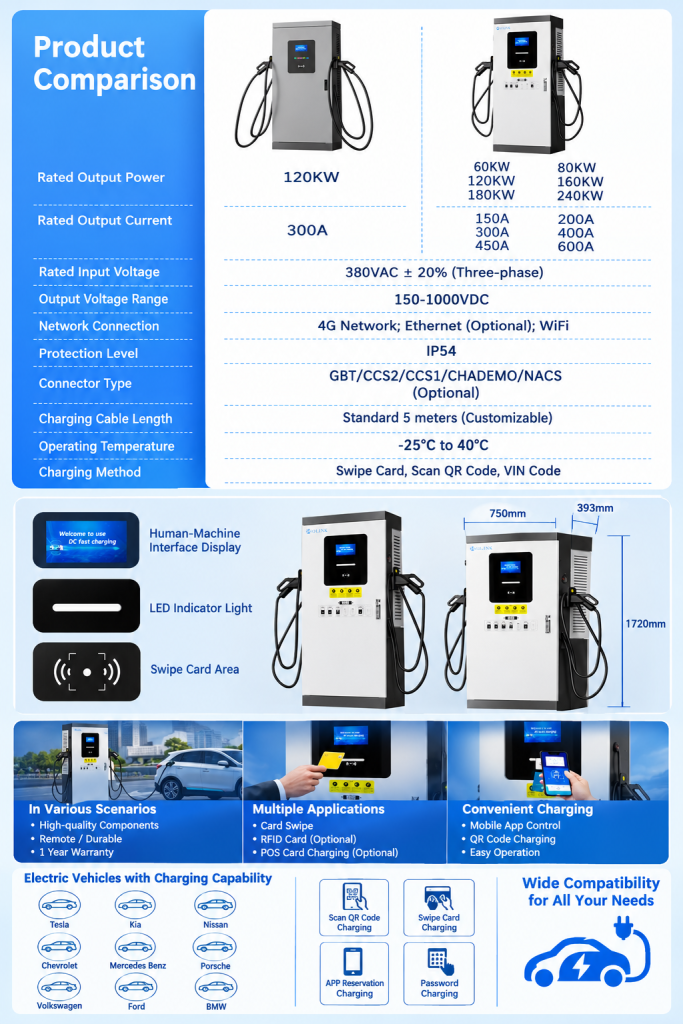
DC fast chargers are designed for applications where vehicles need to charge more quickly. Commercial charging stations, fleet operators, highway charging locations, and public charging networks may require DC chargers ranging from approximately 30kW to 360kW.
Before contacting manufacturers, define:
- Required charging power
- Number of charging points
- Installation environment
- Indoor or outdoor installation
- Single-phase or three-phase power supply
- Required charging connector
- Communication requirements
- Target country and market
Having these specifications ready makes it easier to compare different suppliers.
2. Check the Manufacturer’s Product Range
A reliable EV charger supplier should clearly explain its product range instead of simply listing “EV chargers.”
Ask the manufacturer for detailed technical specifications, including:
- Rated power
- Input voltage
- Output voltage
- Maximum output current
- Charging connector
- Cable length
- IP protection rating
- Operating temperature
- Display and user interface
- Communication interfaces
- Network connectivity
- OCPP compatibility
- Safety protection functions
For large projects, it is also useful to ask whether the manufacturer can provide different power configurations within the same product family.
For example, a supplier may offer AC chargers from 7kW to 22kW and DC fast chargers from 30kW to 360kW. The exact configuration should always be confirmed for the specific model being purchased.
3. Check Charging Connectors and Market Compatibility
Charging connector requirements can vary between markets and vehicle applications.
Depending on the destination market and project requirements, buyers may need different connector configurations, such as CCS or other applicable standards.
Do not select a charger based only on its charging power. Confirm that the charger is compatible with the vehicles, electrical system, and charging infrastructure in the target market.
A professional manufacturer should be able to provide the applicable connector options and technical documentation for the selected model.
4. Evaluate OCPP and Communication Functions
For commercial charging projects, communication capability can be just as important as charging power.
OCPP, or Open Charge Point Protocol, is commonly used to allow charging stations to communicate with a central management system.
Before placing an order, buyers should ask:
- Which OCPP version is supported?
- Is the charger compatible with third-party charging platforms?
- What communication methods are available?
- Does the charger support Ethernet, Wi-Fi, 4G, or other communication options?
- Can firmware be updated remotely?
- Can charging data be monitored remotely?
The correct requirements depend on the buyer’s charging management platform and project design.
5. Review Certifications and Compliance
International buyers should check the certifications and compliance requirements applicable to the destination market.
For example, a manufacturer may provide CE certification for applicable products. However, certification requirements can vary according to the product model, electrical system, destination country, and intended application.
Before ordering, ask the supplier for:
- Applicable certificates
- Test reports
- Product datasheets
- Safety documentation
- User manuals
- Declaration of conformity, where applicable
Do not assume that one certification automatically satisfies every country’s requirements.
6. Check OEM and ODM Capabilities
If you are purchasing EV chargers under your own brand, OEM and ODM capability should be evaluated before selecting a supplier.
Potential customization options may include:
- Company logo
- Product labels
- Housing color
- Packaging
- User interface
- Product appearance
- Charging cable configuration
- Software or communication requirements
- Product documentation
Ask the manufacturer which customizations are standard and which require additional engineering work or minimum order quantities.
For distributors and charging operators, it is also useful to request a sample before starting a large OEM order.
7. Evaluate Manufacturing and Quality Control
A supplier’s manufacturing capability is another important consideration.
Buyers should try to understand:
- Where the products are manufactured
- Production capacity
- Assembly processes
- Quality inspection procedures
- Electrical safety testing
- Finished-product testing
- Packaging procedures
- Quality-control documentation
If possible, request current factory and production photos or arrange a factory inspection.
For large orders, buyers should also clarify how defective products are handled and what warranty and after-sales procedures are available.
8. Confirm MOQ, Lead Time, and Payment Terms
Commercial terms should be confirmed before placing an order.
Important items include:
MOQ: The minimum order quantity may vary according to the model, specifications, customization requirements, and total order volume.
Typical Lead Time: Production time depends on the selected model, order quantity, customization requirements, and production schedule.
Payment Terms: Payment methods and payment schedules should be confirmed directly with the supplier according to the order and project requirements.
Do not compare suppliers only by unit price. A lower product price may not represent a lower total procurement cost if the supplier has higher customization costs, longer lead times, or different shipping and packaging requirements.
9. Ask for a Complete Quotation
A professional RFQ should include enough information for the manufacturer to provide an accurate quotation.
When requesting a quote, provide:
- Product model
- Charging power
- Quantity
- Connector requirements
- OEM requirements
- Packaging requirements
- Destination country
- Delivery terms
- Required certifications
- Expected delivery schedule
For example:
We are looking for 60kW DC fast chargers for a commercial charging project. Please provide the available model, connector options, technical datasheet, certifications, MOQ, lead time, OEM options, and quotation based on our required quantity.
This is much more effective than simply asking, “How much is an EV charger?”
10. Compare Suppliers Based on Total Value
After receiving quotations from several Chinese manufacturers, compare more than the unit price.
Consider:
- Product specifications
- Certifications
- Manufacturing capability
- Quality control
- OEM/ODM support
- MOQ
- Lead time
- Warranty
- Technical support
- Packaging
- Communication capability
- Export experience
- Total landed cost
The cheapest supplier is not necessarily the best supplier for an international EV charging project.
11. Request Samples or Technical Documents Before Bulk Orders
For a new supplier relationship, buyers should consider requesting a sample or detailed technical documentation before committing to a large order.
A sample can help verify:
- Product appearance
- Build quality
- Connector configuration
- Display and user interface
- Installation method
- Communication functions
- Packaging
- Basic charging performance
For larger commercial projects, technical testing and compatibility checks should be completed before mass production whenever practical.
12. Build a Long-Term Supplier Relationship
EV charging equipment is not simply a one-time commodity purchase. Long-term projects may require replacement units, spare parts, software support, firmware updates, technical assistance, and additional production.
A manufacturer that can communicate clearly and support future orders can be more valuable than a supplier offering only a low initial quotation.
For international buyers, the ideal supplier should be able to understand the project’s technical requirements and provide consistent products as the order volume increases.
Frequently Asked Questions
What types of EV chargers can I source from China?
Chinese manufacturers supply various AC and DC EV charging products. Common categories include AC wall-mounted chargers and DC fast charging stations. Available power ratings and configurations depend on the manufacturer and specific product model.
How do I choose between an AC and DC EV charger?
AC chargers are commonly suitable for residential, workplace, hotel, apartment, and longer-duration charging. DC fast chargers are generally more suitable for commercial, fleet, highway, and public charging applications where faster charging is required.
Can Chinese EV charger manufacturers provide OEM services?
Many manufacturers offer OEM or ODM services. Available customization can include branding, packaging, product appearance, charging configuration, and other technical requirements. Buyers should confirm customization options and MOQ with the manufacturer.
What information should I provide when requesting an EV charger quotation?
Provide the required power, quantity, connector type, destination market, certification requirements, OEM requirements, packaging requirements, and preferred delivery terms. More complete information generally allows the manufacturer to provide a more accurate quotation.
What should I check before placing a bulk EV charger order?
Check the product specifications, applicable certifications, quality-control procedures, OEM capability, MOQ, lead time, warranty, payment terms, technical documentation, and after-sales support. For larger projects, consider testing samples before mass production.
Can I request an EV charger quotation from a China manufacturer?
Yes. Buyers can contact the supplier with their required charging power, quantity, destination market, connector configuration, and customization requirements to request a project-specific quotation.
Request an EV Charger Quote
If you are sourcing AC EV chargers or DC fast charging stations from China, prepare your product specifications and project requirements before contacting a manufacturer.
For supplier information and procurement inquiries, visit:
China EV Charging Station Manufacturer
You can provide the required charging power, quantity, connector type, destination market, OEM requirements, and delivery requirements so the supplier can evaluate your project and provide the appropriate product information and quotation.


No reply content