
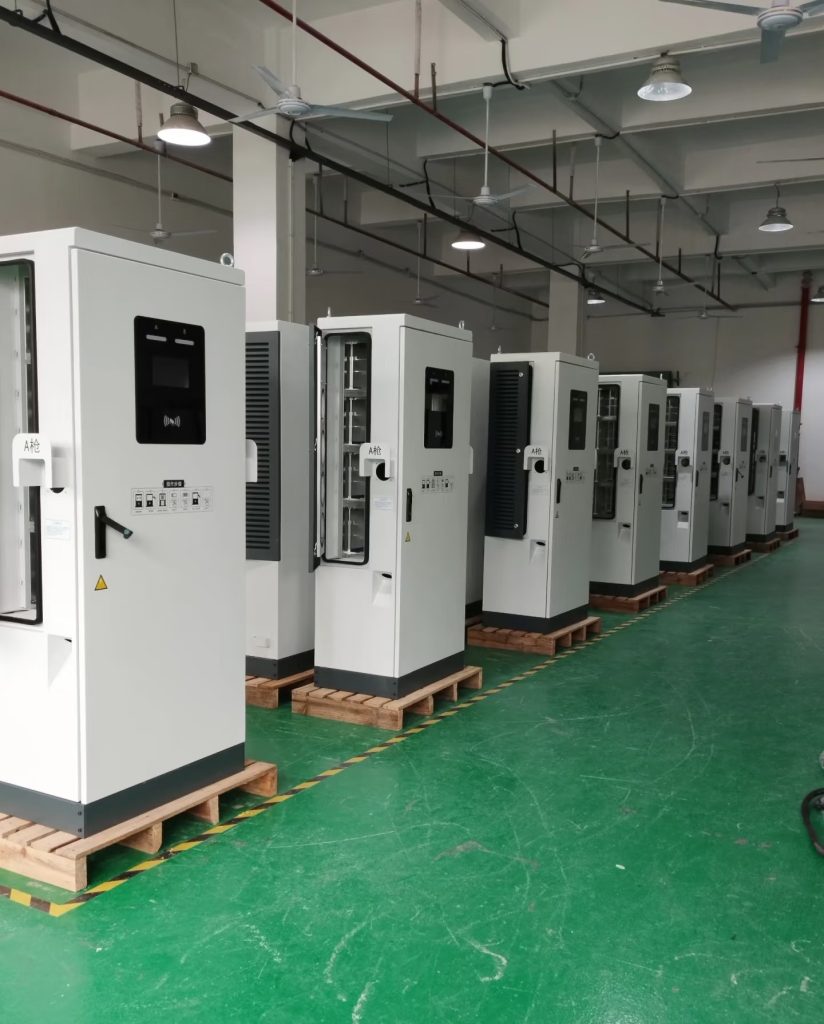
How to Choose the Right AC EV Charger for Home and Commercial Use
Choosing the right AC EV charger requires more than comparing charging power and prices. Homeowners, property developers, commercial operators, EV charging companies, distributors, and importers need to consider electrical capacity, charging speed, connector compatibility, installation conditions, safety features, communication functions, and the requirements of the target market.
For buyers sourcing AC EV chargers from China, understanding these factors before placing an order can help avoid specification problems and improve the efficiency of supplier selection.
1. Understand What an AC EV Charger Does
An AC EV charger supplies alternating current to an electric vehicle. The vehicle’s onboard charger then converts the AC electricity into DC power used by the battery.
AC chargers are commonly used where vehicles remain parked for several hours, including:
- Residential garages
- Apartment buildings
- Offices
- Hotels
- Shopping centers
- Commercial parking facilities
- Company parking areas
- Fleet parking locations
The appropriate charger depends on the vehicle, electrical system, installation environment, and expected charging demand.
2. Choose the Appropriate Charging Power
Charging power is one of the first specifications buyers should confirm.
Common AC EV charger power levels include:
- 3.7 kW
- 7 kW
- 11 kW
- 22 kW
A 7 kW charger can be suitable for many residential applications, while 11 kW and 22 kW chargers may be more suitable for locations with compatible three-phase electrical infrastructure.
However, a higher-rated charger does not automatically mean that every vehicle will charge at that power.
The actual charging speed can be limited by the vehicle’s onboard charger, electrical supply, cable configuration, and other system limitations.
3. Check the Electrical Supply
Before selecting an AC EV charger, buyers should confirm the available electrical supply.
Important information includes:
- Single-phase or three-phase power
- Input voltage
- Frequency
- Available current
- Electrical capacity
- Installation location
- Existing electrical protection
For example, a project designed for a higher-power three-phase charger may require a different electrical installation from a residential single-phase charging point.
International buyers should provide the manufacturer with the electrical requirements of the destination market before confirming the final product specification.
4. Check the Charging Connector
Connector compatibility is another critical consideration.
The required connector can depend on the destination market, vehicle models, and charging standard.
When requesting a quotation, buyers should clearly specify whether they require a particular connector configuration, cable length, socket configuration, or other charging-interface requirements.
Do not assume that two chargers with the same power rating use the same connector.
For distributors and importers, connector configuration should be confirmed before purchasing because changing the configuration after production may not be practical.
5. Consider Installation Type
AC EV chargers can be designed for different installation environments.
Common installation options include:
Wall-mounted chargers
Wall-mounted units are suitable for homes, garages, offices and other locations where a suitable wall is available.
Floor-mounted charging stations
These can be useful for parking lots, commercial facilities and locations where wall mounting is not practical.
Portable AC chargers
Portable solutions can be useful for users who need greater flexibility between different charging locations.
The installation method should be considered together with cable routing, electrical protection, available space and environmental conditions.
6. Indoor and Outdoor Installation Requirements
An outdoor EV charger needs to withstand environmental conditions such as rain, dust, temperature changes and sunlight.
When purchasing chargers for outdoor projects, buyers should confirm the manufacturer’s stated environmental protection rating and operating-temperature range.
Other considerations may include:
- Enclosure construction
- Cable protection
- Connector protection
- Water resistance
- Dust resistance
- Operating temperature
- Ventilation requirements
The actual requirements depend on the installation location and local regulations.
7. Look at Safety and Protection Functions
Safety functions are particularly important for EV charging equipment.
Depending on the product design and target market, buyers may need to consider functions such as:
- Overcurrent protection
- Overvoltage protection
- Undervoltage protection
- Overtemperature protection
- Leakage protection
- Short-circuit protection
- Ground protection
- Surge protection
The exact protection configuration should be confirmed from the manufacturer’s technical documentation rather than assumed from the product name.
8. Decide Whether You Need Smart Charging Functions
Not every project requires a basic standalone charger.
Commercial and networked charging projects may require additional functions such as:
- Wi-Fi
- Ethernet
- 4G
- Bluetooth
- RFID
- Mobile application control
- Remote monitoring
- Charging records
- User authentication
- Load management
If the charger will be integrated into a charging network, the buyer should confirm communication protocols and software compatibility before ordering.
9. Consider Load Management for Multiple Chargers
A single charger and a multi-charger project have different requirements.
For apartment buildings, offices, commercial parking lots, and fleet facilities, several chargers may operate at the same time.
If the available electrical capacity is limited, a load-management system may help distribute available power among multiple charging points.
Buyers should therefore tell the manufacturer how many charging units will be installed and whether simultaneous charging is expected.
10. Evaluate the Manufacturer Before Ordering
When sourcing AC EV chargers from China, buyers should evaluate the manufacturer rather than selecting a supplier based only on product photographs.
Useful questions include:
- What AC charger models are currently produced?
- What charging power levels are available?
- Which connector configurations are supported?
- What electrical input options are available?
- What testing procedures are used?
- What certifications and technical documents are available?
- Can the manufacturer provide samples?
- Is OEM branding available?
- Can packaging be customized?
- What is the warranty policy?
- What is the production lead time?
A detailed technical discussion before ordering can help identify whether the supplier is suitable for the project.
11. Request a Sample Before a Large Order
For distributors and commercial buyers, ordering a sample before mass production is usually a practical step.
The sample can be checked for:
- Appearance
- Housing quality
- Cable quality
- Connector configuration
- Charging performance
- Display operation
- Communication functions
- Protection functions
- Installation method
- Packaging
If the sample is approved, the buyer should keep the approved specification as the reference for mass production.
12. Compare Suppliers Using the Same Specification
When comparing several China AC EV charger manufacturers, send the same technical requirements to each supplier.
For example, the RFQ can specify:
Product: AC EV Charger
Power: 7 kW / 11 kW / 22 kW
Input: Required voltage and phase
Connector: Required configuration
Quantity: Required order quantity
Installation: Wall-mounted or floor-mounted
Communication: Required functions
Certification: Requirements for destination market
Branding: OEM or standard product
Packaging: Standard or customized
Destination: Import country or region
This makes supplier quotations much easier to compare.
Frequently Asked Questions
Is a 22 kW AC charger always faster than a 7 kW charger?
Not necessarily. The actual charging speed can be limited by the vehicle’s onboard charger and the available electrical supply.
Which AC charger is suitable for home use?
A suitable power rating depends on the home’s electrical capacity, vehicle requirements, installation conditions, and local regulations. Many residential projects use lower-power AC charging solutions, but the exact specification should be confirmed before installation.
Are AC EV chargers suitable for commercial projects?
Yes. AC chargers can be used in offices, hotels, apartment buildings, commercial parking areas, fleet facilities and other locations where vehicles remain parked for longer periods.
Should I request a sample before buying AC EV chargers in bulk?
For a new supplier or large project, a sample can help verify the actual product specification, construction quality, charging functions, connector configuration and other requirements before mass production.
What should I provide when requesting an AC EV charger quotation from China?
Provide the required power, electrical input, connector configuration, quantity, destination market, installation type, communication requirements, certification requirements and OEM requirements if applicable.
Conclusion
Choosing an AC EV charger should begin with the application and electrical requirements rather than the product price alone.
International buyers should evaluate charging power, electrical supply, connector compatibility, installation environment, protection functions, communication features, certification requirements, OEM capabilities, sample quality, and supplier reliability.
For wholesale and commercial projects, using a standardized specification when comparing China EV charger manufacturers can make the purchasing process more efficient and reduce the risk of receiving products that do not match the project’s requirements.


No reply content