
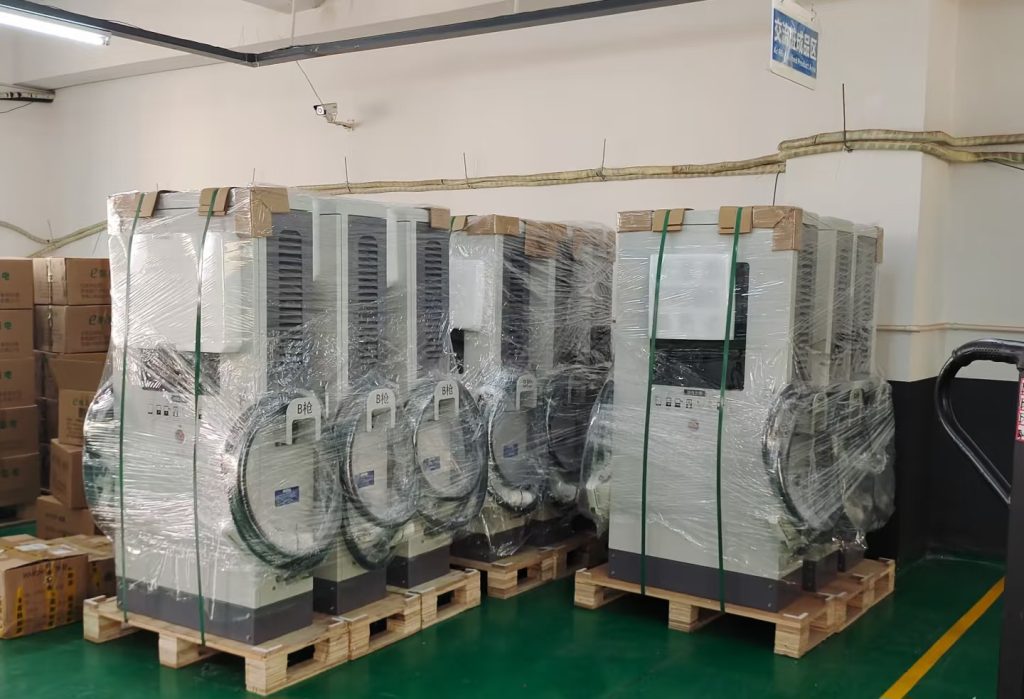
Choosing the right China EV charger manufacturer is a critical step for importers, distributors, charging operators, and companies planning commercial or fleet charging projects. A low quotation alone does not guarantee a successful project. EV charging equipment involves technical specifications, safety standards, certification requirements, production quality, and long-term after-sales support.
Before placing a large order, buyers should evaluate manufacturers using clear and consistent criteria. This guide outlines the key points international buyers should check.
### 1. Confirm the Supplier Is a Real Manufacturer
Not every company selling EV chargers operates its own factory. For bulk or OEM projects, it is important to verify the actual manufacturing capability.
Buyers can ask about:
– Factory location and size
– Main production equipment
– Production capacity (monthly and peak)
– Engineering and R&D team
– Quality control process
– Experience with export orders
A reliable manufacturer should be able to clearly explain product structure, component sourcing, and testing procedures.
### 2. Define Clear Product Requirements First
Before requesting quotations, prepare a detailed specification. This helps ensure all suppliers quote on the same basis.
Typical requirements include:
– AC or DC charging
– Power rating (e.g., 7kW, 11kW, 22kW, 60kW, 120kW+)
– Input voltage and frequency
– Output voltage and current range
– Connector type (Type 2, CCS2, CCS1, GB/T, etc.)
– Cable length
– Communication protocol (OCPP version)
– Network options (Ethernet, Wi-Fi, 4G)
– Enclosure rating (IP54, IP65, etc.)
– Operating temperature range
– Certification requirements for the target market
– OEM or branding needs
– Order quantity
Without a clear specification, price comparisons become misleading.
### 3. Compare Technical Specifications Carefully
Do not rely only on product titles or marketing claims. Review the actual datasheet for each model.
For AC chargers, check:
– Rated power
– Input phase (single-phase or three-phase)
– Protection functions
– Display and user interface
– Smart features
For DC fast chargers, additionally review:
– Output voltage range
– Maximum output current
– Power distribution method
– Cooling system
– Number of connectors
– Noise level
– Installation requirements
### 4. Verify Certification Documents
Certification requirements differ by market. Always inform the manufacturer of the destination country before finalizing the quotation.
Request:
– Relevant certificates
– Test reports
– Technical datasheets
– User manuals
– Installation guides
Confirm that the documents match the exact product model and configuration being ordered. A certificate for one model does not automatically cover all products from the same factory.
### 5. Evaluate Quality Control Processes
Quality consistency is especially important for bulk orders. Ask the manufacturer about their quality control stages, such as:
– Incoming material inspection
– In-process assembly checks
– Functional testing of finished units
– Final inspection before packing
– Aging or burn-in tests (if applicable)
For larger projects, buyers may also arrange third-party pre-shipment inspection.
### 6. Request and Test Samples
A physical sample is one of the most effective ways to evaluate a new supplier. When testing a sample, check:
– Build quality and housing materials
– Cable and connector quality
– Display and interface
– Charging performance
– Communication functions
– Packaging quality
The approved sample should serve as the reference standard for mass production.
### 7. Assess OEM and Customization Capability
Many buyers need private-label or customized solutions. Clarify which options are available:
– Logo and branding
– Custom labels and packaging
– Color options
– Cable and connector configuration
– Software or firmware adjustments
– User interface modifications
More advanced ODM projects may involve structural or functional design changes. Confirm the additional cost and lead time for customization.
### 8. Check Production Capacity and Lead Time
A manufacturer suitable for small trial orders may not be able to support large or recurring projects. Ask about:
– Current production capacity
– Peak capacity
– Typical lead time for standard and OEM orders
– Component supply stability
– Ability to scale production
Discuss production planning early for large orders.
### 9. Review Warranty and After-Sales Support
EV chargers are long-term infrastructure. Confirm:
– Warranty period and coverage
– Spare parts availability
– Remote technical support
– Response process for faults
– Software update support
– Support for overseas installations
Clear after-sales terms reduce operational risk after the equipment is installed.
### 10. Compare Total Project Cost, Not Just Unit Price
The lowest unit price is not always the most economical choice. Consider the complete cost, including:
– Product price
– Customization fees
– Packaging
– Testing and inspection
– Spare parts
– Inland and international logistics
– Potential installation or support costs
A slightly higher unit price with better quality, certification, and support often results in lower total cost over the project life cycle.
### 11. Evaluate Communication Quality
Good communication is essential for international projects. Observe whether the manufacturer can:
– Answer technical questions accurately
– Provide clear documents
– Respond within a reasonable time
– Explain production and quality processes
– Handle English communication professionally
Accurate technical communication is more important than simply fast replies.
### Frequently Asked Questions
**How many manufacturers should I compare?**
Comparing several qualified manufacturers using the same specification gives a clearer view of market options, pricing, and capability differences.
**Is the cheapest quotation always the best?**
Not necessarily. A lower price may reflect different specifications, components, certification levels, or support conditions.
**Should I visit the factory?**
For large or long-term projects, a factory visit or third-party audit can provide additional confidence. For smaller orders, samples, documents, and inspection reports are often sufficient.
**What is the most important factor when choosing a manufacturer?**
There is no single factor. Product suitability, quality control, certification, production capacity, communication, and total cost should be evaluated together.
### Conclusion
Evaluating a China EV charger manufacturer requires more than comparing prices. A structured approach that covers technical capability, quality systems, certification, production capacity, and after-sales support helps buyers reduce risk and select a reliable long-term partner.
When the technical and commercial requirements are clearly defined and compared on the same basis, the selection process becomes more objective and the final project outcome more predictable.


No reply content