
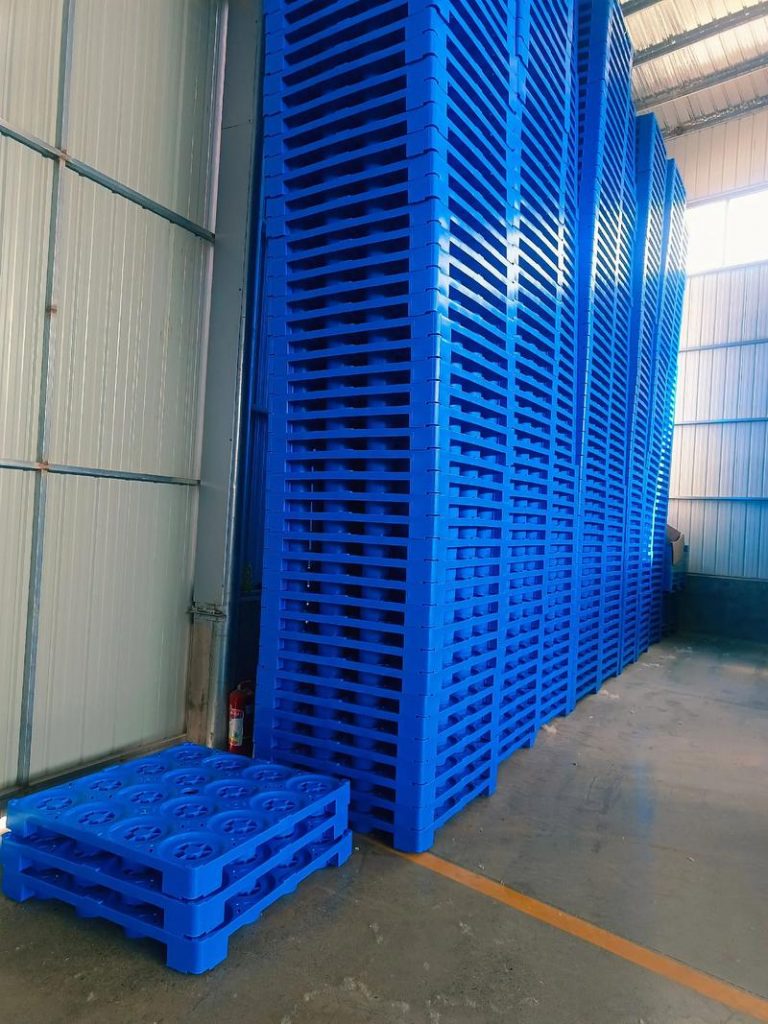
Importing plastic pallets from China can be a practical option for distributors, warehouse operators, manufacturers, logistics companies, and businesses that require pallets in large quantities.
However, a successful import order involves more than finding a supplier and negotiating a unit price. Buyers need to confirm the pallet specification, supplier capability, minimum order quantity, quality requirements, production schedule, container loading, shipping terms, and destination requirements before placing the order.
This guide explains the main steps involved in sourcing plastic pallets from China.
1. Define Your Plastic Pallet Requirements
Before contacting suppliers, prepare a clear product specification.
At minimum, identify:
- Pallet length
- Pallet width
- Pallet height
- Pallet weight
- Material
- Dynamic load
- Static load
- Racking load
- Deck design
- Bottom design
- Fork entry
- Color
- Quantity
- Application
- Destination
For example, instead of asking:
I need plastic pallets. Please send me your price.
A better inquiry would specify:
We need 1200×1000 mm plastic pallets for warehouse use, with a required dynamic load of [requirement], static load of [requirement], quantity of [quantity], and delivery to [destination].
This gives the manufacturer enough information to recommend an appropriate model.
2. Find Suitable Plastic Pallet Suppliers
There are several ways to identify Chinese suppliers.
You can search using product-specific terms such as:
- Plastic pallet manufacturer China
- 1200×1000 plastic pallet factory
- Heavy duty plastic pallet China
- Plastic pallet wholesale supplier
- Custom plastic pallet manufacturer
The more specific the search, the easier it is to identify suppliers that actually offer the required product.
Do not immediately select a supplier based on search position, product photos, or the lowest displayed price.
The next step is supplier verification.
3. Check Whether the Supplier Is a Manufacturer
If you specifically want to buy directly from a factory, ask the supplier whether it manufactures the pallets itself.
Questions can include:
- Where is the production facility?
- Which pallet models are manufactured?
- What production equipment is available?
- Can the factory produce the required quantity?
- Can the factory provide samples?
- Does the factory support customization?
- Does the factory handle export orders?
A supplier’s ability to provide clear technical information can also help you understand its familiarity with the product.
4. Understand MOQ
MOQ means Minimum Order Quantity.
There is no universal MOQ for all plastic pallets.
It can depend on:
- Standard or customized product
- Existing mold
- Production capacity
- Material
- Color
- Order quantity
- Customer requirements
If you are testing a new supplier, ask whether a smaller trial order is possible.
If you plan to purchase regularly, provide an estimated monthly or annual quantity.
A supplier can then evaluate the project based on both the initial order and potential repeat demand.
5. Request a Sample
A sample is useful when purchasing from a new supplier.
The sample can be checked for:
- Dimensions
- Weight
- Appearance
- Material information
- Fork entry
- Stacking
- Deck design
- Bottom structure
- Compatibility with warehouse equipment
If the pallet will be used for racking or automated handling, compatibility should be checked before the bulk order.
A sample should represent the specification that will be used for mass production.
6. Confirm Load Capacity
Never select a plastic pallet based only on the word “heavy duty.”
Ask the manufacturer for the actual load ratings.
Dynamic Load
This is relevant when the pallet is being moved with handling equipment.
Static Load
This refers to the load supported while the pallet remains stationary under the specified conditions.
Racking Load
This applies when pallets are placed on warehouse rack systems under specified support conditions.
These three ratings should be treated separately.
The required capacity depends on the cargo, handling method, support conditions, and storage system.
7. Confirm the Material
Plastic pallets may be produced using different plastic materials and formulations.
Common materials include PP and HDPE.
Ask the supplier:
- What material is used?
- Is recycled material included?
- Is the material consistent between production batches?
- Is the material suitable for the intended environment?
- Does the product specification identify the material clearly?
Material selection should be based on the application rather than simply choosing the lowest-cost option.
8. Compare Suppliers Using the Same Specification
When requesting multiple quotations, give every supplier the same information.
For example:
| Item | Required Specification |
|---|---|
| Size | 1200×1000 mm |
| Quantity | [Quantity] |
| Material | [PP/HDPE] |
| Dynamic Load | [Requirement] |
| Static Load | [Requirement] |
| Racking Load | [Requirement] |
| Color | [Color] |
| Logo | [Yes/No] |
| Application | [Application] |
| Destination | [Port/City/Country] |
| Trade Term | [EXW/FOB/CIF] |
This makes the quotations easier to compare.
Comparing only the unit prices can be misleading if the pallet weights and specifications are different.
9. Check Production Lead Time
Before placing an order, ask the supplier how long production will take.
Confirm:
- Production start date
- Estimated completion date
- Sample approval requirements
- Mold requirements
- Inspection schedule
- Container loading date
If a product requires a new mold, ask about mold development time before confirming the final delivery schedule.
10. Discuss Quality Inspection
Quality requirements should be agreed before mass production.
Depending on the project, buyers may inspect:
- Dimensions
- Weight
- Appearance
- Color
- Material
- Quantity
- Load performance
- Structural condition
- Logo or markings
For large orders, buyers can discuss whether an independent inspection should be arranged before shipment.
The inspection criteria should be based on the agreed product specification.
11. Confirm Container Loading
Plastic pallets are relatively large products, so container utilization matters.
Ask the supplier:
How many pallets can be loaded into the selected container?
Also ask about:
- Pallet stacking height
- Nesting capability
- Loading arrangement
- Number of pallets per stack
- Container type
- Loading photos
The exact loading quantity depends on the pallet model.
Do not assume that a loading quantity for another pallet model will apply to your order.
12. Choose the Shipping Term
Common international trade terms include EXW, FOB, and CIF.
EXW
The buyer generally arranges transportation from the agreed factory location.
FOB
The supplier handles the agreed export-side obligations up to the named port under the agreed FOB terms.
CIF
The quotation includes the goods, insurance, and freight to the named destination port under the agreed CIF terms.
The responsibilities and costs should be confirmed in the commercial documents.
13. Calculate the Total Import Cost
The factory price is not necessarily the final cost.
A buyer may need to consider:
Product cost
-
Export-related costs
-
International freight
-
Insurance where applicable
-
Import duties
-
Taxes
-
Destination charges
-
Local transportation
The actual charges vary by country and shipment.
For this reason, buyers should calculate the total landed cost before deciding which quotation provides the most suitable purchasing arrangement.
14. Confirm Export Documents
Before shipment, ask the supplier and freight provider which documents will be provided.
Depending on the transaction and destination, documents may include:
- Commercial invoice
- Packing list
- Bill of lading
- Certificate of origin where required
- Product information
- Other destination-specific documents
Import requirements vary by country.
The importer should verify local customs requirements before shipment rather than assuming that every destination follows the same procedure.
15. Confirm Packaging and Loading Requirements
Plastic pallets generally have different packaging and stacking characteristics from smaller products.
Before production, confirm:
- Whether individual packaging is required
- Whether pallets can be stacked
- Whether they can be nested
- How the pallets will be secured
- How the container will be loaded
- Whether loading photos can be provided
For large shipments, the loading arrangement should be agreed before the goods are ready.
16. Confirm Customization Before Production
If you need a company logo, special color, special dimensions, or structural modifications, confirm these requirements before production begins.
Customization may affect:
- Unit price
- MOQ
- Mold cost
- Production time
- Sample approval
- Final appearance
If a new mold is required, clarify who owns the mold and what happens if future orders stop.
17. Avoid Choosing a Supplier Based Only on Price
Price is important, but it should be evaluated together with the product specification.
For example, Supplier A may offer a lower price because its pallet is lighter.
Supplier B may offer a higher price because its pallet has a different structure or higher load capacity.
The two quotations may therefore represent different products.
A proper comparison should include:
- Weight
- Material
- Load capacity
- Structure
- Quantity
- MOQ
- Lead time
- Container loading
- Trade term
- Destination cost
18. A Practical Plastic Pallet Import Process
A typical purchasing process can be organized as follows:
Step 1: Define your requirements.
Step 2: Find potential manufacturers.
Step 3: Request technical specifications.
Step 4: Compare supplier information.
Step 5: Request samples if necessary.
Step 6: Confirm the final specification.
Step 7: Negotiate price and commercial terms.
Step 8: Confirm the purchase order.
Step 9: Begin production.
Step 10: Conduct inspection if required.
Step 11: Load the container.
Step 12: Arrange international shipment.
Step 13: Complete destination import procedures.
Step 14: Receive the pallets.
Having a defined process makes the purchasing project easier to manage.
Plastic Pallet Import RFQ Template
You can send the following information to a Chinese manufacturer:
We are looking to import plastic pallets from China.
Product size: 1200×1000 mm
Quantity: [quantity]
Application: [warehouse/export/manufacturing/logistics]
Material: [PP/HDPE/preferred material]
Dynamic load: [requirement]
Static load: [requirement]
Racking load: [requirement]
Color: [color]
Logo: [yes/no]
Destination port: [port]
Preferred term: [EXW/FOB/CIF]Please provide the complete product specification, pallet weight, MOQ, sample availability, unit price, production lead time, container loading quantity, and shipping quotation.
A detailed RFQ can significantly reduce repeated questions during the quotation process.
FAQ
What is the MOQ when importing plastic pallets from China?
MOQ varies by manufacturer and product model. Standard products may have different requirements from customized pallets.
Should I order a sample before a bulk order?
For a new supplier, a sample can help verify the product specification and compatibility with your application before mass production.
How do I check a plastic pallet manufacturer’s quality?
Review the product specification, request samples, ask about production and quality-control procedures, and consider an independent inspection for larger orders.
What information is needed for a plastic pallet quotation?
Provide the dimensions, quantity, material, load requirements, application, customization, destination, and preferred shipping term.
How much does shipping affect plastic pallet imports?
Because pallets are relatively large, container utilization can have a significant effect on the transportation cost per unit.
Can I import customized plastic pallets?
Depending on the supplier, customization may include color, logo, dimensions, and structural design. Some modifications require new tooling.
What should I check before paying for a bulk order?
Confirm the supplier, product specification, agreed quantity, price, payment terms, production schedule, inspection requirements, shipping terms, and destination requirements.
Request a Plastic Pallet Import Quotation
If you are planning to import plastic pallets from China, send your requirements before requesting a final quotation.
Include:
- Pallet dimensions
- Quantity
- Material
- Pallet weight
- Dynamic load
- Static load
- Racking load
- Application
- Color
- Logo requirements
- Destination
- Shipping term
A complete RFQ gives the manufacturer a clearer understanding of your project and makes it easier to prepare a product and shipping quotation.
Send your plastic pallet requirements to start a China factory quotation.


No reply content