
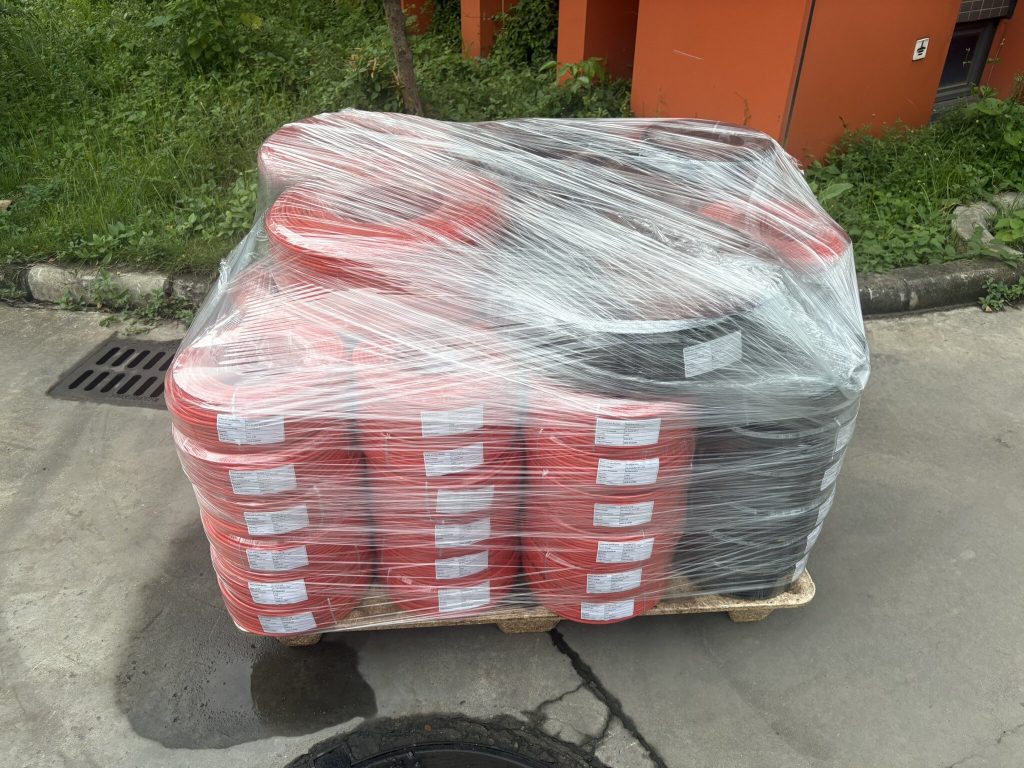
How to Request a Sample from a Chinese Cable Manufacturer
A sample is often the first physical evidence an overseas buyer receives from a Chinese cable manufacturer.
But a sample is more useful when it is treated as part of the purchasing process rather than simply a piece of wire sent by courier.
For a buyer considering a large copper wire order, the sample should answer several practical questions:
Does the product match the requested specification?
Is the conductor construction what the manufacturer described?
Does the insulation and marking match the quotation?
Can the factory reproduce the approved sample in mass production?
And, perhaps most importantly, has the buyer clearly defined what is being approved?
A short piece of cable cannot answer every quality question. However, a properly requested and documented sample can eliminate many misunderstandings before a large production order begins.
1. Do Not Ask for a Sample Without Giving a Specification
A message such as:
“Please send me a copper wire sample.”
does not give the manufacturer enough information.
There are many types of copper wire.
The factory needs to know what you actually want to evaluate.
A useful sample request should include information such as:
- Product type
- Conductor material
- Cross-sectional area
- Conductor construction
- Voltage rating
- Insulation material
- Color
- Applicable standard
- Approximate sample length
- Printing requirements
- Intended application
For example:
We are evaluating a 2.5 mm² single-core PVC-insulated copper wire for building applications. Please provide a sample with the proposed production construction, including the standard conductor and insulation specification.
This is much more useful than simply requesting “2.5 mm copper wire.”
2. Tell the Manufacturer That the Sample Is for Evaluation
The supplier should understand why you are requesting the sample.
There is a difference between:
a marketing sample
and
a pre-production sample for a commercial order.
If the sample is intended to support a future bulk purchase, tell the manufacturer.
For example:
This sample will be evaluated before we place a larger production order. Please make it representative of the proposed mass-production specification.
That sentence changes the context of the sample.
The supplier understands that the sample is not merely promotional material.
3. Ask Whether the Sample Is From Normal Production
This is one of the most important questions.
Ask:
Is the sample made using the same materials and production process that will be used for the bulk order?
A factory may have different grades, constructions or production methods available.
If the sample is produced specifically for demonstration while the bulk order uses a different construction, the evaluation becomes less useful.
For a serious purchase, the buyer should try to approve a sample that represents the actual production configuration.
4. Decide How Much Sample You Actually Need
More sample is not necessarily better.
For a simple visual and dimensional evaluation, a relatively short sample may be sufficient.
For laboratory testing, however, the required length may be much greater.
The required amount depends on what the buyer plans to test.
Possible purposes include:
- Visual inspection
- Conductor construction inspection
- Dimensional measurement
- Electrical testing
- Insulation testing
- Installation testing
- Laboratory analysis
Tell the manufacturer why you need the sample.
If a third-party laboratory requires a specific sample length, provide that requirement before shipment.
5. Ask for the Sample’s Product Information
A sample should not arrive as an unidentified piece of wire.
Ask the supplier to identify:
- Product name
- Size
- Voltage rating
- Standard
- Conductor type
- Color
- Manufacturer
- Production or sample reference
If the manufacturer uses a product code, ask for the code.
This becomes particularly important if you receive samples from several factories.
After a few weeks, it can be surprisingly difficult to remember which sample belongs to which quotation if nothing is labeled.
6. Photograph the Sample Before Testing It
When the sample arrives, take photographs.
Record:
- Outer appearance
- Printing
- Color
- Packaging
- Label
- Reel or coil
- Product code
- Supplier reference
Keep the photographs together with the supplier’s quotation and technical datasheet.
This creates a basic record of what was actually received.
For larger purchasing projects, this documentation can become useful when comparing the eventual production shipment.
7. Compare the Sample With the Quotation
Do not evaluate the sample separately from the commercial documents.
Put the following information side by side:
| Item | Quotation | Sample | Match? |
|---|---|---|---|
| Product | |||
| Size | |||
| Conductor | |||
| Insulation | |||
| Voltage | |||
| Standard | |||
| Color | |||
| Printing | |||
| Packaging |
This simple comparison can reveal discrepancies quickly.
For example, the quotation may specify one conductor construction while the sample appears to use another.
If something does not match, ask the manufacturer before proceeding.
8. Look at the Conductor, Not Just the Insulation
The outside of an insulated wire tells you only part of the story.
If practical and appropriate, examine a cut end of the sample.
Depending on the product, you may be able to observe:
- Solid or stranded construction
- Number of strands
- Approximate strand arrangement
- Conductor appearance
- Insulation thickness
- Conductor centering
Do not use visual appearance alone to determine copper purity or compliance.
For technical purchasing, laboratory or factory test data is much more meaningful than simply looking at whether copper “looks good.”
9. Measure the Sample if You Have the Right Equipment
A buyer can perform basic dimensional checks if suitable measuring equipment is available.
Potential checks include:
- Overall diameter
- Conductor diameter
- Insulation dimensions
- Reel length
- Weight
For more precise verification, use appropriate laboratory or inspection equipment.
The objective is not to turn every buyer into a cable-testing laboratory.
The objective is to identify obvious discrepancies before approving a large production order.
10. Check Conductor Resistance When It Matters
Electrical resistance is an important characteristic of a conductor.
For a technical purchase, the manufacturer should be able to provide the relevant resistance specification and test information.
If the project requires independent verification, a qualified laboratory or inspection company can perform the appropriate test.
Do not assume that a conductor is acceptable simply because:
- It is copper-colored
- It has the correct printed size
- It feels heavy
- The supplier says it is high purity
Copper purity, conductor dimensions, construction and electrical resistance are different aspects of product evaluation.
11. Check the Insulation
The insulation should be evaluated according to the agreed product specification.
Depending on the wire type, relevant characteristics may include:
- Material
- Thickness
- Color
- Surface quality
- Voltage rating
- Electrical performance
- Mechanical properties
A visual inspection can identify obvious problems such as scratches, bubbles or inconsistent surfaces.
However, visual inspection alone cannot establish full compliance with a technical standard.
If compliance is important to the project, use the appropriate testing method.
12. Check the Printing Carefully
Printing is easy to overlook because it does not affect the basic appearance of the wire very much.
But for OEM products and regulated markets, marking can be important.
Check:
- Manufacturer name
- Product designation
- Size
- Voltage
- Standard reference
- Certification marks where legitimately applicable
- Printing clarity
- Printing interval
If the buyer has requested private-label printing, compare the sample against the approved artwork.
Do not approve a sample with the understanding that the factory will “fix the printing later” unless the final artwork is formally documented.
13. Ask for a Technical Datasheet Along With the Sample
A physical sample without technical information has limited value.
Ask the manufacturer to provide a datasheet containing the relevant specifications.
Depending on the product, this may include:
- Conductor construction
- Nominal cross-sectional area
- Insulation material
- Insulation thickness
- Overall diameter
- Rated voltage
- Electrical resistance
- Temperature information
- Applicable standard
- Product weight
The exact information depends on the product.
The buyer can then compare the physical sample against the declared specifications.
14. Check Which Standard the Sample Is Supposed to Meet
A product name alone is not always enough.
For example, buyers may encounter designations such as:
- BV
- BVR
- H07V-U
- H07V-K
These designations relate to different product constructions and standards.
The buyer should identify the exact standard that applies to the product being purchased.
IEC 60227-1:2024 specifies general requirements for PVC-insulated cables with rated voltages up to and including 450/750 V within its scope, while individual parts of the IEC 60227 series cover particular cable types.
If your order depends on a specific standard, ask the manufacturer to state the applicable standard clearly in the quotation and technical documentation.
15. Ask Whether the Sample Has Been Tested
A manufacturer may already have internal test data for the product.
Ask:
Was this sample produced and tested under your normal quality-control process?
If the factory has a test report for the relevant production batch, ask whether it can be provided.
For a new supplier, this can provide additional information before a large purchase.
However, a factory test report should not automatically be treated as an independent certification.
If the project requires third-party verification, arrange testing or inspection accordingly.
16. Consider Third-Party Testing for Important Orders
For a small trial order, internal supplier documentation may be sufficient for an initial evaluation.
For a large project, regulated application or high-value contract, independent testing may be appropriate.
A third-party laboratory can test characteristics according to the relevant specification.
This can be particularly useful when:
- The order value is high
- The destination has strict requirements
- The product is customized
- The buyer has never worked with the supplier
- The product will be resold under the buyer’s brand
The exact testing scope should be determined from the applicable standard and project requirements.
17. Keep an Approved Sample
Once the buyer approves a sample, do not throw it away.
Keep it as a reference.
For a recurring supply relationship, the approved sample can be identified as:
Approved Sample — Product X — Revision 01
Record:
- Date
- Supplier
- Product code
- Specification
- Sample reference
- Approval status
- Any agreed deviations
The physical sample can then be retained by the buyer.
This is particularly useful when the same product is ordered months later.
18. Do Not Let the Sample Approval Remain Verbal
One of the easiest ways to create a future dispute is:
“We approved the sample.”
What exactly was approved?
The color?
The conductor?
The printing?
The packaging?
The full technical specification?
Instead, send a written confirmation.
For example:
We approve the attached sample for the 2.5 mm² single-core copper wire, subject to the agreed technical specification and quotation. Mass production should follow the same approved construction, material and marking requirements.
The exact wording should reflect the actual agreement.
19. Connect the Approved Sample to the Purchase Order
The sample should not exist separately from the purchase contract.
Where practical, the purchase order should identify:
- Product code
- Technical specification
- Standard
- Approved sample reference
- Color
- Packaging
- Quantity
- Inspection requirements
This creates a connection between:
sample → specification → purchase order → production → inspection
That chain is much more useful than keeping the sample as an informal reference.
20. Ask How the Factory Controls Production Consistency
Once the sample has been approved, the next question is:
How will the manufacturer make sure mass production matches it?
Ask about:
- Production batch control
- Raw-material control
- Process inspection
- Finished-product testing
- Printing verification
- Packaging inspection
The sample itself does not guarantee that every later batch will be identical.
The manufacturer’s quality-control system is what makes consistency possible.
21. Be Careful With “Free Samples”
A free sample can be useful, but the word “free” should not determine supplier selection.
Some manufacturers offer free samples because they are actively seeking new customers.
Others charge for the product but refund the sample cost after a bulk order.
Some custom samples may have material or tooling costs.
Ask:
- Is the sample free?
- Who pays shipping?
- Is the sample made to the requested specification?
- Is the sample charge refundable?
- How long will sample production take?
The commercial terms matter less than whether the sample is representative.
22. Shipping the Sample From China
When requesting a sample, provide the manufacturer with the correct delivery information.
Depending on the courier and destination, the supplier may need:
- Recipient name
- Company name
- Full address
- Postal code
- Phone number
- Email address
For international samples, the supplier may also need a description of the goods for shipping documentation.
The description should accurately reflect what is being shipped.
23. Sample Cost Should Be Compared With the Order Risk
Suppose a potential bulk order is worth USD 20,000.
Spending a relatively small amount on a proper sample and testing process can provide useful information before committing to production.
The sample is therefore not simply an expense.
It is part of supplier evaluation.
For high-value purchases, the buyer should consider the cost of:
- Sample
- Courier
- Testing
- Inspection
against the potential cost of receiving a non-conforming production shipment.
24. Ask for Several Samples When Comparing Manufacturers
If you are comparing three manufacturers, use the same specification for each.
For example:
2.5 mm² single-core copper wire
Same:
- Conductor specification
- Insulation
- Voltage
- Color
- Standard
- Sample length
Then compare them using the same checklist.
This creates a more meaningful comparison.
Do not request one supplier’s premium product and another supplier’s standard product and then treat the samples as equivalent.
25. A Sample Request You Can Send to a Chinese Manufacturer
The following information is usually enough to begin a professional sample request:
Product: Single-core copper wire
Size: 2.5 mm²
Conductor: Please confirm construction
Insulation: PVC
Voltage rating: Please quote according to the requested standard
Color: Blue
Quantity: Sample required for evaluation
Application: Building electrical installation
Standard: Please confirm applicable standard
Printing: Standard factory marking
Please provide the technical datasheet, sample cost, shipping cost, production lead time and applicable test information.
For a custom product, add the required brand, printing, packaging and other specifications.
A Practical Sample Inspection Checklist
When the sample arrives, work through the following list.
Product identity
- [ ] Supplier identified
- [ ] Product code recorded
- [ ] Size confirmed
- [ ] Color confirmed
- [ ] Standard confirmed
- [ ] Voltage rating confirmed
Physical inspection
- [ ] Outer surface checked
- [ ] Printing checked
- [ ] Conductor construction checked
- [ ] Insulation checked
- [ ] Dimensions checked where appropriate
- [ ] Packaging checked
Documentation
- [ ] Technical datasheet received
- [ ] Test information received
- [ ] Applicable certification identified
- [ ] Sample reference recorded
Commercial approval
- [ ] Sample matches quotation
- [ ] Sample matches RFQ
- [ ] Mass-production specification confirmed
- [ ] Approved sample reference created
- [ ] Purchase-order requirements prepared
Common Mistakes When Requesting Cable Samples
Mistake 1: Asking for “the cheapest sample”
The cheapest sample may not represent the product you eventually want to buy.
Define the specification first.
Mistake 2: Testing only the appearance
A wire can look excellent while failing a technical requirement.
Use the appropriate testing method for the application.
Mistake 3: Approving a sample without recording the specification
Months later, nobody may remember exactly what was approved.
Keep a written record.
Mistake 4: Changing the specification after sample approval
If the conductor, color, insulation or printing changes, treat it as a new revision and evaluate it again when necessary.
Mistake 5: Assuming the sample guarantees mass-production quality
It does not.
Production controls and inspection are still important.
Frequently Asked Questions
How long should a copper wire sample be?
There is no universal length. It depends on whether the buyer only needs visual evaluation or intends to perform dimensional, electrical or laboratory testing. Ask the testing laboratory or inspection provider for the required quantity when formal testing is planned.
Should I pay for a cable sample from China?
It depends on the supplier and product. Standard samples may sometimes be offered at no product charge, while custom samples can involve material, production or courier costs.
Can I request samples from several Chinese manufacturers?
Yes. Using the same specification for every supplier makes the samples much easier to compare.
Should the sample be made on the same production line as the bulk order?
For serious purchasing, it is useful to ask the manufacturer whether the sample represents the same materials and production process intended for mass production.
What should I do after approving the sample?
Record the approved sample and connect it to the technical specification and purchase order. For larger orders, define inspection and testing requirements before production begins.
Can I use a sample to prove compliance with an IEC standard?
A sample alone does not establish full compliance. Compliance depends on the applicable requirements, testing and certification arrangements. Use the relevant standard and appropriate testing process for the product and market.
What if the sample does not match the quotation?
Ask the supplier to explain the discrepancy before approving the product. Do not assume that the bulk production will automatically follow the quotation.
Final Thoughts
A cable sample is more valuable when it becomes a documented reference point.
The strongest process is not:
request sample → look at it → say yes.
It is:
define specification → request representative sample → inspect → test when necessary → document approval → connect the sample to the purchase order → control mass production.
That process gives an international buyer much more confidence when moving from a small sample to a large order.
For buyers sourcing copper wire from China, the most useful sample is not necessarily the most attractive piece of wire.
It is the sample that clearly represents the exact product the manufacturer has agreed to produce for the buyer’s commercial order.


No reply content