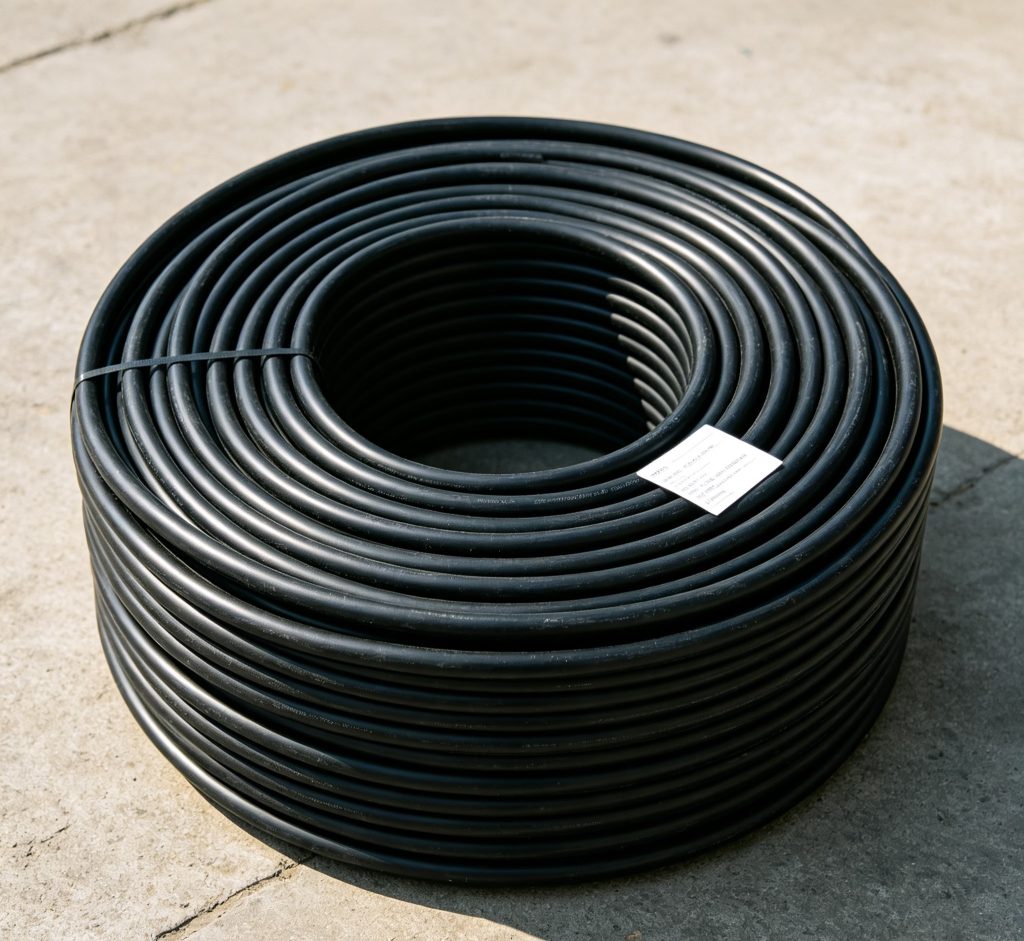
When buying electrical wire from China, many importers focus first on conductor size, copper content, voltage rating and price.
However, the insulation material is equally important.
The conductor carries the electrical current, while the insulation protects the conductor, separates it from other conductive parts and helps determine where the cable can be installed and how it can be used.
For common building wire such as BV, 60227 IEC 01 and H07V-U, PVC is widely used as the insulation material. But PVC is not the only insulation option available for electrical cables.
Depending on the project, buyers may encounter:
- PVC
- XLPE
- PE
- LSZH / LSZH compounds
- Rubber-based insulation
- Other specialty insulation materials
The correct material depends on the electrical, thermal, mechanical, environmental and fire-performance requirements of the project.
This guide explains how PVC compares with other cable insulation materials and what international buyers should check before ordering electrical wire from a Chinese manufacturer.
What Is Cable Insulation?
Cable insulation is the non-conductive material surrounding the electrical conductor.
For a typical single-core building wire, the basic structure is:
Copper conductor → PVC insulation
For a more complex cable, there may be several layers:
Conductor → conductor screen → insulation → inner sheath → armor → outer sheath
The insulation system can affect:
- Rated voltage
- Operating temperature
- Flexibility
- Mechanical performance
- Moisture resistance
- Chemical resistance
- Fire performance
- Installation environment
- Cable diameter
- Cost
Therefore, “copper wire” is not a complete product specification.
The buyer must also identify the required insulation material and construction.
Why Is PVC So Common for Building Wire?
PVC, or polyvinyl chloride, is widely used for electrical insulation because it offers a practical combination of electrical insulation, processing characteristics, mechanical protection and cost.
For standard building-wire applications, PVC can provide a good balance between:
- Electrical insulation
- Abrasion resistance
- Moisture resistance
- Manufacturing efficiency
- Color availability
- Cost
- General installation performance
The current Author 88 product range includes single-core copper PVC building wire under BV / 60227 IEC 01 and H07V-U, rated 450/750V and intended for fixed installations such as conduit, trunking and building wiring.
This makes PVC particularly relevant to residential, commercial and general fixed-wiring projects.
What Is PVC Insulated Building Wire?
PVC insulated building wire normally consists of a copper conductor covered by a PVC insulation layer.
A typical product specification might look like:
2.5 mm² single-core copper conductor + PVC insulation + 450/750V rating
The exact product may then be identified by a standard or designation such as:
- BV
- 60227 IEC 01
- H07V-U
- H07V-R
- BVR
- H07V-K
These designations should not be treated as interchangeable names.
The conductor construction, standard and application must be checked.
For example, the Author 88 wholesale product information distinguishes BV / 60227 IEC 01, H07V-U, H07V-R and BVR / H07V-K according to conductor construction and application.
PVC vs XLPE: What Is the Difference?
PVC and XLPE are two very different insulation materials.
PVC
PVC is widely used for conventional building wire and many general-purpose cables.
Advantages can include:
- Cost-effective
- Easy to process
- Widely available
- Good electrical insulation
- Good abrasion resistance
- Wide range of colors
- Suitable for many common building applications
Limitations can include:
- Lower temperature capability than many XLPE systems
- Some PVC formulations can have limitations in demanding environments
- Standard PVC is not automatically LSZH
- Standard PVC building wire is not automatically suitable for direct burial or outdoor exposure
XLPE
XLPE means cross-linked polyethylene.
It is widely used where higher thermal performance and different electrical properties are required.
Potential advantages include:
- Higher continuous conductor temperature capability in many cable designs
- Good electrical insulation properties
- Suitable for many power-cable applications
- Useful for higher-load and more demanding cable systems
However, XLPE cables can be more expensive and may use a more complex cable construction.
Therefore, a buyer should not replace PVC with XLPE simply because XLPE sounds more advanced.
The material must match the actual project requirement.
PVC vs LSZH
Another common comparison is PVC versus LSZH.
LSZH means Low Smoke Zero Halogen.
LSZH materials are designed to produce low levels of smoke and avoid halogen-containing combustion products under specified fire conditions.
This can be important in environments where smoke and corrosive gases are major safety concerns.
Potential applications include:
- Public buildings
- Transportation facilities
- Data centers
- Certain commercial buildings
- Tunnels
- Areas with strict fire-safety specifications
However, LSZH is not simply a premium version of ordinary PVC.
It is a different material requirement.
If a project specification says LSZH, a standard PVC building wire should not be substituted without approval.
The existing Author 88 10mm² BV product information specifically distinguishes standard PVC from separate flame-retardant, low-smoke and LSZH variants.
PVC vs PE
PE means polyethylene.
Polyethylene has excellent electrical insulation properties and is used in various cable constructions.
It can be found in:
- Communication cables
- Power cables
- Specialty cables
- Outdoor cable constructions
- Cable layers where moisture resistance is important
However, PE is not automatically a substitute for PVC building-wire insulation.
The correct choice depends on the cable design, voltage, temperature, mechanical requirements and applicable standard.
For a simple 450/750V fixed building-wire project, PVC may be the specified material.
For another cable application, PE or another material may be more appropriate.
PVC vs Rubber Insulation
Rubber-based insulation is commonly associated with applications requiring flexibility, mechanical durability or special environmental performance.
Depending on the formulation, rubber-insulated cables can be used for:
- Flexible equipment connections
- Construction equipment
- Industrial machinery
- Portable electrical equipment
- Temporary power applications
- Applications involving repeated movement
This is quite different from standard rigid building wire.
For example, ordinary BV / H07V-U is designed around fixed-installation applications, while flexible cable constructions are selected where greater movement or flexibility is required.
The Author 88 wholesale product information distinguishes rigid BV/H07V-U products from flexible BVR/H07V-K configurations.
A Simple Comparison of Common Insulation Materials
| Material | Typical Strength | Common Applications | Main Buyer Consideration |
|---|---|---|---|
| PVC | Cost-effective general-purpose insulation | Building wire, control wiring, general cables | Standard PVC may not satisfy special fire/environmental requirements |
| XLPE | Higher thermal performance in many cable designs | Power cables, demanding installations | Higher specification and potentially higher cost |
| LSZH | Low smoke and low-halogen fire performance | Public buildings, transport, data facilities | Must meet the specified LSZH standard |
| PE | Strong electrical insulation and moisture-related performance | Communication and specialty cables | Product construction varies significantly |
| Rubber | Flexibility and mechanical performance | Flexible industrial/equipment cables | Usually selected for applications requiring movement or durability |
This table is only a purchasing overview.
The actual specification must come from the project’s applicable standard.
Does a More Expensive Insulation Mean a Better Cable?
Not necessarily.
A cable should be evaluated against the requirements of its intended application.
For example:
A standard indoor building-wire project may specify PVC.
Replacing it with a more expensive material may add cost without providing a useful benefit.
On the other hand, if a project requires:
- High operating temperature
- Low smoke
- Low halogen
- Outdoor exposure
- Chemical resistance
- Continuous flexing
- Special fire performance
then ordinary PVC may not meet the requirement.
The correct material is therefore the one that satisfies the project specification.
What Does 70°C PVC Mean?
Many standard PVC building-wire products use a 70°C normal conductor operating temperature.
The Author 88 product information lists standard PVC building wire with a 70°C normal conductor temperature.
This does not mean the entire cable can be installed in a 70°C environment without considering other factors.
The conductor temperature depends on:
- Current
- Ambient temperature
- Installation method
- Heat dissipation
- Number of loaded conductors
- Conduit conditions
- Grouping
- Voltage drop
- Applicable electrical code
Therefore, buyers should distinguish between:
Conductor operating temperature
and:
Ambient installation temperature
They are not the same thing.
Why Insulation Thickness Matters
The insulation material alone does not determine cable performance.
Insulation thickness is also important.
For example, the Author 88 product information gives different nominal PVC insulation thicknesses according to conductor size. The 10mm² BV product lists a nominal insulation thickness of approximately 1.0mm.
When comparing two factories, buyers should therefore request:
- Insulation material
- Nominal insulation thickness
- Minimum insulation thickness
- Finished cable diameter
- Voltage test
- Insulation resistance
- Applicable standard
A supplier offering a lower price should not be evaluated only by the price per meter.
The complete construction needs to be compared.
How Insulation Affects Cable Diameter
The conductor size is only one part of the finished cable diameter.
A simplified structure is:
Conductor diameter + insulation thickness = approximate finished diameter
If the insulation thickness changes, the finished cable diameter can also change.
This can affect:
- Conduit fill
- Cable routing
- Packaging
- Drum capacity
- Installation
- Weight per kilometer
For projects involving large quantities, even small dimensional differences can affect logistics and installation.
How Insulation Affects Cable Weight
Copper normally accounts for a significant portion of the weight of electrical wire, but insulation also contributes to total cable weight.
The final weight depends on:
- Copper cross-section
- Copper density
- Insulation thickness
- Insulation density
- Conductor construction
- Number of cores
- Outer sheath
- Armor, if applicable
This matters for international buyers because cable weight affects:
- Shipping cost
- Container loading
- Drum selection
- Handling
- Freight quotations
For example, the Author 88 product information provides copper-weight and pricing considerations for different single-core wire sizes.
Does PVC Affect Current Carrying Capacity?
Yes, but not in isolation.
Ampacity is determined by the thermal conditions of the complete installation.
Important factors include:
- Conductor size
- Conductor resistance
- Insulation temperature rating
- Ambient temperature
- Installation method
- Number of loaded conductors
- Grouping
- Conduit
- Heat dissipation
For example, the Author 88 PVC building-wire information provides reference ampacity values for common conductor sizes, but also notes that actual allowable current depends on installation conditions and local code.
This is why buyers should not say:
“2.5mm² PVC wire always carries 25A.”
A more accurate statement is:
“The allowable current depends on the product specification and installation conditions.”
PVC Insulation and Voltage Rating
PVC insulation can be used across a wide range of cable voltage classes.
For the Author 88 building-wire product discussed in this series, the relevant specification is commonly:
450/750V
This is the rated-voltage designation rather than an indication of a fixed current capacity.
The existing [BV Wire 60227 IEC 01 Manufacturer China | 450/750V Single Core] page provides technical information about the 450/750V single-core PVC-insulated construction.
For buyers, the important point is that:
Voltage rating + conductor size + insulation + standard
must be considered together.
When Is Standard PVC a Good Choice?
Standard PVC building wire can be a practical choice when the project requires:
- Fixed indoor installation
- Conduit or trunking
- Residential wiring
- Commercial building wiring
- Standard electrical panels
- General-purpose circuits
- 450/750V single-core building wire
- Cost-effective production
For these applications, changing to a specialty insulation material may not provide a meaningful benefit.
The existing [PVC Insulated Building Wire Supplier China | BV, H07V-U, 450/750V] page covers this type of fixed-installation product.
When Should You Consider a Different Insulation Material?
A different insulation system may be appropriate when the project requires special performance.
High Temperature
Consider a suitable high-temperature cable construction when the operating temperature exceeds the limits of standard PVC.
Low Smoke
Consider LSZH when the project specification requires low-smoke performance.
Halogen-Free
Consider LSZH or another specified halogen-free material when the project explicitly requires it.
Outdoor Exposure
A cable designed for outdoor exposure may require UV-resistant construction or additional protection.
Underground Installation
Underground cables may require sheathing, water protection or mechanical protection.
Continuous Flexing
A flexible cable construction may be required when the cable moves repeatedly.
Chemical Exposure
Special insulation or sheath materials may be required for environments involving oils, solvents or chemicals.
The key point is to specify the environmental conditions before asking the manufacturer for a price.
Why You Should Not Ask a Factory Only for “PVC Wire”
“PVC wire” is too broad for an international purchase order.
A professional RFQ should specify:
Product: Single-core copper building wire
Conductor: Copper
Conductor class: Solid Class 1
Size: 2.5mm²
Insulation: PVC
Voltage: 450/750V
Standard: IEC 60227-3 / required destination-market standard
Color: Blue
Application: Fixed indoor installation
Packing: 100m coils
Quantity: 20,000m
Destination: Country and port
Certification: Required market documentation
This gives the manufacturer enough information to identify the intended product.
PVC vs XLPE: Which One Should an Importer Choose?
The answer depends on the application.
Choose PVC when:
- The project specifies PVC
- Standard building wiring is required
- The installation is fixed
- Cost efficiency is important
- The operating temperature is within the PVC specification
- No special LSZH requirement exists
Consider XLPE when:
- Higher thermal performance is required
- The cable design specifically calls for XLPE
- The project is a power-cable application
- Higher temperature capability is required
However, the final decision should be based on the project’s electrical design and applicable standard.
PVC vs LSZH: Which One Should an Importer Choose?
Again, the project specification should determine the material.
PVC may be appropriate for:
- Standard building wire
- General fixed wiring
- Conventional conduit installation
- Projects without a special smoke/halogen requirement
LSZH may be required for:
- Certain public facilities
- Transportation infrastructure
- Data facilities
- Projects with strict smoke requirements
- Projects specifically specifying halogen-free cable
Do not assume that changing from PVC to LSZH is simply an upgrade.
It is a change in product specification and should be approved by the project engineer or responsible authority.
How to Compare Insulation Quality Between Chinese Suppliers
When comparing two manufacturers, ask for measurable information.
1. Insulation material
Ask for the exact compound or material designation.
2. Insulation thickness
Request nominal and minimum values where applicable.
3. Finished diameter
Compare actual product dimensions.
4. Insulation resistance
Ask for the applicable test value.
5. Voltage test
Confirm the required test voltage and test procedure.
6. Temperature rating
Confirm the normal operating temperature.
7. Flame performance
If required, specify the exact flame or fire-performance standard.
8. Test report
Ask for factory test records or applicable third-party reports.
This gives the buyer something measurable to compare rather than relying on marketing terms.
How Insulation Changes the Final Price
The insulation material is one component of the final cable cost.
A simplified pricing structure can include:
Copper + insulation compound + extrusion + labor + electricity + testing + packaging + certification + logistics + margin
For ordinary PVC building wire, copper can be a major cost component.
The Author 88 supplier’s wholesale information also explains a copper-index pricing approach for wire quotations.
This is why the price of a PVC building wire can change when copper prices change, even if the PVC formulation remains exactly the same.
For large orders, buyers should ask whether the quotation is:
- Fixed price
- Copper-index linked
- Valid for a limited number of days
- Based on EXW
- Based on FOB
- Based on CIF
This prevents confusion when comparing quotations.
A Practical Supplier Comparison Table
When requesting quotations from several Chinese manufacturers, use a table like this:
| Specification | Supplier A | Supplier B | Supplier C |
|---|---|---|---|
| Conductor | Copper | Copper | Copper |
| Size | 2.5mm² | 2.5mm² | 2.5mm² |
| Conductor class | Class 1 | Class 1 | Class 1 |
| Insulation | PVC | PVC | PVC |
| Voltage | 450/750V | 450/750V | 450/750V |
| Standard | Confirm | Confirm | Confirm |
| Insulation thickness | Confirm | Confirm | Confirm |
| DC resistance | Confirm | Confirm | Confirm |
| Operating temperature | Confirm | Confirm | Confirm |
| Test report | Yes/No | Yes/No | Yes/No |
| Certification | Confirm | Confirm | Confirm |
| Packing | Same | Same | Same |
| MOQ | Confirm | Confirm | Confirm |
| Price | Confirm | Confirm | Confirm |
This approach prevents buyers from comparing technically different products simply because all three suppliers call them “PVC copper wire.”
Special Attention for 10mm² PVC Building Wire
For larger building-wire sizes, insulation and conductor construction become even more important because the finished cable becomes heavier and more difficult to handle.
The existing [PVC Building Wire for House Wiring | 10mm² BV Cable Supply] page identifies 10mm² BV as a single-core copper PVC-insulated 450/750V product and provides specifications such as insulation thickness, finished diameter and DC resistance.
For a 10mm² order, buyers should therefore confirm:
- Solid or stranded conductor
- Conductor class
- Copper resistance
- Insulation thickness
- Finished diameter
- Cable weight
- Coil or drum length
- Installation method
- Required certification
This information is more useful than simply asking for a “cheap 10mm² copper wire.”
Common Mistakes When Choosing Cable Insulation
Mistake 1: Assuming all PVC is identical
Different PVC compounds can have different technical properties.
Mistake 2: Choosing only by price
A lower quotation may use a different construction or specification.
Mistake 3: Assuming LSZH is always necessary
LSZH should be used when required by the application or specification.
Mistake 4: Treating PVC and XLPE as direct substitutes
They have different thermal and application characteristics.
Mistake 5: Ignoring the environment
Indoor fixed wiring and outdoor/underground installations can require very different cable constructions.
Mistake 6: Not specifying the standard
The product name alone may not define the complete technical requirement.
Mistake 7: Not checking insulation thickness
Two cables with the same conductor size can have different finished dimensions and insulation constructions.
FAQ
Is PVC a good insulation material for electrical wire?
PVC is widely used for electrical insulation and is suitable for many general-purpose building-wire applications. Whether it is appropriate depends on the project’s voltage, temperature, environment, fire requirements and applicable standard.
Is PVC better than XLPE?
Neither is universally better. PVC is widely used for conventional building-wire applications, while XLPE is used in many cable designs where higher thermal performance is required.
Is PVC better than LSZH?
They serve different requirements. Standard PVC can be appropriate for conventional wiring, while LSZH is selected where low-smoke and low-halogen performance is required.
What is the main advantage of PVC insulated wire?
PVC offers a practical combination of electrical insulation, mechanical protection, manufacturing efficiency, color availability and cost for many common applications.
Can PVC insulated wire be used outdoors?
Not automatically. Standard building wire may require conduit or other protection. Outdoor applications can require UV resistance, sheathing or a different cable construction.
Can PVC insulated wire be buried underground?
The PVC insulation itself does not make ordinary building wire suitable for direct burial. Underground installations may require suitable conduit, sheathing, armor or another approved cable construction.
What temperature is standard PVC building wire rated for?
Many standard PVC building-wire products use a 70°C normal conductor operating temperature, but the exact rating must be confirmed from the applicable product standard and manufacturer specification.
Is 450/750V related to PVC insulation?
450/750V is a rated-voltage designation. PVC is the insulation material. They describe different parts of the cable specification.
What is the difference between PVC and XLPE insulation?
PVC is widely used for general-purpose building and control applications, while XLPE is commonly used in cable designs requiring higher thermal performance and other specific electrical characteristics.
What does LSZH mean?
LSZH means Low Smoke Zero Halogen. It describes a cable material/construction designed to limit smoke and halogen-related combustion products under specified fire conditions.
What should I ask a Chinese cable manufacturer about insulation?
Ask for the exact insulation material, thickness, temperature rating, finished diameter, insulation resistance, voltage test, applicable standard, fire performance where required, certification and test reports.
How to Choose the Right Insulation for Your Project
The correct insulation material should be selected in this order:
1. Identify the application
Is the cable for residential wiring, commercial construction, industrial equipment, panels, outdoor installation or underground use?
2. Identify the electrical requirements
Confirm voltage, conductor size, current and temperature.
3. Identify the environmental conditions
Check moisture, UV, chemicals, mechanical stress and temperature.
4. Identify fire requirements
Determine whether standard PVC, flame-retardant PVC, LSZH or another construction is required.
5. Identify the applicable standard
Confirm the standard required by the destination country and project.
6. Request the technical documents
Ask for specifications, test reports and certification before placing a large order.
7. Compare equivalent products
Only compare prices after confirming that the conductor, insulation, dimensions, standard and certification are equivalent.
Buy PVC Insulated Building Wire from a China Manufacturer
For standard fixed building installations, PVC-insulated copper wire remains an important product category because it combines practical electrical insulation with a relatively efficient manufacturing and purchasing model.
Author 88 currently offers BV / 60227 IEC 01 and H07V-U single-core PVC-insulated copper building wire in the 450/750V class. The existing [PVC Insulated Building Wire Supplier China | BV, H07V-U, 450/750V] page provides product specifications, sizes, conductor information, packing and wholesale details.
Buyers looking for different conductor constructions can also review [Wholesale Single Core Copper Wire Factory | BV H07V-U China], which separates solid BV/H07V-U products from H07V-R and flexible BVR/H07V-K configurations.
For buyers specifically sourcing 10mm² building wire, [PVC Building Wire for House Wiring | 10mm² BV Cable Supply] provides a product-level reference for 450/750V PVC-insulated copper wire.
The most important point is to avoid choosing cable insulation based only on price or the word “PVC.”
Before ordering, confirm:
Conductor + conductor class + insulation material + insulation thickness + voltage + standard + application + certification + packaging.
Once these specifications are fixed, quotations from different Chinese manufacturers become much easier to compare, and the risk of receiving the wrong cable construction is significantly reduced.


No reply content