
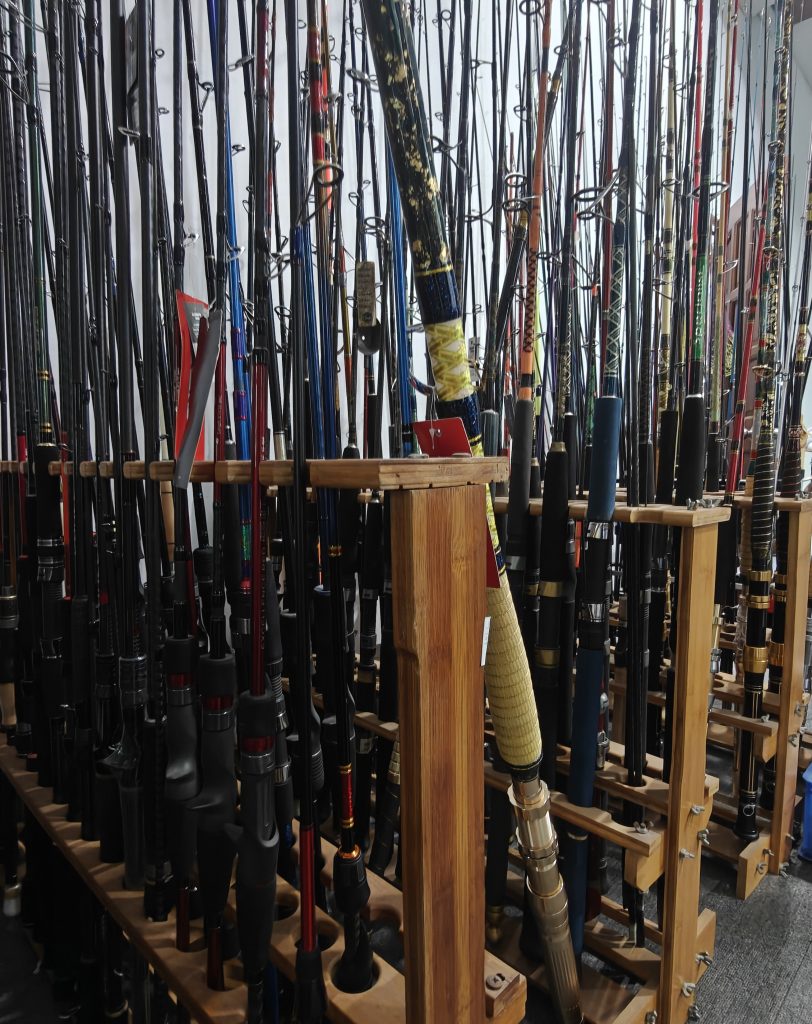
Spinning Rod vs Casting Rod: Key Differences for Buyers and Distributors
Spinning rods and casting rods may look similar in a product catalogue, but they are designed to work with different reel types and fishing setups. For fishing tackle importers, wholesalers, and retailers, understanding this distinction is important when selecting products, preparing product descriptions, and building a range for different customers.
The most visible difference is the reel compatibility. A spinning rod is designed for use with a spinning reel, while a casting rod is designed for a baitcasting reel. Their guide arrangements, reel-seat designs, and typical handling characteristics reflect these different setups.
Neither type is universally suitable for every angler or fishing method. The right choice depends on the target customer, fishing technique, product specifications, and market demand.
1. What Is a Spinning Rod?
A spinning rod is designed to be paired with a spinning reel. In a typical setup, the reel is mounted underneath the rod, and the line passes through guides arranged for that configuration.
Spinning rods are available in many lengths, powers, and actions. They are used in a wide range of freshwater and saltwater applications, depending on the specific model and its components.
Common product categories include:
- Light spinning rods
- Medium and medium-heavy spinning rods
- Travel spinning rods
- Telescopic spinning rods
- Surf spinning rods
- Boat spinning rods
For buyers, the term “spinning rod” alone is not a complete specification. Length, power, action, section count, recommended line range, and intended application should also be confirmed.
2. What Is a Casting Rod?
A casting rod is designed for use with a baitcasting reel. In a conventional baitcasting setup, the reel sits on top of the rod, and the guide arrangement is designed for that position.
Casting rods are often selected for techniques where anglers want specific control over lure presentation and retrieve. However, the suitability of a particular rod depends on its design, power, action, reel compatibility, and intended fishing method.
Common product categories include:
- Baitcasting rods
- Lightweight casting rods
- Medium and heavy casting rods
- Travel casting rods
- Specialty casting rods
When sourcing casting rods, buyers should confirm that the model is designed for the intended reel type and that the rod’s specifications match the target application.
3. Spinning Rod vs Casting Rod: Main Differences
| Feature | Spinning rod | Casting rod |
|---|---|---|
| Reel compatibility | Designed for spinning reels | Designed for baitcasting reels |
| Typical reel position | Reel mounted below the rod | Reel mounted above the rod |
| Guide arrangement | Designed for a spinning setup | Designed for a casting setup |
| Reel seat | Configured for spinning reels | Configured for baitcasting reels |
| Product range | Available in many general-purpose and specialized models | Available in many technique-specific and specialized models |
| Buyer’s key check | Confirm spinning reel compatibility and intended line/lure range | Confirm baitcasting reel compatibility and intended line/lure range |
The table describes common configurations. Buyers should verify the design of the exact model rather than relying only on catalogue labels or product photographs.
4. How Reel Compatibility Affects Product Selection
Reel compatibility is one of the first details to verify when purchasing rods in bulk.
A spinning rod should be paired with a compatible spinning reel, while a casting rod should be paired with a compatible baitcasting reel. The reel seat must hold the intended reel securely, and the guide arrangement should match the rod’s design.
For a retail or wholesale product listing, make the reel type clear in the product name and specifications. This can reduce confusion for customers who are purchasing a rod separately from a reel.
When requesting a quotation, buyers can ask the supplier to identify:
- Reel type
- Reel-seat design
- Guide configuration
- Recommended line range
- Recommended lure range, if applicable
- Rod power and action
- Intended fishing application
5. Differences in Handling and Learning Curve
Anglers may experience spinning and baitcasting setups differently. A spinning setup is commonly used across a broad range of recreational fishing situations. A baitcasting setup may offer particular handling characteristics that experienced anglers seek for certain techniques.
However, the experience depends on the reel, rod, line, lure, and angler’s skill. It is better for buyers to describe the intended customer and use case than to make broad claims that one rod type is always easier or more effective.
For product planning, consider whether the target customer is:
- A beginner purchasing a first fishing setup
- A recreational angler replacing an existing rod
- An experienced angler seeking a technique-specific product
- A traveler looking for a compact rod
- A retailer building a range across several price points
These customer groups may require different combinations of rod type, specifications, packaging, and product information.
6. Choosing the Right Rod for Different Fishing Applications
The application should guide the specification. The following examples are general product-planning considerations, not universal rules.
General freshwater fishing
For a broad recreational range, buyers may compare spinning models in several lengths and power ratings. A clear product description should identify the recommended use and compatible reel type.
Lure-focused fishing
Buyers sourcing rods for lure fishing should confirm the recommended lure weight, line range, power, and action. These specifications help customers match the rod with their intended setup.
Travel fishing
For travel models, collapsed length, number of sections, joint design, protective case, and packed dimensions may be important alongside reel compatibility.
Surf or boat applications
For specialized applications, confirm the manufacturer’s intended use, rod length, power, component specifications, and recommended line range. Do not assume that every spinning or casting model is suitable for every environment.
7. What Specifications Should Wholesale Buyers Compare?
When comparing spinning and casting rod quotations, request a consistent set of product details.
| Specification | Why it matters |
|---|---|
| Rod type | Confirms spinning or casting configuration |
| Length | Helps match the intended fishing application |
| Section count | Affects transport, storage, and product design |
| Blank material | Identifies the construction specified for the model |
| Power | Describes the rod’s intended loading range according to the supplier’s rating system |
| Action | Describes the rod’s bending characteristics according to the supplier’s rating system |
| Recommended line range | Helps customers select compatible line |
| Recommended lure range | Useful for lure-oriented models |
| Guides | Confirms component arrangement and specifications |
| Reel seat | Confirms compatibility with the intended reel type |
| Handle | Identifies material, design, and dimensions |
| Packed dimensions | Supports freight estimates and warehouse planning |
Power and action terminology can vary between manufacturers. Ask the supplier to explain the ratings used for each model and provide the same information for all products being compared.
8. How to Build a Product Range for a Fishing Tackle Business
A retailer or distributor does not necessarily need to choose only spinning rods or only casting rods. A product range can include both, provided the selection reflects actual customer demand and the business’s inventory capacity.
One possible planning approach is to organize products by customer need:
Entry-level recreational range
Focus on clearly described models, practical specifications, and packaging suitable for the intended retail channel.
General-purpose range
Offer selected lengths and power ratings for common fishing situations in the target market.
Technique-specific range
Add specialized spinning or casting models where customer demand supports the additional inventory.
Travel range
Consider compact designs with clearly stated collapsed lengths and protective packaging.
Before expanding the range, review sales feedback, returns, customer questions, and supplier lead times. This can help identify which models deserve repeat orders.
9. Questions to Ask a Fishing Rod Manufacturer
When requesting a quotation from a Chinese supplier, include questions that clarify both the product and the order conditions.
- Is the model designed for a spinning reel or a baitcasting reel?
- What are the rod length and section count?
- What are the power and action ratings?
- What line and lure ranges does the supplier recommend?
- What blank material and components are used?
- Are alternative guide or handle options available?
- Can the supplier provide a sample?
- What is the MOQ for standard models?
- Are custom logos, colors, or retail packaging available?
- What are the sample cost, production lead time, and carton dimensions?
If you are unsure which model fits your market, describe the target customer, fishing application, price range, and expected order quantity. The supplier can then identify models for you to review.
10. A Practical Checklist Before Placing a Bulk Order
Before approving an order, confirm the following:
- The rod type is clearly identified as spinning or casting.
- The reel-seat design matches the intended reel type.
- The model number and written specifications are recorded.
- The approved sample matches the product being quoted.
- Power, action, line range, and lure range are confirmed where applicable.
- Logo and packaging details are approved if customization is required.
- MOQ, price, production lead time, and delivery terms are documented.
- Carton dimensions and packing quantities are available for freight planning.
This checklist helps reduce avoidable misunderstandings between the quotation stage and final delivery.
Frequently Asked Questions
Can I use a spinning reel on a casting rod?
Spinning rods and casting rods are designed around different reel configurations. For a normal fishing setup, choose a rod designed for the reel type you intend to use. Confirm compatibility with the supplier for any specialized model.
Are spinning rods only for beginners?
No. Spinning rods are available across a wide range of lengths, powers, actions, materials, and applications. Product suitability depends on the model and the angler’s intended use.
Are casting rods only for experienced anglers?
Casting setups are used by anglers with different experience levels. The appropriate rod and reel combination depends on the technique, equipment, and user requirements. Buyers should describe the target customer rather than assume one skill level applies to every casting product.
What is the most important difference for a wholesale buyer?
Reel compatibility is a fundamental distinction. Buyers should also compare length, power, action, line and lure recommendations, components, packaging, MOQ, and price.
Should a distributor stock both spinning and casting rods?
That depends on the distributor’s customers, market demand, available inventory budget, and product positioning. Reviewing customer requests and sales data can help determine which models to introduce or reorder.
What should I provide when requesting a quotation?
Provide the rod type, intended application, preferred length, estimated quantity, target market, customization requirements, and packaging needs. If exact specifications are not yet available, explain the intended customer and ask the supplier to recommend suitable models.
Conclusion
Spinning rods and casting rods are designed for different reel configurations, and that distinction should be clear in product selection, quotations, and retail descriptions. Buyers should look beyond the product name and confirm the reel type, rod specifications, components, intended application, and packaging.
For importers and distributors sourcing fishing rods from China, a clear product brief and sample review can help establish whether a model fits the target market before a wholesale order is placed.
Guangzhou Fishing Tackle Co., Ltd welcomes inquiries for spinning rods, casting rods, telescopic rods, carbon fiber fishing rods, and other fishing tackle products. Buyers can provide their required rod type, specifications, estimated quantity, and destination market to begin a product discussion.


No reply content