
China Custom Clothing Manufacturer
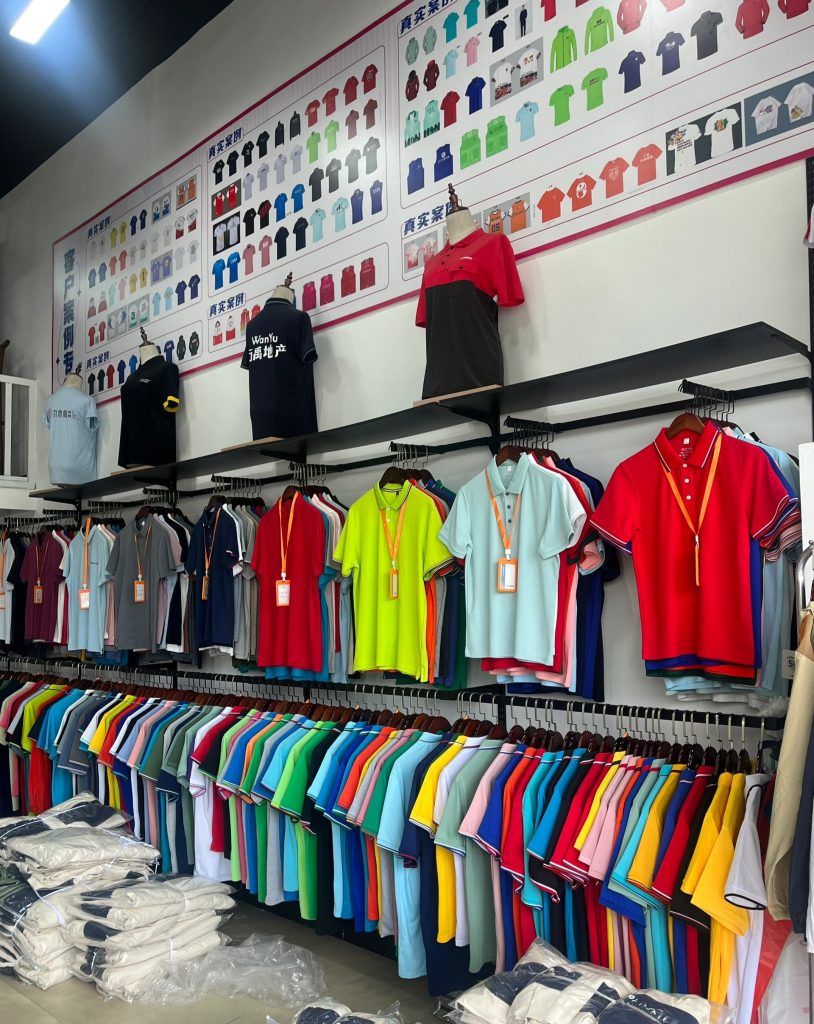
Sourcing short-sleeve garments (T-shirts, polos, and casual tops) from China is often viewed as a commodity play. However, the difference between a “cheap shirt” and a “commercially viable garment” lies in the microscopic details of yarn spinning, dyeing chemistry, and stitch density. This article provides an original, ground-level analysis of the Chinese short-sleeve export industry, addressing the technical failures that lead to customer returns and brand damage.
The central problem for importers is specification decay—the phenomenon where the approved pre-production sample differs significantly from the bulk shipment due to fabric substitution or construction shortcuts.
1. Fiber Composition: The Cotton-Polyester Dichotomy
The foundation of any short-sleeve garment is its fiber content. Chinese mills operate in two distinct worlds:
-
Cotton Systems: The key metric is Combed vs. Carded. Combed cotton removes short fibers, resulting in a smoother, stronger yarn with less pilling. Low-cost exporters often use carded cotton or even “open-end” spinning, which creates a fuzzier surface prone to pilling after three washes.
-
Synthetic Blends: Polyester is used for durability and moisture-wicking. The problem arises with low-melt polyester. Inferior blends use coarse polyester that feels waxy. Professional exporters use micro-denier polyester (e.g., 75D/72F) that mimics the hand-feel of cotton.
-
The Solution: Request the CV% (Coefficient of Variation) of the yarn. A low CV% indicates consistent yarn thickness, which translates to a uniform fabric surface. Without this data, you are buying blind.
2. Fabric Construction: Knitting Machines and GSM
The weight of the fabric (GSM – Grams per Square Meter) is often misrepresented.
-
Single Jersey vs. Interlock: Most T-shirts use single jersey. The critical factor is twist direction. Improper yarn twist causes “skewing” or “torque”—where the side seams twist around the body after washing.
-
The 180GSM Lie: Many factories quote 180GSM but achieve this by using high-twist yarns that relax and shrink in the wash, dropping the effective weight to 160GSM.
-
Technical Fix: Insist on compact spinning technology. Compact yarn has higher tensile strength and less hairiness. A professional exporter will provide a fabric shrinkage report (warp and weft) before cutting begins.
3. Colorfastness and Dye Chemistry
Color bleeding is the #1 return reason for short-sleeves.
-
Reactive Dyes: Used for cotton. The issue is hydrolysis. If the washing-off process after dyeing is rushed, unfixed dye remains in the fabric, causing bleeding.
-
Disperse Dyes: Used for polyester. Sublimation occurs under high heat (like in a dryer), transferring color onto other garments.
-
The Solution: Demand AATCC 61-2A (washing fastness) and AATCC 16 (light fastness) test results. A professional factory maintains a “lab dip” library and uses spectrophotometers to ensure batch-to-batch consistency, not just visual matching under D65 light.
4. Garment Construction: The Devil in the Stitch Density
The durability of a short-sleeve is determined by the sewing thread and needle type.
| Component | Amateur Production | Professional Standard |
|---|---|---|
| Shoulder Seam | Single-needle lockstitch, no reinforcement. | Double-needle with fusible interlining tape to prevent stretching. |
| Neck Rib | Poor lycra recovery, collar curls after washing. | 1×1 or 2×2 rib with high elastane content, tubular knitted. |
| Side Seams | Lockstitch with high tension, breaks during wear. | Overlock stitch (504 or 512) with balanced thread tension. |
| Labeling | Heat-transfer labels that crack. | Woven labels with satin finish or screen-printed care labels. |
FAQ: Solving Common Sourcing Defects
Q1: How can I prevent “Needle Cutting” in lightweight fabrics?
A: Needle cutting (holes appearing along seams) occurs when the needle blade is too large for the fine yarn. Ensure the factory uses ballpoint needles (size 70/10 or 80/12) for knits. Additionally, the thread should be core-spun polyester, not spun polyester, to prevent abrasion-induced breakage.
Q2: What is the “Spirality” issue and how is it fixed?
A: Spirality (twisted side seams) happens when the fabric courses are not perpendicular to the wales. It is caused by unbalanced loop formation during knitting. A professional exporter performs a relaxation process (steaming and resting the fabric for 24-48 hours) before cutting to allow the yarn to stabilize.
Q3: How do I verify the actual cotton origin?
A: Chinese factories often blend Xinjiang cotton with imported cotton (USA, India, Australia). To verify, request a HVI (High Volume Instrument) report for the cotton bales used. Alternatively, perform a Burn Test and a NIR (Near-Infrared Spectroscopy) scan on the fabric swatch to detect foreign fibers.
Q4: What is the difference between “Yarn-Dyed” and “Piece-Dyed”?
A: Yarn-dyed fabrics are colored before weaving/knitting, offering superior colorfastness and a richer look (common in stripes). Piece-dyed fabrics are colored after the fabric is made. For short-sleeves, piece-dyeing is standard, but ensure the factory uses bio-polishing to remove surface fuzz before dyeing for a cleaner finish.
Q5: How do I stop collars from stretching out?
A: This is a function of the rib knit construction. Request a rib with a high percentage of Lycra® fiber (at least 5%). Also, check the course and wale count. A tighter rib (more courses per inch) recovers better from stretching. Avoid “cut-and-sew” ribs; insist on tubular knitted ribs for the neckband.
Conclusion
Choosing a Chinese short-sleeve exporter is not about finding the lowest CM (Cut and Make) cost. It is about partnering with a factory that understands yarn physics and dye chemistry.
Before signing a contract, visit the dye house. If they cannot explain their salt and alkali dosage curve during reactive dyeing, or if their knitting machines lack positive feeding systems, they lack the technical capability to deliver consistent quality. Invest in the process, not just the product.


No reply content