
Dongguan PremiumGift BoxPackaging
Stop sourcing “boxes.” Start sourcing packaging engineering. Learn the difference between cartonboard densities, magnetic closure calibration, and global compliance from a specialist manufacturer.
Introduction: The Unseen Failure Points
Most buyers think a packaging box is simple: four walls, a lid, and maybe a logo.
But for premium brands, the box is the first physical touchpoint of the product. A flap that doesn’t close flush, a magnet that is too weak to hold, or paper that scuffs during shipping—these are the details that destroy perceived value.
As a dedicated packaging manufacturer, we don’t just print and fold; we engineer structural integrity and material science. Here is how we approach custom packaging boxes for global brands.
1. Material Science: It’s Not Just “Cardboard”
The term “cardboard” is misleading. The performance of your box depends entirely on the substrate.
| Material Type | Density/Grade | Best Application | Key Characteristic |
|---|---|---|---|
| Greyboard (Chipboard) | 800gsm – 2000gsm | Rigid boxes (Setup boxes) | Provides the core structure. Higher GSM = more luxury feel. |
| Corrugated Fiberboard | E-Flute / F-Flute | Shipping boxes, mailers | Flute size determines crush resistance and print smoothness. |
| Solid Bleached Sulphate (SBS) | C1S / C2S | Cosmetic boxes, retail cartons | Bright white, smooth surface for high-end printing. |
| Kraft Paper | 100gsm – 300gsm | Eco-friendly packaging | High tensile strength, natural texture. |
Our Rule: Never use 1200gsm greyboard for a box smaller than 15cm. It becomes too stiff to wrap cleanly. Never use 800gsm for a box larger than 30cm. It will sag.
2. The Mechanics of a Perfect Closure
The most common complaint about rigid boxes is a misaligned lid or a weak magnet.
-
The 3mm Gap Rule: We engineer a 3mm clearance between the lid and the base. This ensures the lid slides on smoothly without friction, yet fits tightly enough to not rattle.
-
Magnetic Flux Calibration: We don’t just drop in standard magnets. We test the pull force (measured in Gauss). For a jewelry box, 0.8N is sufficient. For a heavy cigar box, we use 1.5N magnets recessed into the board to prevent “magnet jump.”
-
Wrap Alignment: On a rigid box, the paper wrap must align perfectly with the board edges. We use automated corner pasting machines to ensure a tolerance of ±0.2mm.
3. Printing and Finishing: Beyond CMYK
Color is subjective; finishing is objective.
-
Pantone Matching System (PMS): We never rely on CMYK conversion for brand colors. We mix spot colors using a spectrophotometer to ensure your “Brand Red” is identical across 10,000 boxes.
-
Finishing Durability:
-
Hot Foil Stamping: We calibrate the temperature (120°C – 150°C) and pressure to ensure the foil adheres without cracking on the edges.
-
Embossing/Debossing: We use brass dies for fine details. The depth is calculated based on the paper fiber; too deep, and the paper fibers break.
-
4. Structural Protection: The Insert
A beautiful box is useless if the product moves inside.
-
EVA Foam: Closed-cell foam for heavy items (electronics, bottles). We use laser cutting for precision cavities.
-
Paper Pulp: Molded pulp inserts for sustainable packaging. High compression strength, 100% recyclable.
-
Corrugated Fitments: Die-cut cardboard supports for lightweight items.
5. Supply Chain and Compliance
Exporting packaging requires more than just good looks.
-
FSC Certification: We provide FSC-certified packaging upon request, ensuring the paper comes from responsibly managed forests.
-
Heavy Metal Testing: Our inks and coatings are tested for Lead (Pb), Cadmium (Cd), Mercury (Hg), and Hexavalent Chromium (Cr VI) to comply with EU REACH and US CPSC regulations.
-
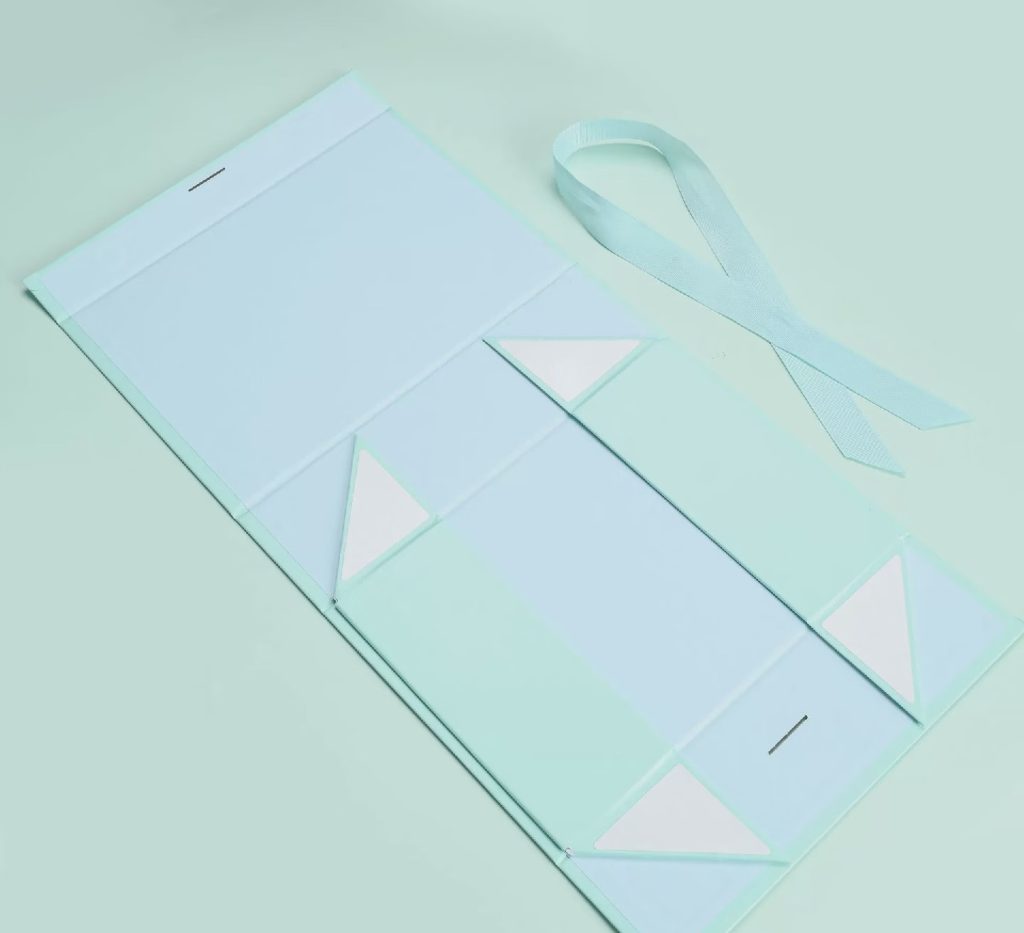
Flat-Pack Efficiency: For large orders, we design boxes to be shipped flat (KD – Knocked Down) to reduce shipping volume by 80%, saving significant freight costs.
Frequently Asked Questions (FAQ)
Q1: What is the difference between a “Rigid Box” and a “Folding Carton”?
A: A Rigid Box (or Setup Box) is made from thick greyboard (usually >1000gsm) and wrapped with paper. It is non-collapsible and feels heavy and premium. A Folding Carton is made from thinner SBS or Kraft board, shipped flat, and assembled by the user. It is cheaper and more compact for shipping.
Q2: Can you match the exact texture of a competitor’s box?
A: Yes. We use a surface profilometer to measure the roughness (Ra value) of your sample. We then source paper stocks with the same grain pattern and embossing depth. We will send you a physical strike-off for approval before mass production.
Q3: How do you prevent boxes from warping during shipping to humid countries?
A: Warping is caused by moisture imbalance. We control the moisture content of the greyboard to 10%-12% during lamination. For tropical destinations (Southeast Asia, South America), we recommend laminating the board with PET film to act as a moisture barrier.
Q4: What is your policy on “Over-Running” or “Under-Running” quantities?
A: Due to the nature of die-cutting and setup, exact quantities are impossible. Our standard tolerance is ±5%. We invoice based on the actual quantity shipped. We advise clients to plan their inventory with this buffer in mind.
Q5: Do you provide 3D mockups before production?
A: Yes. We provide high-resolution 3D renderings showing the box structure, paper texture, and foil effects. However, we strongly recommend ordering a Physical Pre-Production Sample (PPS) for $50-$150, as digital screens cannot accurately represent texture and color.
Conclusion: Your Box is Your Brand’s Handshake
A cheap box makes a cheap product. A precision-engineered box justifies a premium price. By focusing on material density, magnetic mechanics, and ink chemistry, we ensure your packaging performs as well as it looks.


No reply content