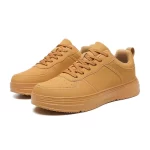
China Jinjiang shoe manufacturer in


If you’re reading this, you’re likely a buyer, a brand founder, or a distributor looking for a men’s athletic shoes supplier. You’ve probably sat through endless Zoom calls with trading companies showing you the same catalog of generic sneakers. They use words like “innovative,” “high-quality,” and “competitive pricing.”
Let me translate that for you: “Innovative” usually means copying last year’s Nike design. “High-quality” means the glue might hold for three months. And “competitive pricing” means they’ve found a way to shave $0.15 off the cost by using cardboard insoles.
I’m Li Wei, and I run the production floor for a footwear manufacturer in Jinjiang, Fujian. We don’t just make shoes; we make tools for performance. Whether it’s a trail running shoe that needs to survive a monsoon or a basketball shoe that needs to support a 250-pound athlete landing from a dunk, the stakes are high. One structural failure, and someone gets hurt—or worse, your brand gets sued.
So, let’s skip the sales pitch and talk about what actually matters when you’re sourcing men’s athletic footwear.
1. The Anatomy of a Midsole: EVA vs. Phylon vs. PU
Most buyers get lost in the upper design. They obsess over the knit pattern or the color of the laces. That’s superficial. The soul of an athletic shoe is the midsole. It determines comfort, durability, and performance.
-
EVA (Ethylene Vinyl Acetate): This is your standard foam. It’s cheap, lightweight, and easy to mold. But it has a fatal flaw: compression set. After 300 miles of running, EVA turns into a pancake. It loses its rebound. If your target market is budget-conscious casual wearers, EVA is fine. If you’re selling performance shoes, it’s a liability.
-
Phylon: This is EVA that has been compressed and heat-treated. It’s firmer, more responsive, and lasts longer. We use a proprietary Phylon blend for our mid-range basketball and training shoes. It offers a good balance between cushioning and court feel.
-
PU (Polyurethane): This is the gold standard for durability. It’s heavier than EVA but offers superior shock absorption and doesn’t break down easily. For high-end hiking boots or heavy-duty work trainers, PU is the only way to go.
The Supplier Secret: Ask your supplier for the density rating of the foam. A density of 0.20 g/cm³ is cheap and soft. A density of 0.35 g/cm³ is firm and durable. If your supplier doesn’t know the density, they are buying pre-made blocks from a third party and have no control over the quality. We mix our own chemical compounds in-house to hit exact specifications.
2. The Upper: Knitting vs. Leather vs. Synthetics
The upper is where the aesthetics happen, but it’s also where structural integrity is tested.
Flyknit and Engineered Mesh: Everyone wants knitted uppers now. They’re breathable and stylish. But there’s a huge difference between a cheap single-layer knit and a multi-layer engineered mesh. We use TPE thermoplastic yarn for reinforcement in high-wear areas like the toe box and the eyestay. A cheap knit shoe will develop holes in the toe within weeks. Ours won’t.
Leather and Suede: For lifestyle and skateboarding shoes, leather is king. But not all leather is equal. We source from tanneries in Brazil and Italy. The difference is in the chrome tanning process. Poorly tanned leather will crack when bent repeatedly. Good leather will crease naturally and develop a patina.
The Stitching: Look at the stitches per inch (SPI). A cheap shoe has 6 SPI. A quality shoe has 8-10 SPI. More stitches mean the seam is stronger and less likely to rip when the shoe is under stress. We enforce a strict 9 SPI standard on all our athletic models.
3. The Outsole: Grip, Durability, and Carbon Rubber
The outsole is the only part of the shoe touching the ground. It needs to grip, flex, and resist abrasion.
We use a combination of solid rubber and blown rubber. Solid rubber is tough and goes in high-wear areas (the heel and ball of the foot). Blown rubber is lighter and more flexible, used in the forefoot for responsiveness.
A common trick suppliers use to lower costs is to reduce the amount of rubber and replace it with EVA. This makes the shoe lighter and cheaper, but it wears out in a month. We use a non-marking carbon rubber compound for our basketball outsoles. It leaves no skid marks on gym floors and lasts 500+ miles.
The Flex Groove Test: Take a shoe and bend it. If it bends easily at the ball of the foot but resists twisting in the arch, it’s well-designed. If it twists like a towel, it offers no stability for the foot.
4. The Last: Why Fit is Everything
The “last” is the foot-shaped mold around which the shoe is built. This is the secret sauce of footwear manufacturing.
Many suppliers have a library of standard lasts. They take a design and force it onto a generic last. This results in shoes that fit weirdly—too narrow in the toe, too loose in the heel.
We have spent years developing our own lasts based on 3D scans of thousands of feet across North America and Europe. We have different lasts for different activities:
-
The Running Last: Narrower heel, wider toe box for toe splay.
-
The Basketball Last: Wider base for lateral stability.
-
The Hiking Last: Curved arch support for long-distance trekking.
If your supplier doesn’t have a dedicated last development department, you are just selling a commodity product.
5. Quality Control: Beyond the Visual Check
Quality control (QC) in footwear is notoriously difficult. It’s not just about checking if the logo is straight. It’s about destructive testing.
At our factory, every production run undergoes:
-
The SATRA TM92 Abrasion Test: We rub the outsole against sandpaper until it wears down. We measure the volume of rubber lost.
-
The Flexing Machine: We attach the shoe to a machine that simulates 100,000 steps. We check for delamination (the sole separating from the upper).
-
The Bond Strength Test: We pull the upper away from the midsole to measure the strength of the adhesive.
When you visit a potential supplier, ask to see their lab. If they don’t have a flexing machine or an abrasion tester, they are guessing about their quality.
6. Supply Chain Transparency and MOQs
Let’s talk numbers. Minimum Order Quantities (MOQs) are a major pain point.
Standard suppliers will demand 1,000 pairs per colorway. That’s a huge risk for a startup brand. We’ve structured our production to be more flexible. We can do 300 pairs per colorway for existing molds. If you need a completely new mold (a new design), the MOQ is 800 pairs.
Why the difference? Because creating the cutting dies and the lasting molds takes time and money. But once that infrastructure is in place, we can run smaller batches efficiently.
We also believe in transparency. We can provide a full cost breakdown: material cost, labor cost, overhead, and margin. If a supplier refuses to give you a detailed quote, they are hiding something—usually the fact that they are outsourcing the work to another factory they don’t even control.
7. Sustainability: It’s Not Just a Buzzword
The market is demanding eco-friendly options. But “eco-friendly” is a vague term. We focus on measurable impact:
-
Recycled PET: Our linings and laces are made from recycled plastic bottles.
-
Bio-based Rubber: We are experimenting with rubber derived from dandelion sap and corn waste.
-
Water-Based Adhesives: Traditional shoe glue is toxic and solvent-based. We use water-based glues that are better for the workers and the environment.
8. Who Is This For?
We are not the supplier for everyone. We don’t make cheap flip-flops or PVC shoes for dollar stores. We specialize in performance men’s athletic footwear for brands that care about the details.
If you are a boutique brand looking to make a mark in the running or basketball space, we can help you compete with the big boys. If you are a distributor looking for a reliable private label partner, we offer consistent quality and on-time delivery.


No reply content