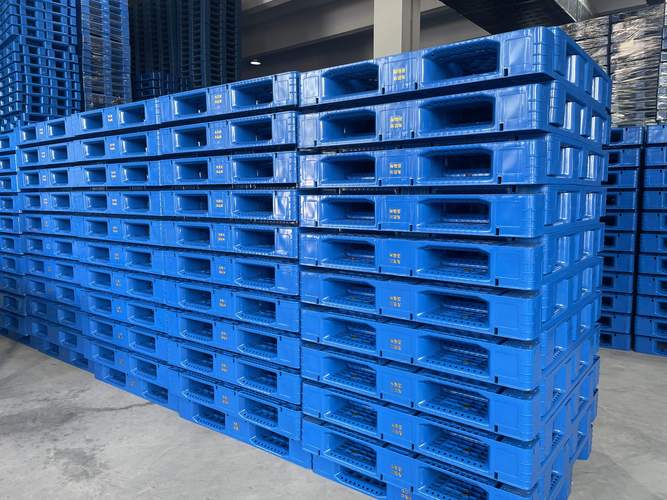
If you’re reading this, chances are you’ve been there—standing in your warehouse, staring at yet another cracked plastic pallet that barely survived six months of use. The forklift driver shrugs. Your procurement manager sighs. And your budget takes another hit.
You’re not alone. Premature pallet failure is one of the most expensive hidden costs in supply chain operations, quietly draining thousands of dollars annually through replacements, downtime, and damaged goods.
But here’s the good news: it doesn’t have to be this way.
As a direct plastic pallet manufacturer, we’ve spent over a decade engineering solutions that don’t just survive—they outlast. In this article, we’ll break down exactly how reinforced design, smarter material choices, and manufacturing precision can triple your pallet lifespan and slash your total cost of ownership.
Why Do Standard Plastic Pallets Fail So Fast?
Before we talk solutions, let’s diagnose the problem. Most pallet failures trace back to three root causes:
Failure Cause
|
What Happens
|
The Real Cost
|
Thin deck boards
|
Forklift tines punch through under heavy loads
|
Product damage + safety hazard
|
Weak rib structure
|
Bottom reinforcement can’t distribute weight evenly
|
Pallet sags, then cracks at stress points
|
Recycled-material overload
|
High regrind content without virgin resin balance
|
Brittleness, especially in cold environments
|
The frustrating part? These aren’t inevitable. They’re design choices—usually made to hit the lowest possible price point. But the cheapest pallet upfront is almost never the cheapest pallet over 3–5 years.
How Source Factories Engineer Triple-Lifespan Pallets
Here’s where manufacturer-direct expertise changes the game. When you cut out the trading middleman and work straight with the factory, you get access to engineering decisions that actually matter:
1. Reinforced Deck Thickness (Not Just “Heavier”)
It’s not about adding random plastic—it’s about strategic thickness. Our heavy-duty models feature deck boards thickened by 20–30% at exactly the high-impact zones: forklift entry points and load-bearing surfaces.
🔑 Key spec to ask for: Deck thickness of 4.5mm–6mm minimum for racking applications (vs. the industry-standard 3mm–4mm on budget models).
, 2. Steel-Reinforced Internal Structure
For high-rack and dynamic load scenarios, the best manufacturers offer steel-reinforced pallets—galvanized steel tubes embedded inside the plastic body. This hybrid approach delivers:
-
Racking load capacity: Up to 1,500 kg without deflection
-
Zero moisture absorption (unlike wooden pallets)
-
No rust compromise thanks to fully encapsulated steel
3. High-Impact HDPE with Virgin Resin Blend
Not all plastic is created equal. We formulate our own HDPE (High-Density Polyethylene) blends with:
-
30–40% virgin resin for impact strength
-
UV stabilizers for outdoor storage longevity
-
Anti-static additives for electronics and pharmaceutical use
This is the difference between a pallet that snaps at -20°C and one that flexes safely through freeze cycles.
4. One-Piece Injection Molding (No Welds, No Weak Seams)
Cheap pallets are often assembled from separate pieces welded together. Those seams? That’s where cracks start. One-piece injection molding creates a seamless, monolithic structure where stress distributes evenly across the entire pallet—not just at the joints.
5. Reinforced Rib Geometry
It’s not just how much reinforcement—it’s where. Advanced CAD simulation lets manufacturers place ribs exactly where finite element analysis shows maximum stress concentration. The result: a pallet that’s lighter than a solid block design but stronger where it counts.
The Numbers: What “Triple Lifespan” Actually Looks Like
Let’s put this in hard numbers. Here’s a real-world comparison from one of our logistics clients:
Metric
|
Standard Budget Pallet
|
Reinforced Manufacturer Pallet
|
Unit price
|
$18
|
$32
|
Expected lifespan
|
18 months
|
5+ years
|
Replacements over 5 years
|
3–4 units
|
1 unit
|
Total cost (5-year)
|
$54–72
|
$32
|
Downtime & labor cost
|
High
|
Minimal
|
Bottom line: Pay ~$14 more upfront, save $40+ over five years. That’s a 280% ROI—before you even factor in reduced product damage and fewer safety incidents.
How to Choose the Right Reinforced Pallet for Your Operation
Not every warehouse needs the same spec. Here’s a quick decision framework:
Your Operation
|
Recommended Design
|
Key Feature
|
Cold storage / freezer
|
HDPE with high virgin content
|
Crack-resistant at -30°C
|
High-rack racking systems
|
Steel-reinforced, 3-runner base
|
1,500kg racking load
|
Export & one-way shipping
|
Lightweight 9-leg nestable
|
Cost-efficient, ISPM-15 exempt
|
Automated conveyor systems
|
Anti-slip deck + precision dimensions
|
Smooth handling, no jams
|
Food & pharmaceutical
|
HACCP-compliant, smooth deck
|
Easy-clean, contamination-free
|
Why Buying Direct from the Manufacturer Matters
When you source through distributors or trading companies, you’re paying a markup—often 30–50%—for a product you could get straight from the factory floor. But the real loss isn’t just the margin. It’s the engineering transparency:
-
❌ Distributors can’t tell you the exact resin blend or rib structure.
-
✅ Manufacturers can customize wall thickness, color-coding, RFID embedding, and anti-slip surfaces to your exact specs.
-
❌ Distributors quote 4–6 week lead times because they’re waiting on someone else.
-
✅ Manufacturers with in-house tooling can turn around standard orders in 10–15 days and custom prototypes in 7.
Ready to Stop Replacing Broken Pallets?
If your current pallets are cracking, sagging, or failing inspection, it’s time to rethink your sourcing strategy. A reinforced plastic pallet from a direct manufacturer isn’t just a product—it’s a long-term cost control decision.
👉 Get a free load-spec consultation and sample quote from our engineering team. Tell us your racking load, operating environment, and annual volume—we’ll recommend the exact model that delivers triple the lifespan at the right price point.
No obligation. Just straight answers from the people who actually make the pallets.



No reply content