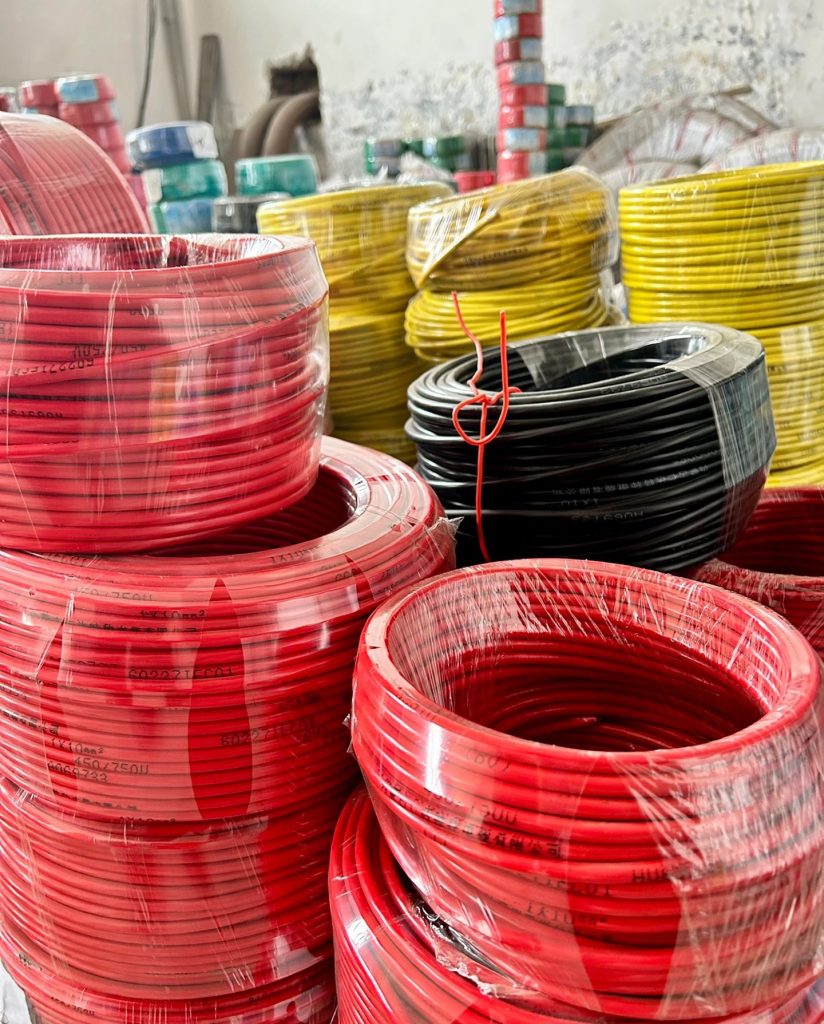
What Is 450/750V Electrical Wire and Where Is It Used?
When purchasing electrical wire for a construction, residential, commercial or industrial project, buyers often see specifications such as 450/750V, BV, 60227 IEC 01, H07V-U, or H07V-R.
For an experienced electrical engineer, these markings are familiar. For an importer or distributor, however, it can be difficult to understand exactly what the voltage rating means and whether a particular 450/750V wire is suitable for a project.
The term 450/750V does not mean that the wire should normally carry 750 volts continuously in every installation. It is a rated-voltage designation used in the applicable cable standard.
This guide explains what 450/750V means, where this type of electrical wire is commonly used, how BV and H07V-U relate to the specification, and what international buyers should confirm before placing an order with a Chinese manufacturer.
What Does 450/750V Mean?
The designation 450/750V represents the rated voltage of the cable according to the applicable standard.
It is normally written as:
U₀/U = 450/750V
The two numbers have different meanings.
- U₀ = rated voltage between the conductor and earth
- U = rated voltage between conductors
Therefore:
U₀ = 450V
and
U = 750V
This distinction is important when reading technical documentation.
A buyer should not interpret “750V wire” simply as a product that can be used at any voltage below 750V under every possible installation condition.
The actual suitability depends on the applicable cable standard, system configuration, installation method, temperature, environmental conditions and local electrical regulations.
Where Is 450/750V Electrical Wire Used?
450/750V PVC-insulated building wire is commonly associated with fixed electrical installations.
Typical applications include:
- Residential electrical wiring
- Commercial buildings
- Offices
- Retail buildings
- Schools
- Hotels
- Warehouses
- Electrical panels
- Conduit installations
- Cable trunking
- Building distribution circuits
- Internal equipment wiring where the applicable standard permits it
The current Author 88 supplier information describes BV / 60227 IEC 01 and H07V-U as 450/750V single-core PVC-insulated copper building wires for conduit, trunking and fixed house or commercial wiring.
However, this does not mean that ordinary 450/750V building wire is suitable for every outdoor, underground, industrial or mobile application.
The installation environment must always be considered.
450/750V Does Not Mean the Same Wire Can Be Used Everywhere
This is one of the most important points for importers.
A 450/750V rating describes the electrical rating within the applicable standard. It does not automatically define:
- Outdoor suitability
- Underground suitability
- UV resistance
- Mechanical protection
- Water resistance
- Oil resistance
- Continuous-flexing capability
- Fire performance
- Chemical resistance
For example, an unsheathed PVC building wire may be suitable inside conduit but unsuitable for direct burial.
The current supplier information specifically distinguishes standard BV/H07V-U building wire from sheathed or armored cable applications.
Therefore, buyers should specify the installation environment before choosing the cable.
What Is BV 450/750V Wire?
BV is a commonly used Chinese designation for PVC-insulated copper building wire.
A related international designation frequently encountered by buyers is:
60227 IEC 01
The existing Author 88 manufacturer page describes BV / 60227 IEC 01 as a single-core, non-sheathed PVC-insulated wire for fixed electrical installations with a 450/750V rating.
Typical characteristics include:
- Single-core construction
- Copper conductor
- PVC insulation
- 450/750V rated voltage
- Fixed installation applications
- Common building-wire sizes
- Various insulation colors
- Solid Class 1 construction for standard configurations
For buyers looking specifically for this product, the existing BV Wire 60227 IEC 01 Manufacturer China | 450/750V Single Core page provides additional technical information.
What Is H07V-U 450/750V Wire?
H07V-U is another commonly requested 450/750V PVC-insulated single-core copper wire.
The designation contains useful information.
In simplified form:
- H = harmonized designation
- 07 = 450/750V voltage class
- V = PVC insulation
- U = solid conductor
The existing Vlefooena technical guide explains the meaning of the H07V-U designation and its relationship with 450/750V PVC-insulated building wire.
H07V-U is particularly relevant to buyers working with European-oriented specifications and markets where harmonized cable designations are required.
However, buyers should always confirm the exact standard and certification requirements for the destination country.
BV vs H07V-U: Are They the Same?
This is a common sourcing question.
BV and H07V-U belong to closely related product categories, but buyers should not simply assume that the names are interchangeable.
The important factors are:
- Applicable standard
- Conductor construction
- Insulation
- Voltage rating
- Dimensions
- Conductor resistance
- Marking
- Certification
- Destination-market requirements
For an importer, the safest approach is to tell the manufacturer which standard the project requires rather than asking for “something equivalent.”
If the project documentation specifies H07V-U, request H07V-U according to the required harmonized specification.
If the project specifies 60227 IEC 01, request that exact product designation.
The existing [BV Wire 60227 IEC 01 Manufacturer China | 450/750V Single Core] resource can be used as a reference when comparing this product category.
What Sizes Are Commonly Available?
450/750V building wire is available in many cross-sectional areas.
Common sizes include:
- 1.5 mm²
- 2.5 mm²
- 4 mm²
- 6 mm²
- 10 mm²
- 16 mm²
- 25 mm²
- 35 mm²
- Larger sizes depending on the product construction and manufacturer
The most appropriate size should be determined from the electrical design rather than selected simply according to the voltage rating.
For example, 450/750V describes the voltage class, while 2.5 mm² or 6 mm² describes the conductor cross-sectional area.
These are two different technical parameters.
450/750V vs Wire Size
A common purchasing mistake is to treat voltage rating and conductor size as if they were the same thing.
They are not.
Consider:
450/750V, 2.5 mm²
The two specifications describe different characteristics:
- 450/750V → rated voltage
- 2.5 mm² → conductor cross-sectional area
A different product could be:
450/750V, 6 mm²
The voltage class is the same, but the conductor is significantly larger.
Similarly:
450/750V, 10 mm²
has the same nominal voltage class but a larger conductor cross-section.
For buyers, this means that asking a supplier only for “450/750V wire” is not enough to receive a precise quotation.
Does 450/750V Tell You the Current Capacity?
No.
The voltage rating and ampacity are different specifications.
For example, the existing Author 88 product information provides reference ampacity values for several common solid copper sizes:
| Conductor Size | Reference Ampacity* |
|---|---|
| 1.5 mm² | 15–18 A |
| 2.5 mm² | 20–25 A |
| 4 mm² | 30–35 A |
| 6 mm² | 40–45 A |
| 10 mm² | 55–65 A |
*These are planning/reference values rather than universal installation limits. Actual allowable current depends on installation method, ambient temperature, grouping, conduit conditions and local electrical code.
Therefore:
450/750V ≠ 750A
and:
450/750V ≠ a specific ampacity
The wire’s allowable current must be determined separately.
Why Does Installation Method Matter?
The same wire can have different allowable current depending on how it is installed.
Factors can include:
- Ambient temperature
- Number of loaded conductors
- Conduit fill
- Grouping
- Cable spacing
- Installation depth
- Ventilation
- Surrounding material
- Local electrical regulations
For example, a wire installed individually in a favorable environment may dissipate heat differently from several loaded wires bundled inside a conduit.
This is why professional electrical design should not select wire size based only on a simple online ampacity table.
Is 450/750V Wire Suitable for House Wiring?
In many fixed residential wiring systems, 450/750V PVC-insulated building wire is a common product category.
Applications can include:
- Lighting circuits
- Socket circuits
- Distribution circuits
- Fixed equipment circuits
- Internal conduit wiring
- Electrical panels
However, the exact product and conductor size must comply with the electrical code applicable to the project location.
For international buyers, the destination country should be provided to the manufacturer before ordering.
A wire suitable for one market may require different marking, testing or certification for another.
Is 450/750V Wire Suitable for Outdoor Use?
Not automatically.
An unsheathed single-core PVC building wire is generally intended to be installed in an appropriate protected system rather than exposed directly to outdoor conditions.
Outdoor installations can involve:
- UV exposure
- Rain
- Mechanical damage
- Temperature changes
- Moisture
- Soil contact
If the cable will be installed outdoors, underground or in an exposed industrial environment, buyers should explain the application to the manufacturer.
A different cable construction may be required.
For example, a sheathed or armored cable may be more appropriate than ordinary unsheathed BV/H07V-U building wire.
Is 450/750V Wire Suitable for Underground Installation?
Standard unsheathed BV or H07V-U should not simply be placed directly into soil because its 450/750V rating does not automatically provide direct-burial protection.
Underground projects may require:
- Suitable conduit
- Protective ducts
- Sheathed cable
- Armored cable
- Water-resistant construction
- Mechanical protection
The exact requirement depends on the installation method and local code.
When requesting a quotation, clearly state:
“This cable will be installed underground.”
Do not simply tell the supplier:
“I need 450/750V wire.”
The first statement provides the manufacturer with information that can materially affect product selection.
What Is the Normal Temperature Rating?
Standard PVC-insulated building wire commonly uses a 70°C normal conductor operating temperature under the relevant product specification.
The Author 88 supplier information also lists 70°C as the normal conductor temperature for its standard PVC building-wire configuration.
However, this should not be interpreted as permission to operate the cable continuously at 70°C regardless of installation conditions.
Temperature affects:
- Ampacity
- Insulation life
- Voltage drop
- Installation requirements
- Derating
If a project requires higher-temperature operation, the buyer should ask for an appropriate insulation compound and standard.
What About Short-Circuit Temperature?
For the referenced standard PVC building-wire configuration, the supplier information gives a short-circuit conductor temperature of up to approximately 160°C for a limited duration, subject to the applicable standard and conditions.
This is another example of why buyers should read the complete technical specification rather than relying only on the “450/750V” marking.
Voltage, operating temperature and short-circuit performance are separate technical characteristics.
What Is the Difference Between H07V-U and H07V-R?
This is especially important for international buyers.
H07V-U
H07V-U is associated with a solid conductor construction.
It is suitable for fixed installation applications where a rigid conductor is appropriate.
H07V-R
H07V-R uses a stranded rigid conductor.
This can make the wire easier to handle and pull through certain conduit routes, particularly as conductor size increases.
The current Author 88 supplier page specifically separates H07V-U, H07V-R and flexible BVR/H07V-K by conductor construction.
For a detailed comparison of solid and stranded conductors, buyers should also refer to the existing supplier content about BV, H07V-U and other single-core copper-wire configurations.
What Is the Difference Between H07V-R and Flexible H07V-K?
These should not be treated as identical.
A stranded rigid conductor and a flexible conductor have different mechanical characteristics.
H07V-R is generally associated with a stranded rigid construction for fixed installations.
H07V-K is associated with a more flexible conductor construction.
This difference matters when the wire will be:
- Routed through tight spaces
- Connected inside panels
- Bent frequently
- Used in equipment wiring
- Installed in applications requiring greater flexibility
When ordering, specify the exact conductor construction rather than asking for “stranded wire.”
What Standards Should an Importer Request?
The appropriate standard depends on the destination market and project specification.
Potential references can include:
- IEC 60227-3
- IEC 60228
- GB/T 5023.3
- GB/T 3956
- HD 21
- EN 50525-related requirements
- Destination-country standards
The supplier’s current technical information references IEC, GB and HD/EN-related standards for different configurations.
The correct approach is not to ask a factory for every possible certification.
Instead, tell the supplier:
- Destination country
- Project application
- Required standard
- Required conductor class
- Required voltage
- Required certification
- Required marking
This allows the manufacturer to quote a product that actually matches the project.
What Should Be Printed on the Wire?
For commercial export orders, cable marking is an important quality-control issue.
Depending on the applicable standard and market, marking may include:
- Manufacturer identification
- Product designation
- Voltage rating
- Conductor size
- Standard
- Batch information
- Meter marking
The Author 88 manufacturer information describes laser-printed markings for standard, voltage, size and batch traceability on its BV product line.
Before mass production, buyers should request a marking sample for approval.
This prevents problems such as:
- Incorrect voltage marking
- Incorrect standard designation
- Incorrect conductor size
- Wrong company name
- Wrong color identification
- Incorrect certification marks
How Should International Buyers Request a 450/750V Wire Quotation?
A good RFQ should be much more specific than:
“Please quote 450/750V copper wire.”
Instead, provide:
Product: Single-core PVC-insulated copper building wire
Voltage: 450/750V
Conductor: Copper
Conductor construction: Solid Class 1 / stranded Class 2 / flexible as required
Size: 1.5 / 2.5 / 4 / 6 / 10 mm²
Standard: Required IEC / EN / GB specification
Insulation: PVC
Colors: Brown, blue, green-yellow, etc.
Packing: 100m coil / 500m coil / drum
Quantity: Required meters per size
Destination: Country and port
Certification: Required documents
This format makes supplier quotations much easier to compare.
How to Compare Two Chinese Manufacturers
Suppose two suppliers both quote:
2.5 mm², 450/750V copper PVC wire
Do not immediately choose the lower price.
Check:
| Specification | Supplier A | Supplier B |
|---|---|---|
| Copper conductor | Confirm | Confirm |
| Cross-section | 2.5 mm² | 2.5 mm² |
| Conductor class | Confirm | Confirm |
| Standard | Confirm | Confirm |
| DC resistance | Confirm | Confirm |
| Insulation thickness | Confirm | Confirm |
| Voltage | 450/750V | 450/750V |
| Color | Same | Same |
| Packing | Same | Same |
| Certification | Same | Same |
| Test report | Available? | Available? |
| Sample | Available? | Available? |
This prevents a common purchasing problem: comparing two products that have the same marketing description but different technical specifications.
What Quality Checks Should Buyers Request?
For a bulk order, buyers can request documentation or inspection covering:
Conductor
Check:
- Material
- Diameter or cross-sectional area
- Conductor class
- DC resistance
Insulation
Check:
- Material
- Thickness
- Diameter
- Color
- Surface quality
Electrical performance
Check:
- Rated voltage
- Resistance
- Voltage test
- Applicable type/routine tests
Marking
Check:
- Product name
- Standard
- Size
- Voltage
- Manufacturer
- Batch information
Packaging
Check:
- Coil length
- Drum length
- Label information
- Quantity
- Batch traceability
For repeated wholesale orders, maintaining batch records can be especially useful when the same product is imported several times.
When Should You Choose 450/750V Building Wire?
450/750V PVC-insulated building wire can be appropriate when the project requires:
- Fixed installation
- Single-core building wire
- Copper conductor
- PVC insulation
- 450/750V rated voltage
- Conduit or trunking installation
- Residential or commercial wiring
- Applicable IEC/EN/GB specification
It may not be the appropriate product when the application requires:
- Direct burial
- Heavy mechanical protection
- Continuous flexing
- Special fire performance
- Low-smoke zero-halogen insulation
- High-temperature insulation
- Outdoor exposure without suitable protection
The application should determine the cable construction.
FAQ
What does 450/750V mean on electrical wire?
It refers to the rated voltage designation U₀/U, meaning 450V between conductor and earth and 750V between conductors under the applicable cable standard.
Is 450/750V wire suitable for 220V systems?
A 450/750V cable can be used in systems whose operating voltage is within its applicable rated-voltage range, provided the cable construction and installation comply with the relevant electrical standard and local code.
Is 450/750V wire suitable for 380V systems?
It may be suitable for certain 380V/400V systems depending on the conductor-to-earth voltage, system configuration, installation method and applicable standard. The project specification should be checked rather than relying only on the voltage marking.
Is 450/750V the same as 750V cable?
450/750V is the more precise rated-voltage designation. It describes U₀/U rather than simply saying that the cable is a generic “750V cable.”
What is the difference between 450/750V and 300/500V wire?
They represent different rated-voltage classes. The correct choice depends on the electrical system and the applicable product standard.
Is BV 60227 IEC 01 a 450/750V cable?
Yes, 60227 IEC 01 is associated with single-core, non-sheathed PVC-insulated wire in the 450/750V class. The existing Vlefooena manufacturer page provides further technical information.
Is H07V-U a 450/750V wire?
Yes. H07V-U is a 450/750V PVC-insulated single-core copper-wire designation, generally associated with a solid conductor construction.
Can 450/750V wire be buried underground?
The voltage rating alone does not make the wire suitable for direct burial. Standard unsheathed building wire generally requires suitable conduit or protection, while some underground applications require a different cable construction.
Can 450/750V wire be used outdoors?
Not simply because it is rated 450/750V. Outdoor exposure can require UV resistance, mechanical protection, moisture resistance or a different cable construction.
What information should I give a Chinese wire manufacturer?
Provide the destination country, application, conductor size, conductor construction, voltage, standard, insulation, colors, quantity, packaging and required certification.
How to Buy 450/750V Electrical Wire from China
For importers, the most important lesson is that 450/750V is only one part of the product specification.
A professional purchase specification should combine:
Voltage + conductor size + conductor class + insulation + standard + application + certification + packaging.
For example:
2.5 mm² single-core copper PVC building wire, solid Class 1, 450/750V, required IEC specification, blue, 100m coils, for fixed indoor installation.
That specification is far more useful to a manufacturer than simply saying:
“I need 450/750V copper wire.”
For buyers researching the product further, the existing Vlefooena resources on [PVC Insulated Building Wire Supplier China | BV, H07V-U, 450/750V] and [Wholesale Single Core Copper Wire Factory | BV H07V-U China] provide additional product and sourcing information.
Buyers can also review [What Is 60227 IEC 01 Cable? Specifications, Applications and Buying Guide] to understand the relationship between 60227 IEC 01, H07V-U, conductor construction and application.
Before placing a bulk order, confirm the destination-market standard, conductor construction, cross-section, resistance, insulation thickness, marking, certification and installation environment with the manufacturer.
That process reduces the risk of receiving a wire that has the correct “450/750V” label but does not match the actual requirements of the project.


No reply content