
Dongguan Plastic Manufacturing Plant
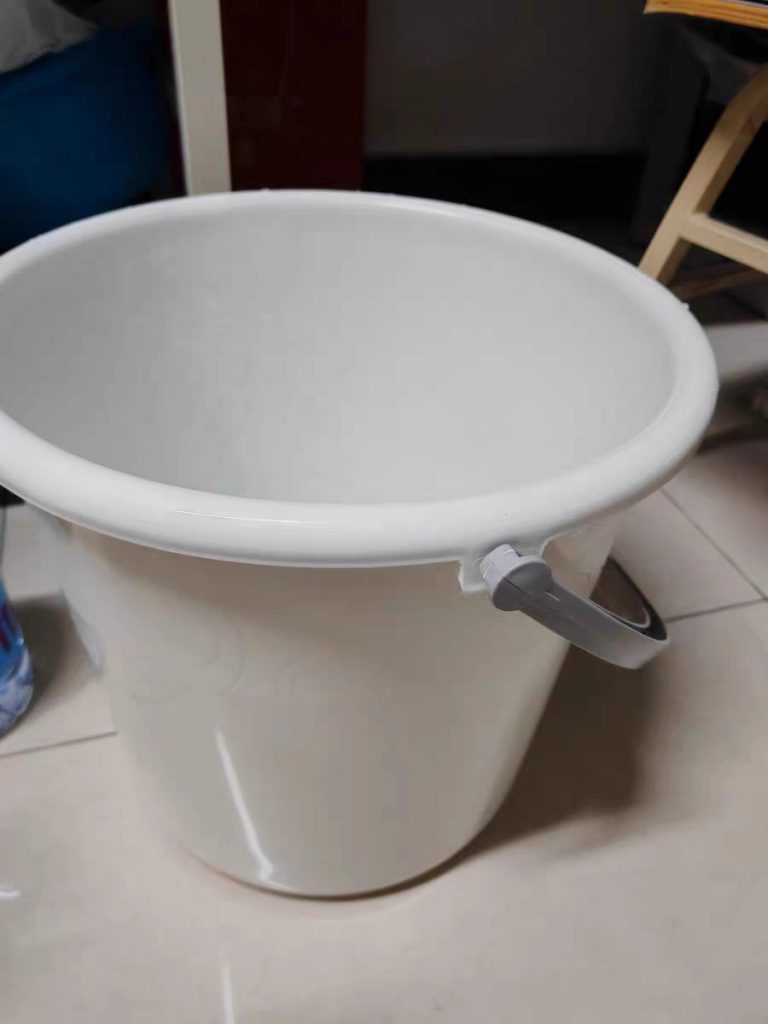
Choosing the right material is one of the most important decisions when purchasing household water buckets. The material affects durability, weight, flexibility, appearance, chemical resistance, temperature performance, and overall cost.
For most household water buckets, PP (polypropylene) and PE (polyethylene) are the two materials buyers are most likely to encounter. However, the best choice depends on how the bucket will be used.
1. PP Plastic: A Popular Choice for Household Buckets
PP, or polypropylene, is widely used for household plastic products.
Its advantages include:
-
Good rigidity and strength
-
Relatively lightweight
-
Good resistance to many household chemicals
-
Good moisture resistance
-
Suitable for injection molding
-
Available in many colors
-
Generally cost-effective
PP is often a good choice when buyers want a bucket that is relatively rigid and maintains its shape during everyday use.
For household cleaning, washing, gardening, and general water carrying, PP can be a practical option.
2. PE Plastic: Flexible and Impact Resistant
PE, or polyethylene, is another commonly used plastic.
Depending on the specific PE grade, it can provide:
-
Good impact resistance
-
Better flexibility than many rigid plastics
-
Good moisture resistance
-
Good low-temperature performance
-
Good chemical resistance
PE may be suitable when the bucket needs greater flexibility or impact resistance.
However, “PE” covers several different material types, so buyers should ask the manufacturer exactly which grade is being used rather than accepting only the general term “PE.”
3. PP vs. PE: Which Should You Choose?
Feature |
PP |
PE |
|---|---|---|
Rigidity |
High |
Usually lower |
Flexibility |
Moderate |
Generally higher |
Impact resistance |
Good |
Very good |
Lightweight |
Yes |
Yes |
Chemical resistance |
Good |
Good to very good |
Household applications |
Excellent |
Excellent |
Custom colors |
Easy |
Easy |
Typical cost |
Competitive |
Competitive |
There is no universal winner. PP is often preferable for a more rigid household bucket, while PE can be attractive when flexibility and impact resistance are priorities.
4. Consider the Intended Use
The best material depends on what the bucket will actually be used for.
General household water storage and carrying:
PP or PE can both be suitable, depending on the required rigidity and design.
Cleaning and washing:
PP is commonly suitable because of its rigidity and ease of molding.
Outdoor use:
Consider impact resistance, temperature exposure, UV exposure, and the specific plastic formulation.
Heavy-duty applications:
Ask about wall thickness, material grade, handle construction, and load testing rather than choosing based on material name alone.
5. Don’t Choose Based Only on Material Name
A common purchasing mistake is assuming that all PP buckets or all PE buckets have the same quality.
Actual performance also depends on:
-
Material grade
-
Wall thickness
-
Product weight
-
Injection molding process
-
Additives
-
Recycled material content
-
Handle design
-
Mold quality
-
Manufacturing tolerances
For example, two buckets may both be advertised as PP, but their durability can be very different because their material grades, weights, and designs are different.
6. Ask About Virgin and Recycled Material
Buyers should ask the manufacturer whether the bucket is made from:
-
Virgin plastic
-
Recycled plastic
-
A mixture of virgin and recycled material
For general industrial or cleaning applications, recycled material may be acceptable depending on the specification.
For applications involving drinking water or food contact, buyers should pay particular attention to the applicable food-contact requirements in the destination market and request appropriate compliance documentation.
7. Check Food-Contact Requirements Carefully
If the bucket is intended to hold drinking water or food, do not assume that a manufacturer calling a product “food grade” is sufficient.
Ask for documentation showing that the specific material, additives, colorants, and finished product comply with the relevant requirements for the target market.
The requirements can differ between countries and applications.
8. Evaluate the Handle as Well as the Bucket
The bucket body is only one part of the product.
A strong bucket can still fail if the handle or handle attachment is poorly designed.
When evaluating samples, check:
-
Handle thickness
-
Handle attachment points
-
Handle flexibility
-
Handle load capacity
-
Sharp edges
-
Connection strength
For large-volume purchases, buyers can request handle load or durability testing according to their intended use.
9. Compare Total Product Cost
Material price is important, but it should not be the only consideration.
A better comparison is:
Material + product weight + manufacturing quality + packaging + shipping + expected service life
A slightly more expensive bucket may provide better value if it is stronger, lasts longer, and produces fewer customer complaints.
10. Request Samples Before Bulk Purchasing
Before placing a large order, ask the manufacturer for samples made with the same material specification and production process that will be used for mass production.
Test the samples for:
-
Strength
-
Flexibility
-
Leakage
-
Handle durability
-
Surface quality
-
Odor
-
Color consistency
-
Load performance


No reply content