
China Custom Furniture Factory
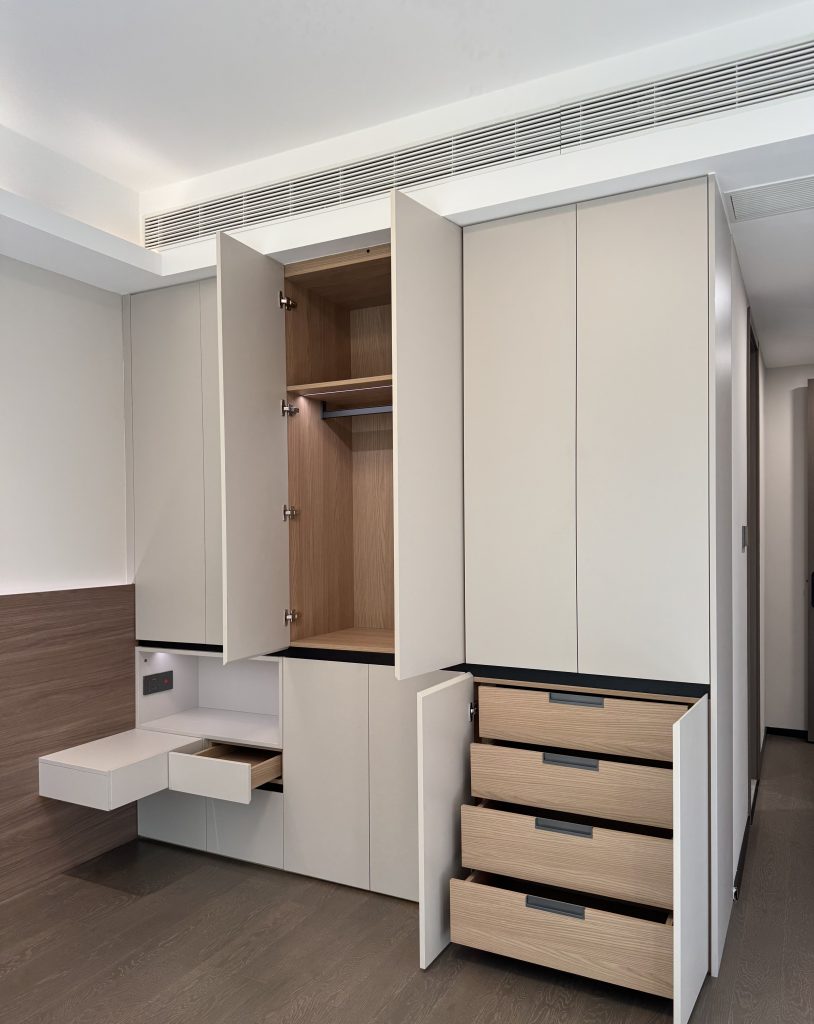
Choosing the right material is one of the most important decisions when purchasing custom kitchen cabinets for a humid environment. Kitchens naturally contain water, steam, heat, cooking oils, and frequent temperature changes. In coastal areas, tropical climates, rainy regions, and homes with poor ventilation, these conditions can put additional stress on cabinet materials.
A cabinet that performs well in a dry climate may not perform the same way in a consistently humid environment.
However, there is no single material that is automatically the best for every kitchen. Cabinet performance depends on the core material, surface finish, edge sealing, hardware, manufacturing quality, installation, ventilation, and how the kitchen is maintained.
This guide explains the most commonly used materials for custom kitchen cabinets and how buyers can select an appropriate construction for humid conditions.
1. Why Humidity Matters for Kitchen Cabinets
Humidity can affect wood-based furniture in several ways.
Repeated exposure to moisture can contribute to:
-
Swelling
-
Edge expansion
-
Surface deterioration
-
Delamination
-
Warping
-
Mold growth
-
Hardware corrosion
Water exposure is especially important around:
-
Sinks
-
Dishwashers
-
Countertops
-
Plumbing connections
-
Cooking areas
-
Floor-level cabinets
A kitchen cabinet does not need to be completely waterproof to perform well. Instead, it needs to be appropriately designed and protected against the moisture conditions it is likely to encounter.
2. The Cabinet Core Material Is Only One Part of the Solution
When buyers compare kitchen cabinet materials, they often focus only on the board used for the cabinet box.
That is important, but it is not the complete picture.
Long-term performance also depends on:
-
Surface treatment
-
Edge banding
-
Adhesive quality
-
Joint construction
-
Hardware
-
Cabinet feet
-
Sealing around sinks
-
Installation quality
-
Ventilation
For example, a good moisture-resistant board can still experience problems if exposed edges are poorly sealed.
Therefore, buyers should evaluate the complete cabinet construction rather than choosing a material based only on its name.
3. MDF for Humid Kitchens
Medium-density fiberboard, commonly known as MDF, is widely used for kitchen cabinet doors and furniture components.
MDF provides a smooth and uniform surface, making it suitable for:
-
Painted doors
-
Decorative panels
-
Routed designs
-
Modern flat-panel cabinets
However, standard MDF should not automatically be considered waterproof.
When MDF is used in humid conditions, buyers should ask about the specific grade and moisture resistance.
The most important areas to protect are exposed edges and cut surfaces.
Appropriate edge sealing and surface finishing can significantly improve the practical performance of the finished cabinet.
4. Moisture-Resistant MDF
Moisture-resistant MDF is specifically engineered to provide improved performance under higher humidity conditions compared with standard MDF.
It can be useful for:
-
Kitchen cabinet doors
-
Bathroom furniture
-
Utility cabinets
-
Humid residential environments
However, moisture-resistant does not mean waterproof.
Continuous exposure to standing water can still damage the material.
For kitchens, moisture-resistant MDF should therefore be combined with good finishing, edge sealing, proper installation, and adequate ventilation.
5. Particle Board for Kitchen Cabinets
Particle board is commonly used in kitchen furniture because it can offer a practical balance between cost and performance.
Its suitability for humid environments depends heavily on the grade of the board and the quality of its surface and edge protection.
When considering particle board, buyers should ask:
-
What is the board grade?
-
Is it moisture resistant?
-
What is the board thickness?
-
How are edges sealed?
-
What surface material is used?
-
What adhesive is used?
-
What environmental standard does it meet?
A high-quality moisture-resistant particle board with proper edge treatment can perform well in many residential kitchen applications.
However, it should not be exposed to prolonged standing water.
6. Plywood for Humid Environments
Plywood is often considered a strong option for kitchen cabinets, especially for cabinet boxes.
It consists of multiple layers of wood veneer bonded together.
Depending on the grade and construction, plywood can provide good structural stability and strength.
Potential advantages include:
-
Good screw-holding performance
-
Strong cabinet construction
-
Good dimensional stability
-
Suitable for heavier cabinet components
-
Availability in different grades
However, plywood quality varies significantly.
Buyers should not assume that every plywood product has the same moisture resistance.
Important specifications include:
-
Plywood type
-
Number of layers
-
Thickness
-
Core quality
-
Glue type
-
Surface grade
-
Edge treatment
For humid kitchens, the edges and exposed surfaces should still be properly protected.
7. Solid Wood Cabinets
Solid wood can provide a premium appearance and long service life when properly manufactured and maintained.
However, wood naturally responds to changes in humidity.
It can absorb and release moisture, causing dimensional movement.
For this reason, solid wood kitchen cabinets require careful:
-
Wood selection
-
Kiln drying
-
Moisture control
-
Construction
-
Finishing
-
Installation
A quality manufacturer should properly prepare the wood before manufacturing.
Solid wood should not be viewed as automatically more moisture resistant than engineered boards.
Its performance depends heavily on species, construction, finishing, and environmental conditions.
8. Laminate Surfaces for Humid Kitchens
Laminate is widely used as a cabinet surface because it can provide a durable and easy-to-clean finish.
It can help protect the underlying board from normal kitchen moisture when properly applied.
Laminate surfaces are available in many:
-
Colors
-
Textures
-
Wood patterns
-
Matte finishes
-
Gloss finishes
However, the edges and joints remain important.
If water reaches an exposed core through an unsealed edge or damaged area, the underlying board may absorb moisture.
Therefore, the surface material and edge treatment should always be considered together.
9. Melamine-Faced Panels
Melamine-faced panels are common in modern kitchen furniture.
The decorative surface is bonded to a wood-based panel and can provide a practical combination of appearance, cleanability, and cost efficiency.
They are available in many colors and wood-grain designs.
For humid environments, the key considerations include:
-
Core board quality
-
Moisture resistance
-
Edge banding
-
Joint construction
-
Surface durability
Melamine surfaces can work well in kitchens when the underlying board and edge treatment are appropriately specified.
10. Acrylic Cabinet Finishes
Acrylic finishes can create a modern high-gloss or premium appearance.
They are commonly used for contemporary kitchen doors and panels.
Acrylic surfaces can be easy to clean, but buyers should still pay attention to the substrate and edge construction.
A high-quality surface does not eliminate the need for appropriate moisture protection around:
-
Sink cabinets
-
Cut edges
-
Joints
-
Cabinet backs
The complete panel construction matters more than the decorative surface alone.
11. PVC Film Cabinet Doors
PVC film is commonly used on certain types of MDF kitchen doors.
It can provide a continuous decorative surface and is available in different colors and textures.
It may be suitable for many residential kitchens, but buyers should pay attention to:
-
Film quality
-
Adhesion
-
Edge construction
-
Heat exposure
-
Manufacturing quality
Areas exposed to excessive heat or steam should be designed carefully.
12. Cabinet Edges Are Critical in Humid Environments
One of the most overlooked parts of kitchen furniture is the cabinet edge.
A board can have a moisture-resistant core, but exposed edges may still allow moisture to enter.
Common edge treatments include:
-
PVC edge banding
-
ABS edge banding
-
Sealed painted edges
-
Protective laminates
The edge should be properly bonded and finished.
This is particularly important around:
-
Sink cabinets
-
Dishwasher openings
-
Countertop joints
-
Cutouts
-
Cabinet bottoms
13. The Sink Cabinet Requires Extra Protection
The cabinet below the sink is one of the highest-risk areas in a kitchen.
It is exposed to:
-
Plumbing
-
Condensation
-
Water splashes
-
Cleaning products
-
Leaks
For this cabinet, buyers should consider stronger moisture protection.
Useful measures include:
-
Moisture-resistant panels
-
High-quality edge sealing
-
Protective bottom panels
-
Waterproof or moisture-resistant liners
-
Easy-access plumbing areas
The cabinet should also allow future plumbing maintenance.
14. Protect the Cabinet Below the Dishwasher
Dishwashers generate heat and moisture during operation.
The surrounding cabinet structure should therefore be designed according to the appliance manufacturer’s installation requirements.
Important considerations include:
-
Appliance dimensions
-
Steam protection
-
Ventilation
-
Edge protection
-
Countertop sealing
-
Door movement
A protective barrier or appropriate moisture-resistant treatment may be necessary depending on the cabinet construction and appliance design.
15. Hardware Matters in Humid Kitchens
Cabinet hardware can experience corrosion in humid or coastal environments.
Important components include:
-
Hinges
-
Drawer slides
-
Pull-out mechanisms
-
Handles
-
Screws
-
Connectors
Stainless steel and appropriately treated metal components may be suitable for humid conditions, depending on the exact environment and product specification.
Buyers should not judge hardware only by appearance.
Ask the manufacturer about:
-
Material
-
Surface treatment
-
Corrosion resistance
-
Load capacity
-
Operating cycles
-
Warranty
16. Stainless Steel Kitchen Cabinets
Stainless steel cabinets provide an alternative to wood-based cabinet construction.
They are commonly used in:
-
Commercial kitchens
-
Restaurants
-
Professional food preparation areas
-
Industrial environments
Potential advantages include:
-
High moisture resistance
-
Easy cleaning
-
Resistance to many common kitchen conditions
-
Strong structural performance
However, stainless steel kitchens can have a different appearance and cost structure compared with traditional residential cabinetry.
The stainless steel grade and fabrication quality also matter.
Not every metal product offers the same corrosion resistance.
17. Aluminum Kitchen Cabinets
Aluminum can also be used in kitchen furniture.
It is naturally resistant to corrosion and can be useful in humid environments.
Potential applications include:
-
Cabinet frames
-
Doors
-
Structural components
-
Outdoor kitchens
-
Coastal environments
However, aluminum kitchen systems can have a different appearance, weight, cost, and construction method from traditional wood-based cabinets.
The appropriate choice depends on project requirements.
18. Best Materials for Tropical Kitchens
Tropical environments can combine high humidity with high temperature.
For these conditions, buyers should pay particular attention to:
-
Moisture-resistant boards
-
Proper edge sealing
-
Good ventilation
-
Corrosion-resistant hardware
-
Appropriate adhesives
-
High-quality finishes
Plywood, moisture-resistant engineered boards, aluminum, and stainless steel can all be considered depending on the project.
There is no universal material choice because residential and commercial kitchens have different requirements.
19. Best Materials for Coastal Areas
Coastal kitchens may experience both humidity and salt exposure.
Salt-rich air can accelerate corrosion of some metal components.
For coastal properties, buyers should pay additional attention to:
-
Hardware corrosion resistance
-
Metal finishes
-
Cabinet ventilation
-
Moisture protection
-
Surface durability
Hardware specification is especially important for homes close to the sea.
20. Ventilation Is Just as Important as Material
Even the best cabinet materials can experience problems if the kitchen has poor ventilation.
Good ventilation helps control:
-
Steam
-
Condensation
-
Heat
-
Humidity
A range hood or suitable ventilation system can reduce the amount of moisture that accumulates around cabinets.
Cabinets should not be designed in a way that blocks required ventilation openings for appliances.
21. Avoiding Water Damage During Installation
Installation quality can have a major impact on cabinet durability.
Common risk areas include:
-
Sink cutouts
-
Countertop joints
-
Plumbing connections
-
Dishwasher openings
-
Wall gaps
-
Floor contact
Any areas that may be exposed to water should be appropriately sealed according to the cabinet and countertop materials.
The cabinet should also be installed correctly so that it is not exposed to unnecessary moisture from the floor or wall.
22. How to Choose the Right Material Based on Budget
Different buyers have different priorities.
Budget-Oriented Projects
Moisture-resistant particle board or appropriately specified MDF can provide a practical solution when properly finished and installed.
Mid-Range Projects
Higher-quality engineered panels, better edge treatment, and upgraded hardware can provide a balance between price and durability.
Premium Residential Kitchens
Plywood, premium MDF, veneer, solid wood, or advanced cabinet systems may be considered depending on design requirements.
Commercial Kitchens
Stainless steel and other highly durable materials may be more appropriate where the kitchen experiences frequent water exposure, intensive cleaning, and heavy use.
23. How to Compare Cabinet Materials From Different Manufacturers
Do not compare suppliers based only on material names.
For example, two manufacturers may both advertise “plywood cabinets,” but the plywood could differ in:
-
Thickness
-
Core structure
-
Grade
-
Glue
-
Surface
-
Manufacturing quality
Similarly, “MDF” can refer to different grades and specifications.
Ask suppliers for detailed technical information.
A useful comparison should include:
Specification |
Supplier A |
Supplier B |
|---|---|---|
Cabinet board |
Confirm |
Confirm |
Thickness |
Confirm |
Confirm |
Moisture resistance |
Confirm |
Confirm |
Door material |
Confirm |
Confirm |
Edge banding |
Confirm |
Confirm |
Adhesive |
Confirm |
Confirm |
Hardware |
Confirm |
Confirm |
Surface finish |
Confirm |
Confirm |
Warranty |
Confirm |
Confirm |
This allows buyers to compare actual specifications instead of marketing descriptions.
24. Questions to Ask a Custom Kitchen Furniture Manufacturer
Before ordering, ask:
What cabinet board do you use?
Request the exact material and specification.
Is the board moisture resistant?
Ask for technical documentation where appropriate.
How are cabinet edges sealed?
This is particularly important around sinks and appliances.
What hardware is used?
Ask about corrosion resistance if the kitchen is in a humid or coastal location.
What finish is applied?
Understand the surface construction and cleaning requirements.
Can you customize the cabinet construction for a humid climate?
The manufacturer should be able to recommend appropriate materials and construction methods.
How are cabinets packaged?
Proper packaging helps prevent damage and moisture exposure during transportation.
25. Common Mistakes When Buying Cabinets for Humid Areas
Choosing material based only on price
A cheap cabinet may not provide the required moisture performance.
Assuming “water-resistant” means waterproof
Moisture-resistant materials still require proper installation and maintenance.
Ignoring edge sealing
Exposed edges can become vulnerable to water absorption.
Using low-quality hardware
Humid environments can accelerate corrosion.
Ignoring ventilation
Poor ventilation can create excessive condensation.
Forgetting the sink cabinet
The area below the sink deserves special attention.
Not checking the manufacturer’s specifications
Material names alone are not enough to evaluate quality.
26. Maintenance Tips for Humid Kitchen Cabinets
Even high-quality cabinets require maintenance.
Practical measures include:
-
Wipe water spills promptly
-
Keep cabinet interiors dry
-
Check plumbing regularly
-
Inspect sink cabinet areas
-
Avoid prolonged standing water
-
Keep ventilation systems clean
-
Check cabinet edges periodically
-
Inspect hinges and drawer slides
-
Repair damaged surfaces promptly
Preventing repeated moisture exposure is one of the simplest ways to extend cabinet service life.
27. Material Selection for International Kitchen Projects
International buyers should consider the destination environment before specifying materials.
A kitchen designed for a dry inland region may have different material requirements from a kitchen installed in a tropical coastal city.
Before ordering, provide the manufacturer with:
-
Destination country
-
Climate conditions
-
Indoor or outdoor application
-
Expected humidity
-
Kitchen usage
-
Project type
-
Cleaning requirements


No reply content