
A Structural Analysis of Three Wind-Resistant Umbrella Frame Designs
Introduction: The Hidden Cost of a Broken Promotional Umbrella
In the promotional umbrella market, breakage is not just a quality issue—it is a brand risk.
Many importers, brand owners, and marketing agencies have faced the same frustrating scenario:
A custom advertising umbrella looks fine in the showroom, but fails after the first strong gust of wind. Ribs bend permanently, stretchers snap, or the entire frame collapses.
From a manufacturing and engineering perspective, this failure is rarely accidental.
In most cases, it is the result of incorrect umbrella frame structure selection, not just material choice or price pressure.
This article takes a structural engineering and production-side approach to answer one core question:
Why do so many custom promotional umbrellas break in the wind—and how do different wind-resistant frame structures actually perform?
Understanding Wind Load on an Umbrella: A Structural Engineering Perspective
An umbrella behaves like a temporary aerodynamic surface under wind pressure.
Key Forces Acting on an Umbrella in Wind Conditions
- Uplift Force – Wind pushing upward against the canopy
- Bending Moment – Stress concentration at rib joints and stretchers
- Torsional Load – Twisting force along ribs and shaft
- Fatigue Stress – Repeated opening, closing, and vibration cycles
Low-cost promotional umbrellas often fail because their frames are not engineered to distribute these forces evenly.
Why Custom Advertising Umbrellas Are More Prone to Wind Damage
1. Cost-Driven Frame Simplification
In promotional projects, factories are often asked to:
- Reduce rib thickness
- Use lower-grade steel
- Minimize joint reinforcement
This results in:
- Reduced yield strength
- Lower moment of inertia
- Higher probability of plastic deformation
2. Logo Customization Adds Stress Points
Large logo panels and full-surface printing:
- Increase fabric tension
- Reduce canopy flexibility
- Amplify wind load on specific ribs
Without a compatible frame structure, stress concentrates at rib hinges.
3. Structural Mismatch Between Canopy and Frame
High-density fabric + weak rib structure = guaranteed failure.
Wind resistance must be treated as a system, not a single component.
The Three Main Wind-Resistant Umbrella Frame Structures Explained
From a production standpoint, wind resistance depends primarily on rib architecture, not marketing labels.
Below are the three most common structural solutions used in modern umbrella manufacturing.
Structure Type 1: Standard Straight Rib Frame (Single-Layer Steel)
Structural Overview
This is the most common and least wind-resistant structure, widely used in low-cost promotional umbrellas.
Design Characteristics:
- Straight steel ribs
- Single hinge joint
- Uniform rib thickness
- Minimal reinforcement
Mechanical Behavior Under Wind Load
- High bending stress at the rib-stretcher joint
- Low elastic recovery
- Permanent deformation once yield point is exceeded
Typical Failure Mode
- Rib bends backward
- Joint fractures
- Umbrella cannot return to original shape
Best Use Case
- Indoor events
- Short-term promotions
- Non-windy environments
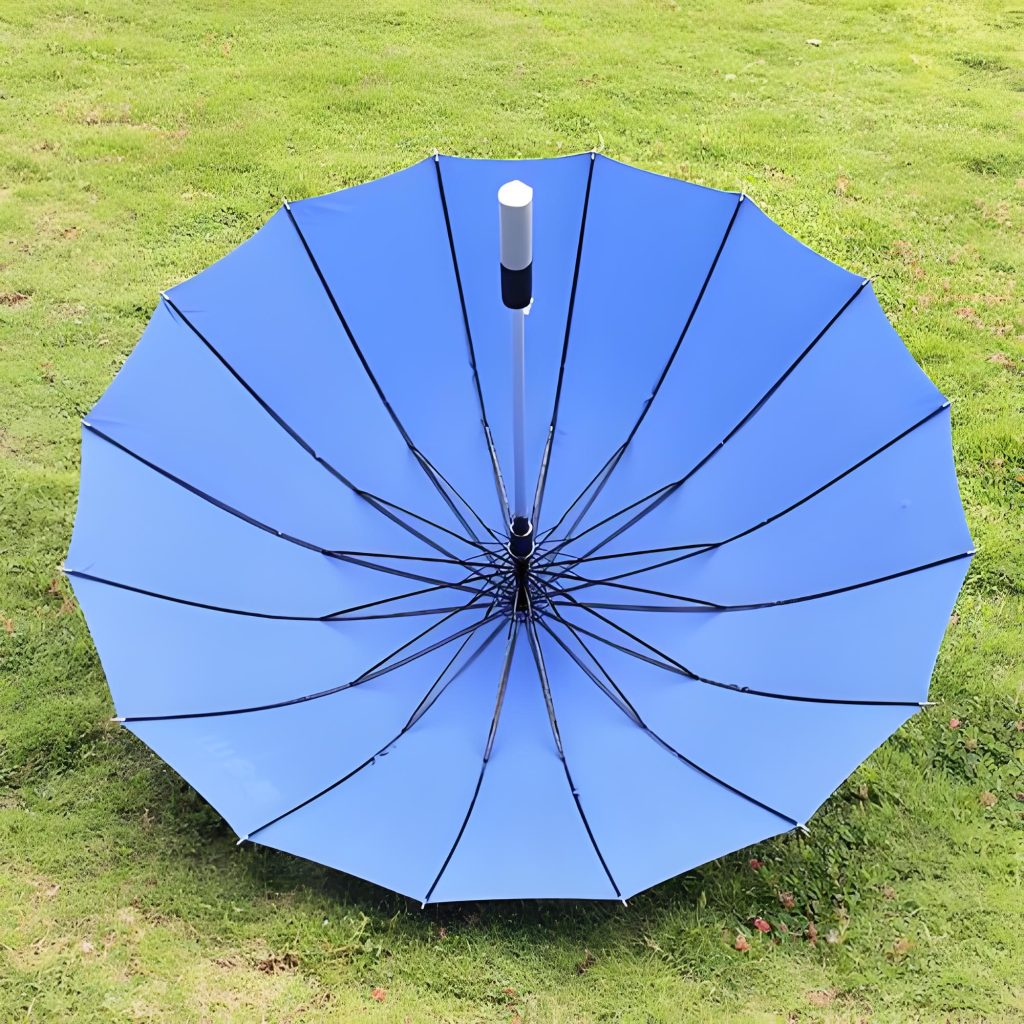
Structure Type 2: Reinforced Double-Rib or Thicker Gauge Frame
Structural Overview
This design improves strength by increasing material thickness or adding secondary ribs.
Design Characteristics:
- Thicker steel or fiberglass ribs
- Reinforced joint points
- Higher rib cross-sectional area
Mechanical Advantages
- Increased moment of inertia
- Improved load-bearing capacity
- Reduced localized stress
Limitations
- Heavier overall weight
- Still relies on rigid resistance rather than flexibility
- Can snap under extreme gusts
Best Use Case
- Mid-range promotional umbrellas
- Corporate gifts
- Moderate wind conditions
Structure Type 3: Flexible Anti-Wind Frame (Inverted or Spring-Loaded Design)
Structural Overview
This is the most effective wind-resistant structure, used in high-quality umbrellas.
Design Characteristics:
- Elastic ribs (fiberglass or composite)
- Spring-loaded joints
- Controlled deformation design
- Energy-dissipating structure
Engineering Principle
Instead of resisting wind force, this structure:
- Absorbs energy
- Temporarily inverts under pressure
- Automatically recovers shape
Mechanical Advantages
- Lower peak stress
- High fatigue resistance
- Excellent elastic recovery
Best Use Case
- Outdoor promotions
- Coastal or windy regions
- Long-term brand use
Technical Specification Comparison Table
| Parameter | Standard Straight Rib | Reinforced Frame | Flexible Anti-Wind Frame |
|---|---|---|---|
| Rib Material | Low-carbon steel | Thick steel / fiberglass | Fiberglass / composite |
| Rib Diameter (mm) | 2.8–3.0 | 3.5–4.2 | 3.0–4.0 |
| Yield Strength | Low | Medium | High |
| Elastic Recovery | Poor | Moderate | Excellent |
| Weight Impact | Light | Heavy | Moderate |
| Wind Load Distribution | Concentrated | Improved | Optimized |
| Fatigue Resistance | Low | Medium | High |
| Typical Lifespan | Short | Medium | Long |
| Cost Level | Low | Medium | High |
Why Flexible Structures Outperform Rigid Ones in Real Wind Conditions
Rigid frames fail because:
- Stress exceeds material yield point
- No energy dissipation mechanism exists
Flexible anti-wind frames succeed because:
- Stress is distributed across multiple joints
- Elastic deformation reduces peak load
- Structure returns to original geometry
From an engineering perspective, controlled flexibility is superior to brute strength.
Common Buyer Mistakes in Anti-Wind Umbrella Selection
- Focusing only on rib thickness
- Ignoring joint design and hinge quality
- Choosing heavy frames assuming “heavier = stronger”
- Not testing umbrellas under real wind simulation
- Over-customizing without structural upgrade
How to Verify Wind Resistance Before Mass Production
Professional buyers should request:
- Rib material specification sheet
- Bending fatigue test results
- Sample wind inversion testing
- Pre-production prototype approval
A reliable factory should explain why a structure works—not just claim it does.
Frequently Asked Questions (FAQ)
Q1: Why do promotional umbrellas break more easily than retail umbrellas?
Because promotional umbrellas often use simplified frame structures to meet low-cost targets.
Q2: Is fiberglass always better than steel for umbrella ribs?
Not always, but fiberglass offers better elasticity and fatigue resistance under wind load.
Q3: Can a thicker rib fully solve wind resistance issues?
No. Without flexible joints and proper structure, thicker ribs can still snap.
Q4: What is the best umbrella structure for outdoor advertising?
Flexible anti-wind frame designs with elastic ribs and reinforced joints.
Q5: Does wind resistance increase production cost significantly?
Yes, but it reduces breakage, complaints, and brand damage long-term.
Final Conclusion: Wind Resistance Is a Structural Decision, Not a Marketing Feature
When a custom advertising umbrella breaks in the wind, the root cause is almost always structural, not accidental.
Understanding the three core umbrella frame structures allows buyers to:
- Reduce after-sales issues
- Improve brand perception
- Match product design to real-world use
A truly wind-resistant umbrella is not the strongest—it is the best engineered.
{
  "@context": "https://schema.org",
  "@type": "FAQPage",
  "mainEntity": [
    {
      "@type": "Question",
      "name": "Why do custom promotional umbrellas break easily in the wind?",
      "acceptedAnswer": {
        "@type": "Answer",
        "text": "Most promotional umbrellas use simplified frame structures that cannot properly distribute wind load, leading to rib deformation or breakage."
      }
    },
    {
      "@type": "Question",
      "name": "What is the most wind-resistant umbrella frame structure?",
      "acceptedAnswer": {
        "@type": "Answer",
        "text": "Flexible anti-wind frame structures with elastic ribs and spring-loaded joints offer the highest wind resistance."
      }
    },
    {
      "@type": "Question",
      "name": "Is thicker umbrella rib material always better?",
      "acceptedAnswer": {
        "@type": "Answer",
        "text": "No. Structural design and flexibility are more important than thickness alone when resisting wind forces."
      }
    }
  ]
}


No reply content