
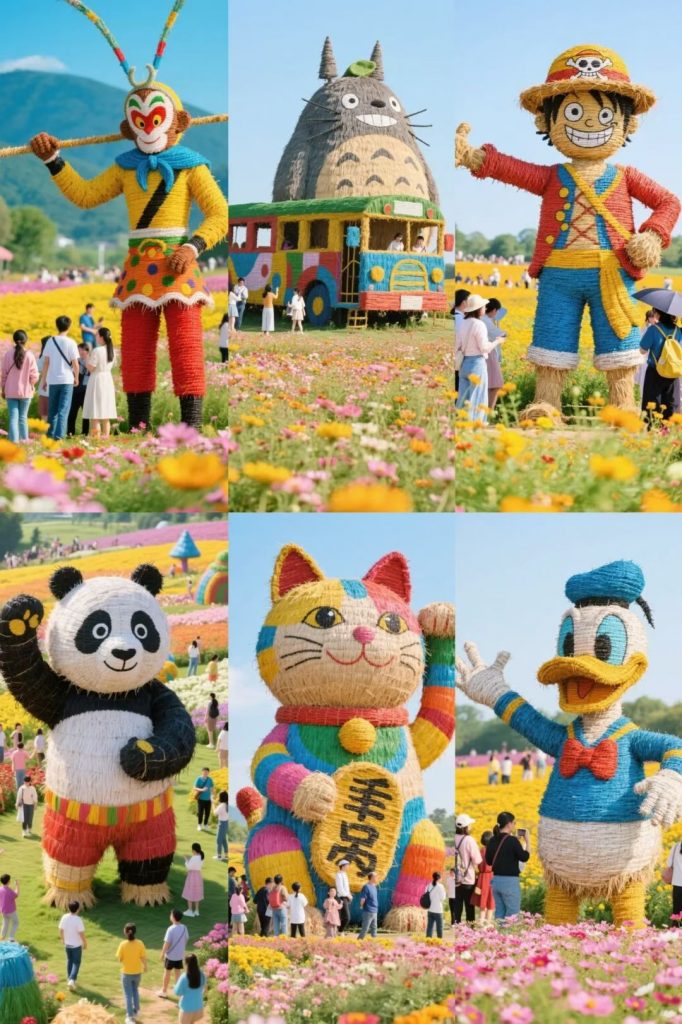
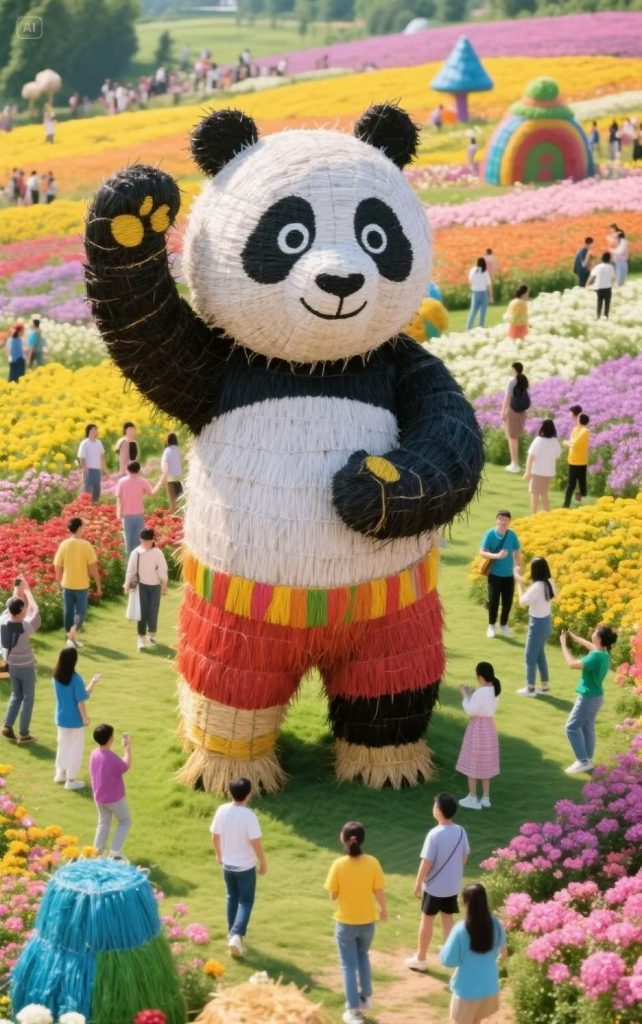
In the competitive landscape of tourism and event design, standing out requires more than just aesthetics—it demands creativity. As travelers and festival-goers seek experiences that surprise, delight, and inspire, outdoor art has evolved from static decoration to dynamic storytelling. Among the most innovative trends reshaping amusement resorts and flower festivals is creative giant panda straw artwork: larger-than-life sculptures crafted from natural straw, designed to push boundaries in form, function, and interaction. These installations blend the universal charm of pandas with imaginative design, transforming ordinary spaces into unforgettable destinations. This article explores how creative straw pandas are redefining entertainment and event landscapes, diving into their design philosophy, technical innovation, and impact on visitor engagement.
The Power of Creative Art in Modern Tourism
The global tourism industry thrives on novelty. A 2024 study by the World Tourism Organization (UNWTO) found that 81% of travelers prioritize “unique experiences” over traditional sightseeing, with 69% willing to pay a premium for attractions that feel “one-of-a-kind.” Amusement resorts and flower festivals, in particular, compete fiercely for attention: resorts aim to extend guest stays beyond rides, while festivals seek to become annual must-visits.
Creative outdoor art addresses this challenge by serving as a magnet for foot traffic, social media buzz, and emotional connection. Unlike generic decor, creative installations tell stories, invite interaction, and adapt to seasons or events. The giant panda, with its global appeal, provides the perfect canvas for this creativity—its iconic shape allows for endless reinterpretation, from playful poses to abstract interpretations, all while maintaining instant recognition.
Why the Panda? A Canvas for Creative Expression
The giant panda is more than a cute animal; it is a cultural and ecological symbol that transcends borders. Native to China but adored worldwide (with over 15 million Instagram posts tagged #panda), pandas evoke feelings of warmth, nostalgia, and curiosity. For creative designers, this makes them an ideal subject:
-
Universal Recognition: Even without context, a panda silhouette sparks joy. This familiarity lowers the barrier to engagement, ensuring visitors of all ages and backgrounds connect with the art.
-
Morphological Flexibility: Pandas’ round bodies, distinct black-and-white markings, and expressive faces lend themselves to creative distortion—artists can exaggerate features (oversized heads, elongated limbs) or simplify forms (abstract geometric shapes) without losing identity.
-
Narrative Potential: Pandas are linked to conservation, bamboo forests, and playfulness—themes that resonate with modern values (sustainability, family fun, mindfulness). Creative designs can weave these narratives into the sculpture itself.
Defining “Creative”: Beyond the Ordinary Panda Sculpture
What separates a “creative” giant panda straw artwork from a standard one? It lies in three key dimensions: interactivity, contextual adaptation, and conceptual innovation.
1. Interactivity: Turning Spectators into Participants
Traditional sculptures are passive; creative ones invite action. Designers embed interactive elements into straw pandas to deepen engagement:
-
Kinetic Features: Moving parts, like a panda waving a bamboo arm or blinking eyes (via hidden motors), surprise visitors. At a flower festival, a panda “picking” flowers with its paws can trigger a sensor that releases a mist of lavender scent.
-
Tactile Experiences: Straw’s natural texture encourages touch. Some sculptures have “fur” that feels soft (short straw) or rough (long straw), while others include removable accessories (hats, scarves) for kids to dress the panda.
-
Digital Integration: Augmented reality (AR) apps let visitors “see” the panda come to life—pointing a phone at the sculpture might reveal a virtual cub playing nearby, or a video of pandas in the wild.
For amusement resorts, interactivity boosts repeat visits: families return to “play” with the panda, while teens share AR clips on TikTok.
2. Contextual Adaptation: Designing for Place and Purpose
A creative panda never feels “out of place.” Designers tailor sculptures to their environment, whether a bustling resort or a serene flower field:
-
Resort Integration: In a “Jungle Adventure” zone, a panda might be depicted swinging from vines; in a “Winter Wonderland” area, it could wear a knitted sweater and hold a snowflake. For resorts with water parks, a panda could sit on a lily pad in a lazy river, its legs dangling in the water.
-
Festival Seasonality: Flower festivals thrive on change. A spring festival might feature a panda surrounded by cherry blossoms, while an autumn event pairs it with chrysanthemums. Some festivals rotate pandas yearly—one year a “musical panda” with a guitar, the next a “chef panda” holding a bamboo steamer.
-
Cultural Fusion: In multicultural resorts, pandas can reflect local traditions. A panda in a Japanese garden might wear a kimono; in a Mexican-themed area, it could sport a sombrero and hold a maraca. This adaptability makes the art feel personal to visitors.
3. Conceptual Innovation: Pushing Artistic Boundaries
Creative pandas challenge the definition of “sculpture.” Designers experiment with form, material, and meaning:
-
Abstract Interpretations: Instead of realistic fur, some sculptures use geometric patterns (triangles for ears, circles for eyes) or gradient straw colors (light to dark) to create a modern aesthetic. A “Pixel Panda” might resemble a 3D video game character.
-
Mixed Media: Straw is combined with other natural materials—dried flowers, twigs, seashells—to add texture. A panda in a coastal resort could have a shell necklace; one in a desert festival might be adorned with cactus spines.
-
Storytelling Series: Resorts and festivals commission series of pandas to tell a story. For example, a “Panda Family” set: a parent panda teaching a cub to climb bamboo, or a group of pandas celebrating a festival. This encourages visitors to explore multiple installations.
The Making of a Creative Panda: From Concept to Creation
Crafting a creative giant panda straw sculpture requires collaboration between artists, engineers, and clients. The process balances imagination with technical precision:
Step 1: Ideation—Brainstorming the “Wow Factor”
Clients (resorts/festivals) share their goals: target audience (families? couples?), theme (adventure? romance?), and desired interaction (photo ops? educational?). Artists then brainstorm concepts—e.g., “a panda astronaut floating among balloons” for a kid’s festival, or “a panda poet writing with a bamboo pen” for a literary event.
Step 2: 3D Modeling and Prototyping
Concepts are translated into 3D models using software like Blender or ZBrush. For complex designs (e.g., kinetic parts), physical prototypes are built with foam or clay to test movement and stability. Clients approve iterations, ensuring the final design aligns with their vision.
Step 3: Frame Construction—The Skeleton of Creativity
A steel or aluminum frame forms the sculpture’s structure. For interactive elements (moving arms, blinking eyes), engineers integrate motors, sensors, and wiring into the frame. The base is reinforced to support weight and withstand crowds—critical for amusement resorts with high foot traffic.
Step 4: Straw Application—Weaving Imagination
Artisans layer straw onto the frame, using techniques that enhance the creative design:
-
Texture Mapping: Short straw for smooth areas (face), long straw for shaggy fur (back).
-
Color Gradients: Dyed straw (using natural pigments like turmeric for yellow, beetroot for pink) creates ombre effects—e.g., a panda with a pink belly fading to white.
-
Mixed Materials: Twigs are woven into the frame for a “wild” look; dried flowers are glued to the paws for a floral festival.
Step 5: Testing and Refinement
Before installation, sculptures undergo stress tests (wind resistance, load-bearing) and user testing (kids and adults try interacting with them). Feedback leads to tweaks—e.g., adjusting the sensitivity of a motion sensor or reinforcing a weak joint.
Step 6: Installation and Activation
Cranes lift the sculpture into place, with teams ensuring it’s level and secure. For interactive elements, technicians calibrate sensors and motors. Resorts might add signage explaining the panda’s story; festivals could host opening ceremonies with performers dressed as pandas.
Applications: Transforming Resorts and Festivals
Creative giant panda straw artworks are versatile enough to enhance diverse settings. Below are two key applications:
1. Amusement Resorts: Extending the Guest Journey
Resorts use creative pandas to fill “dead zones” (underutilized areas) and create photo-worthy moments that drive social media shares. Examples include:
-
Entrance Statements: A 20-foot “Welcome Panda” with arms outstretched greets guests, its chest displaying the resort’s logo.
-
Themed Zone Anchors: In a “Pirate Island” area, a panda dressed as a pirate (eye patch, bandana) sits on a treasure chest.
-
Nighttime Spectacles: LEDs embedded in the straw create glowing effects—e.g., a panda with bioluminescent “fireflies” flying around it.
One U.S. resort reported a 30% increase in photo uploads to its app after installing a “Musical Panda” that played a tune when guests clapped nearby.
2. Flower Festivals: The Heart of the Celebration
Festivals rely on creative pandas to anchor their identity and encourage repeat attendance. Popular designs include:
-
Seasonal Mascots: A “Spring Panda” covered in cherry blossoms, an “Autumn Panda” with maple leaf patterns.
-
Interactive Games: A panda with a puzzle board on its belly—solving it reveals a discount for festival snacks.
-
Collaborative Art: Kids paint sections of a “Community Panda” during workshops, fostering ownership.
A Dutch tulip festival saw a 50% spike in ticket sales after introducing a “Tulip Panda” that appeared to “grow” from a bed of flowers (via hidden lifts that raised the sculpture gradually).
User Experience: Why Creative Pandas Captivate Visitors
The success of these installations lies in their ability to engage visitors on multiple levels:
1. Emotional Connection
Pandas’ inherent cuteness triggers oxytocin release, creating feelings of happiness. Creative designs amplify this—an “awkward dancing panda” or “sleepy panda” elicits laughter, while a “protective mama panda” with a cub inspires warmth.
2. Shareability
In the age of Instagram, creative pandas are built for photos. Unusual poses (a panda doing yoga), interactive elements (AR effects), and seasonal backdrops (cherry blossoms, sunflowers) make for compelling content. A 2024 study found that 92% of festival-goers share art installations on social media, with creative pandas being the most shared category.
3. Learning and Discovery
Many creative pandas incorporate educational elements. A “Habitat Panda” might have panels explaining bamboo ecosystems; a “Diet Panda” could show the difference between bamboo and other foods. For families, this turns art into a teaching moment.
Sustainability: A Creative Bonus
Like all straw art, creative pandas are eco-friendly:
-
Material: Straw is an agricultural byproduct, diverting waste from landfills.
-
Biodegradability: At the end of their 3–5 year lifespan, sculptures decompose naturally.
-
Low Energy: Handcrafting and solar-powered interactive elements minimize carbon footprints.
For resorts and festivals marketing themselves as “green,” this adds a layer of authenticity.
Overcoming Challenges: Ensuring Creative Success
Designing creative pandas isn’t without hurdles:
-
Durability vs. Delicacy: Intricate designs (e.g., moving parts) require stronger frames and frequent maintenance. Solution: Use modular components for easy repairs.
-
Weather Resistance: Rain and sun can fade dye or weaken straw. Solution: Apply plant-based sealants and store sculptures indoors during harsh seasons.
-
Budget Constraints: Complex designs cost more. Solution: Prioritize 1–2 “wow” features (e.g., AR) over excessive details.
Conclusion: Creativity as the Ultimate Attraction
Creative giant panda straw artworks are more than decor—they are experiences. By blending the panda’s universal appeal with imaginative design, interactivity, and contextual adaptation, they transform amusement resorts and flower festivals into destinations that linger in memory.
In a world saturated with distractions, these sculptures cut through the noise. They make visitors laugh, think, and share—driving loyalty and growth for the venues that host them. As the tourism industry evolves, one thing is clear: creativity is the new currency, and the creative panda is its most charming ambassador.
For any resort or festival seeking to make a mark, investing in a creative giant panda straw artwork isn’t just a design choice—it’s a strategic move to win hearts, minds, and social media feeds. After all, in the race for attention, the most creative idea wins.
Article link:https://www.vlefooena.com/creative-giant-panda-straw-artwork-for-amusement-resort-flower-festival-display


No reply content