

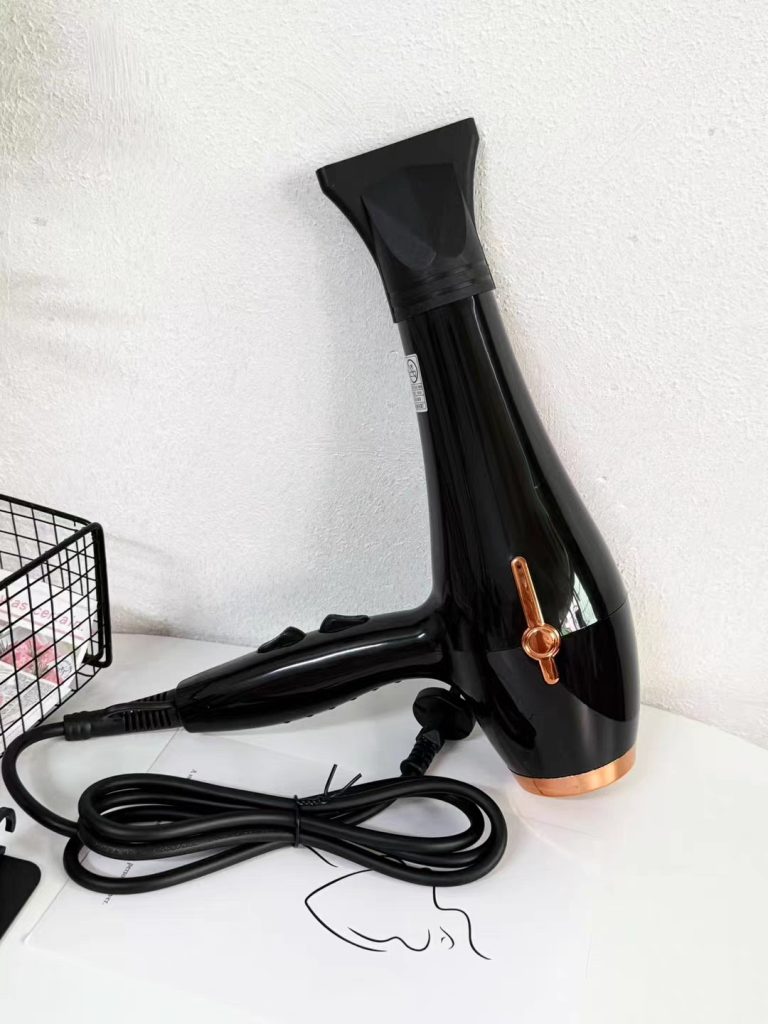
Hair Dryer Wattage Guide for Different Countries and Markets
Choosing the correct wattage is an important part of sourcing hair dryers for international markets. A hair dryer sold in one country may not use the same electrical configuration as a model supplied to another country, and wattage should never be evaluated separately from voltage, frequency, motor performance, heating elements, airflow, and the intended application.
For importers, distributors, hotel groups, retailers, and private-label brands, understanding these specifications before production can help reduce compatibility problems and make supplier quotations easier to compare.
This guide explains how hair dryer wattage works, what buyers should consider in different markets, and how to prepare a clear specification when requesting quotations from a manufacturer.
1. What Does Hair Dryer Wattage Mean?
Wattage indicates the electrical power consumed by the hair dryer under its specified operating conditions.
For example, a product rated at 1,600 W is designed to operate at approximately 1,600 watts under its rated conditions.
However, wattage alone does not tell you how powerful or efficient the hair dryer will feel during use.
Two products with similar wattage can have different:
- Airflow
- Motor performance
- Heating efficiency
- Drying speed
- Temperature control
- Noise levels
- Energy consumption
- Overall user experience
This is why professional buyers should avoid choosing a model solely because it has a higher wattage.
A complete specification is much more useful.
2. Wattage Must Be Considered With Voltage
Voltage and wattage are closely related to the electrical design of a hair dryer.
A buyer should normally provide the manufacturer with both the target voltage and the desired power range.
For example, a specification might state:
Rated Voltage: 220–240 V
Frequency: 50 Hz
Rated Power: 1,800 W
Another market may require a different electrical configuration.
The manufacturer needs to know the destination market before confirming the final electrical design.
This is particularly important for OEM projects because changing the electrical configuration after production has started can affect components, testing, labeling, packaging, and certification requirements.
If you are sourcing from China, it is useful to understand the broader process explained in What Should You Check Before Importing Hair Dryers From China?.
3. Common Wattage Ranges
Hair dryers are available in many power configurations.
Depending on the product category and market, buyers may encounter models around:
- 1,000 W
- 1,200 W
- 1,400 W
- 1,600 W
- 1,800 W
- 2,000 W
- 2,200 W
- 2,400 W
These numbers are examples of common product configurations rather than universal standards.
The appropriate wattage depends on the product’s intended market and application.
A compact travel hair dryer may be designed around lower power consumption, while a professional salon model may use substantially more power.
A hotel hair dryer may fall somewhere between these categories depending on the manufacturer’s design.
4. Does Higher Wattage Mean Faster Drying?
Not necessarily.
Higher wattage can provide more electrical power to the motor and heating system, but actual drying performance depends on the complete product design.
Important factors include:
Airflow
Strong airflow can move more air through the hair and help remove moisture.
Motor Efficiency
A well-designed motor can provide useful airflow without simply increasing power consumption.
Heating Element
The heating system determines how effectively electrical energy is converted into heat.
Airflow Path
The internal design influences how efficiently air travels from the inlet through the heating area and out of the nozzle.
Temperature Control
A product that maintains a stable operating temperature can provide a more consistent user experience.
Therefore, when comparing a 1,600 W product with a 2,000 W product, buyers should compare the complete specifications rather than assuming that the 2,000 W model is automatically better.
5. Why Country Matters
Electrical systems vary between countries and regions.
A buyer should identify the destination market before selecting the final model.
Relevant information includes:
- Voltage
- Frequency
- Plug configuration
- Power requirements
- Applicable electrical regulations
- Product labeling requirements
- Certification requirements
For example, a model intended for a market using approximately 220–240 V may require a different electrical configuration from a model intended for a market using approximately 110–120 V.
The plug is also important.
Even when voltage is compatible, the plug supplied with the product may not be suitable for the destination market.
For international distribution, buyers should therefore specify the complete electrical configuration rather than simply saying “international model.”
6. Hair Dryer Wattage for 220–240 V Markets
Many countries use electrical systems around 220–240 V.
For these markets, buyers may encounter hair dryers in a variety of power ratings, including approximately 1,400 W, 1,600 W, 1,800 W, 2,000 W, or higher.
The exact specification depends on the product design and target application.
For example:
Basic Household Model
A lower-powered product may be sufficient for consumers who prioritize compact size and moderate energy consumption.
Hotel Model
A hotel may choose a balanced configuration that provides reasonable drying performance while remaining suitable for repeated guest use.
Professional Model
Professional products may use higher power where strong airflow and faster drying are important.
The important point is that the wattage should be selected as part of the overall product specification.
7. Hair Dryer Wattage for 110–120 V Markets
Markets using approximately 110–120 V require appropriate electrical designs.
The same product cannot simply be assumed to work identically after changing the plug.
The manufacturer may need to use components designed for the target voltage.
Buyers should therefore specify:
Voltage: Target voltage
Frequency: Target frequency
Power: Required wattage
Plug: Target plug type
The manufacturer can then confirm whether an existing model can be adapted or whether a different configuration is required.
This is particularly important for private-label projects where the buyer wants one brand to be sold across multiple markets.
8. Frequency Is Also Important
Buyers sometimes focus on voltage and forget frequency.
Electrical frequency is normally expressed in hertz, such as 50 Hz or 60 Hz.
Depending on the motor and electrical design, frequency can affect equipment operation.
For this reason, an international RFQ should not simply state:
220 V hair dryer
A more complete specification should identify both voltage and frequency.
For example:
Rated Voltage: 220–240 V
Rated Frequency: 50 Hz
The manufacturer should confirm whether the selected model is appropriate for the target market.
9. How Wattage Affects Energy Consumption
Wattage also affects electricity consumption.
A simple calculation can help buyers understand the relationship.
If a 2,000 W hair dryer operates continuously for 15 minutes:
2,000 W × 0.25 hours = 500 Wh
That equals:
0.5 kWh
This does not mean every user consumes exactly 0.5 kWh because real operation may involve different heat settings, cycling, and operating times.
However, the calculation illustrates why power consumption can matter for hotels and other facilities with large numbers of units.
If a hotel has hundreds of rooms, even relatively small differences in energy consumption can become relevant over long periods.
10. Hotels Should Not Automatically Choose the Highest Wattage
For hospitality projects, the highest wattage is not necessarily the best choice.
A hotel may need to balance:
- Drying performance
- Energy consumption
- Noise
- Product weight
- Electrical capacity
- Guest expectations
- Safety requirements
- Purchase cost
- Long-term operating cost
For example, a lightweight hotel hair dryer with good airflow and controlled heating may provide a better guest experience than a heavier high-wattage model.
The correct approach is to test the product in realistic conditions.
If the product is intended for hotels, see the related guide:
How to Choose a Hair Dryer for Hotel and Hospitality Projects
11. Wattage and Motor Performance
The motor is a major part of the hair dryer’s performance.
A motor drives the fan, which moves air through the appliance.
When comparing manufacturers, buyers can ask for information about:
- Motor type
- Motor speed
- Airflow
- Rated power
- Expected operating life
- Noise
- Thermal performance
A manufacturer that only provides the wattage but cannot explain airflow or motor characteristics may not be providing enough information for a professional product comparison.
For professional and high-performance applications, buyers may also want to compare different motor technologies.
12. Wattage and Heating Elements
The heating element converts electrical energy into heat.
A higher-rated product may be able to generate more heat, but temperature control is equally important.
The buyer should evaluate:
- Heating speed
- Temperature stability
- Maximum operating temperature
- Heat distribution
- Thermal protection
- Cool-air function
A good hair dryer should provide useful heat without creating excessive temperature fluctuations.
This becomes especially important for products intended for professional or frequent use.
13. Dual-Voltage Hair Dryers
Some travel hair dryers are designed with dual-voltage capability.
A dual-voltage product may be able to operate across different voltage ranges when properly configured.
However, buyers should not assume that every hair dryer can support multiple voltages.
If dual voltage is required, state this clearly in the RFQ.
For example:
Required electrical configuration: dual voltage
The manufacturer should then confirm:
- Supported voltage range
- Frequency
- Maximum power
- Switching method
- Plug configuration
- Safety requirements
Dual-voltage functionality can be useful for travel products, but it may not be necessary for a fixed hotel installation.
14. How to Specify Wattage When Requesting a Quotation
A common mistake is to ask:
Please quote your best hair dryer.
This gives the manufacturer too much room to choose the product configuration.
A better RFQ could say:
Product: Professional hair dryer
Application: Hotel guest rooms
Quantity: 2,000 units
Voltage: 220–240 V
Frequency: 50 Hz
Power: 1,800–2,000 W
Plug: Specify destination plug
Speed: 2 or 3 settings
Temperature: 2 or 3 settings
Cool Shot: Required
Logo: Required
Color: Custom
Packaging: Custom hotel packaging
Destination: Specify country
This creates a much more useful quotation.
15. How to Compare Different Wattage Options
Suppose a manufacturer offers three models:
| Model | Rated Power | Application |
|---|---|---|
| Model A | 1,400 W | Compact / basic use |
| Model B | 1,800 W | General household / hotel use |
| Model C | 2,200 W | Higher-performance applications |
The buyer should not choose Model C simply because 2,200 W is the highest number.
Instead, compare:
- Airflow
- Drying performance
- Temperature
- Noise
- Weight
- Energy consumption
- Electrical compatibility
- Price
- Safety features
- Expected service life
The final selection should match the actual market and application.
16. Consider Plug Type Separately
The plug is part of the electrical configuration but should be specified separately.
A buyer should tell the manufacturer the destination country and confirm the exact plug requirement.
For international orders, the product label, plug, voltage, frequency, and user instructions should all be consistent.
A common procurement mistake is to request the correct voltage but forget the plug configuration.
This can create unnecessary rework before shipment.
17. Certification and Compliance
Electrical products may be subject to different regulatory and certification requirements depending on the destination market.
The buyer should identify the target market before requesting compliance documentation.
Ask the manufacturer:
- What certifications are available for the model?
- Which market do they apply to?
- Are the documents current?
- Does the exact model number match the documentation?
- Are the electrical specifications consistent with the tested product?
Do not assume that a certificate for one model automatically applies to every model produced by the same factory.
For a detailed purchasing approach, see:
How to Verify a Hair Dryer Manufacturer in China
18. Test the Actual Sample
Before placing a large order, test the actual sample.
Record:
- Voltage
- Frequency
- Wattage
- Airflow
- Temperature
- Noise
- Weight
- Cable length
- Plug
- Functions
- Appearance
If the buyer approves the sample, the final production specification should correspond to the approved version.
This is especially important for OEM orders because the final product may include customized components or branding.
19. Prepare a Country-Specific Specification
If you sell the same brand in multiple countries, do not assume that one specification is suitable everywhere.
Instead, maintain a country-specific product table.
For example:
| Market | Voltage | Frequency | Plug | Power |
|---|---|---|---|---|
| Market A | Confirm locally | Confirm locally | Confirm locally | Select based on design |
| Market B | Confirm locally | Confirm locally | Confirm locally | Select based on design |
| Market C | Confirm locally | Confirm locally | Confirm locally | Select based on design |
The actual values should be confirmed against the destination market’s current electrical requirements and the manufacturer’s technical documentation.
This approach is safer than using one generic “international” specification.
20. Work With the Manufacturer on the Final Configuration
The manufacturer should confirm whether the requested combination of voltage, frequency, wattage, motor, heating element, plug, and accessories is technically available.
This is particularly important when buyers request custom configurations.
A professional manufacturer should be able to explain whether:
- An existing model can be used
- Components need to be changed
- A new sample is required
- Testing is required
- The MOQ changes
- Production lead time changes
- Packaging needs to be updated
This information should be confirmed before the buyer approves the final order.
FAQ
What wattage is best for a hair dryer?
There is no single wattage that is best for every application. The appropriate power depends on the target market, voltage, product design, airflow, motor, heating system, and intended use.
Does higher wattage make a hair dryer more powerful?
Not necessarily. Higher wattage can provide more electrical power, but actual performance also depends on the motor, fan, airflow design, heating element, and temperature control.
What wattage is suitable for hotel hair dryers?
Many hotel products use moderate to relatively high power, but the correct specification depends on the property’s electrical system, guest requirements, product design, and energy considerations.
Does voltage affect hair dryer wattage?
Voltage and wattage are related to the electrical design, but they are separate specifications. Buyers should provide the manufacturer with the required voltage and desired power rather than selecting wattage independently.
Do I need to specify frequency when buying hair dryers?
Yes. Frequency can be an important part of the electrical specification, especially for international sourcing. The manufacturer should confirm compatibility with the destination market.
Can one hair dryer work in multiple countries?
Some models are designed for multiple voltage ranges, including certain dual-voltage travel products. However, buyers should confirm the exact supported voltage, frequency, plug, and operating requirements with the manufacturer.
Is a 2,000 W hair dryer better than a 1,600 W model?
Not automatically. A 2,000 W model may consume more power, but actual drying performance depends on the complete design. Buyers should compare airflow, temperature control, motor performance, noise, weight, and energy consumption.
What information should I provide to a hair dryer manufacturer?
Provide the destination market, voltage, frequency, plug type, target wattage, product application, quantity, required functions, branding, packaging, and any specific performance requirements.
Should I test a hair dryer before placing a bulk order?
Yes. A sample allows the buyer to confirm actual electrical specifications and evaluate airflow, heating, noise, ergonomics, functions, appearance, and packaging.
Does wattage affect electricity costs?
Yes. Higher rated power can result in higher electricity consumption when operating for the same amount of time, although actual consumption depends on operating settings and usage patterns.
Can a manufacturer customize the wattage?
In some cases, manufacturers can customize electrical configurations, but the available options depend on the product architecture, motor, heating element, target market, and production requirements.
Conclusion
Hair dryer wattage should never be considered as an isolated number.
For international buyers, the complete electrical configuration includes voltage, frequency, power, plug, cable, motor, heating system, and applicable market requirements.
For hotels and other large projects, buyers should also consider airflow, noise, energy consumption, durability, maintenance, branding, and long-term supply.
The most reliable sourcing process starts with a clear specification, followed by sample testing and confirmation of the final production configuration.
Instead of asking a manufacturer for the “most powerful” hair dryer, define the actual application and destination market first. The manufacturer can then recommend a suitable configuration based on the required performance and electrical environment.
A well-defined wattage specification makes supplier quotations easier to compare and reduces the risk of receiving a product that is unsuitable for the intended market.


No reply content