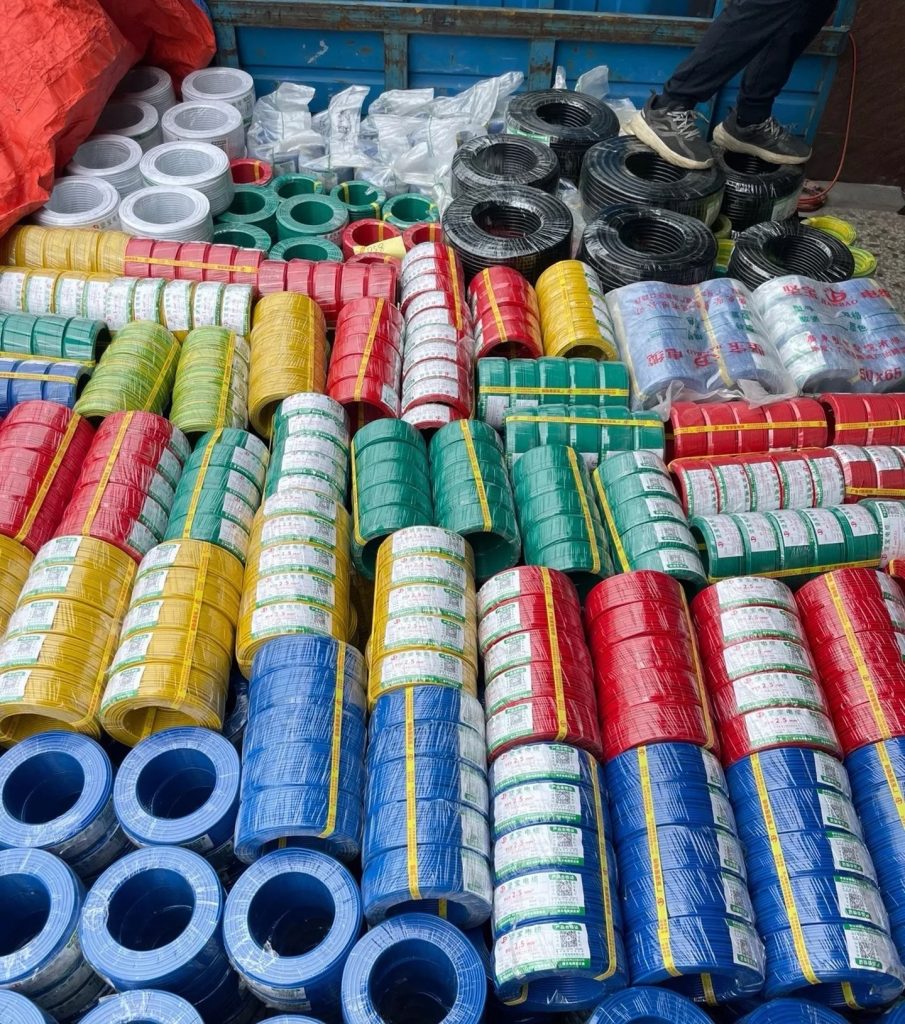
How to Buy Electrical Wires from China: A Step-by-Step Guide for Importers
Buying electrical wires from China can be cost-effective, but getting a competitive quotation is only one part of the purchasing process. For importers, distributors, electrical wholesalers, contractors, and project buyers, the more important questions are whether the wire matches the required standard, whether the copper conductor is correctly sized, whether the insulation meets the specification, and whether the supplier can maintain the same quality across repeated shipments.
A buyer may receive several quotations for what appears to be the same 450/750V PVC insulated copper wire, yet the final products can differ in conductor construction, resistance, insulation thickness, packaging, certification, and manufacturing tolerance.
This guide explains how to buy electrical wires from China step by step, from defining the specification and finding a suitable manufacturer to requesting samples, comparing quotations, checking quality, confirming packaging, and placing a first bulk order.
For buyers specifically looking for BV, 60227 IEC 01, or H07V-U products, it is useful to review the detailed PVC Insulated Building Wire Supplier China | BV, H07V-U, 450/750V product information before preparing an RFQ.
1. Decide Exactly What Electrical Wire You Need
The first mistake many importers make is contacting factories with a request such as:
“Please quote electrical wire.”
That is not enough information for a serious factory quotation.
Electrical wire is not a single standardized product. The manufacturer needs to know the conductor material, cross-sectional area, insulation material, voltage rating, conductor class, applicable standard, color, packing method, required length, certification, destination market, and expected quantity.
For example, a specification could be:
- Product: single-core copper building wire
- Conductor: copper
- Conductor class: solid Class 1
- Insulation: PVC
- Voltage: 450/750V
- Size: 1.5mm², 2.5mm², 4mm², 6mm², 10mm²
- Standard: IEC 60227-3 / 60227 IEC 01
- Color: brown, blue, green/yellow
- Packing: 100m coils
- Quantity: 10,000m per size
- Destination: specified country and port
- Certification: according to the destination market
This level of information allows factories to quote the same product instead of sending different specifications under the same product name.
2. Understand BV, 60227 IEC 01 and H07V-U Before You Buy
One of the most important issues when importing electrical wire from China is understanding the terminology.
BV wire and 60227 IEC 01 are commonly associated with single-core PVC-insulated copper building wire. H07V-U belongs to a different designation system and is commonly specified for European-style procurement.
The physical construction may look very similar, but the marking and applicable standards can be different.
The supplier’s BV Wire 60227 IEC 01 Manufacturer China | 450/750V Single Core information is useful when the purchasing specification specifically requires BV or 60227 IEC 01.
For buyers comparing Chinese BV wire with European-style H07V-U wire, the H07V-U Solid Copper Cable: Complete Technical and Pricing Guide from a China Manufacturer guide provides a more focused reference.
Do not assume that a factory can print every standard mark simply because the wire has a similar appearance.
If a buyer requires dual marking, the supplier should confirm that the actual construction, testing, and documentation support the declared standards.
3. Choose the Correct Wire Size
The cross-sectional area is one of the most important specifications in an electrical wire order.
Common building-wire sizes include:
| Size | Typical application |
|---|---|
| 1.5mm² | Lighting and smaller circuits |
| 2.5mm² | General sockets and ordinary power circuits |
| 4mm² | Higher-load branch circuits |
| 6mm² | Larger AC and sub-feed applications |
| 10mm² | High-load circuits, panel feeds and selected EV charging applications |
| 16mm² and above | Main feeders and larger distribution systems |
These are purchasing references rather than universal installation rules. The correct wire size depends on local electrical codes, installation method, conductor temperature, cable length, voltage drop, ambient temperature, grouping, and load.
A supplier should not simply tell a buyer that “2.5mm² is suitable” without understanding the actual application.
For buyers specifically purchasing larger house-wiring conductors, the PVC Building Wire for House Wiring | 10mm² BV Cable Supply page can be used as a product-level reference.
4. Ask for Conductor Resistance, Not Just a Product Name
A cheap quotation does not necessarily mean a cheaper product.
The copper conductor is one of the largest cost components of electrical wire. If the actual conductor is smaller than specified, the supplier may be able to offer a surprisingly low price, but the electrical performance will not be equivalent.
For common solid copper building wire, buyers should request:
- Nominal cross-sectional area
- Conductor construction
- Maximum DC resistance at 20°C
- Conductor diameter
- Copper material
- Conductor class
- Insulation thickness
- Overall diameter
For example, reference values commonly used for 450/750V solid copper PVC building wire include approximately:
| Size | Maximum DC resistance at 20°C |
|---|---|
| 1.5mm² | 12.1 Ω/km |
| 2.5mm² | 7.41 Ω/km |
| 4mm² | 4.61 Ω/km |
| 6mm² | 3.08 Ω/km |
| 10mm² | 1.83 Ω/km |
These values should always be checked against the exact standard and construction specified in the purchase contract.
A professional buyer should therefore compare the technical specification, not simply compare the price per meter.
5. Find a Manufacturer Instead of Comparing Only Trading Quotes
China has many companies selling electrical wire, but an importer should first determine whether the supplier is:
- A manufacturer
- A factory with its own production lines
- A trading company
- A distributor
- A sourcing company
For repeated wholesale purchases, dealing directly with a suitable manufacturer can make it easier to control conductor specifications, colors, packaging, printing, production batches, and quality documentation.
The Wholesale Single Core Copper Wire Factory | BV H07V-U China information is particularly relevant for buyers looking for wholesale BV and H07V-U single-core copper wire.
However, “factory” should not be accepted as proof of quality by itself.
A buyer should still verify:
- What products are actually manufactured?
- What conductor sizes are produced?
- What standards are supported?
- What testing equipment is available?
- Can the factory provide batch test records?
- Can the supplier provide production photos or videos?
- Can samples be produced?
- Can the supplier maintain the same specification for repeat orders?
6. Send the Factory a Professional RFQ
A good RFQ saves time for both sides.
Instead of writing:
“Please quote BV cable.”
Send something closer to:
Product: PVC insulated single-core copper building wire
Standard: IEC 60227-3 / 60227 IEC 01
Voltage: 450/750V
Conductor: solid copper, Class 1
Sizes: 1.5 / 2.5 / 4 / 6 / 10mm²
Colors: brown / blue / green-yellow
Packing: 100m coil
Quantity: 10,000m per size
Printing: required
Certification: specify required market certification
Destination port: [port]
Trade term: FOB / CIF
Target delivery: [date]
Then ask the supplier to provide:
- Unit price
- MOQ
- Production lead time
- Packing details
- Gross/net weight
- Coil dimensions
- Carton quantity
- Certificate availability
- Test report
- Sample availability
- Payment terms
- Quotation validity
This produces much more useful quotations than simply asking for “best price.”
7. Compare Quotations on the Same Basis
Suppose three Chinese suppliers send three different prices.
Do not immediately select the lowest number.
Create a comparison table.
| Item | Supplier A | Supplier B | Supplier C |
|---|---|---|---|
| 2.5mm² price/m | — | — | — |
| Copper specification | — | — | — |
| Insulation thickness | — | — | — |
| DC resistance | — | — | — |
| Standard | — | — | — |
| Certification | — | — | — |
| Packing | — | — | — |
| MOQ | — | — | — |
| Production time | — | — | — |
| Test report | — | — | — |
| FOB/CIF | — | — | — |
This often explains why one quotation is much cheaper than another.
For example, one supplier may quote 100m retail coils while another quotes 500m coils or drums. One quotation may include certification while another does not. One may include OEM printing, while another charges it separately.
The quotation must therefore be normalized before making a purchasing decision.
8. Understand How Copper Changes the Price
Electrical wire is highly sensitive to copper prices.
A quotation that looks attractive today may not remain valid for several weeks.
The final price generally includes several components:
Copper + PVC + production + energy + testing + printing + packaging + certification + factory margin + logistics
For larger contracts, importers can ask whether the supplier supports a copper-index pricing mechanism.
This is particularly useful for distributors purchasing repeatedly throughout the year.
Instead of demanding a fixed price for twelve months, the contract can define:
- Base copper price
- Adjustment index
- Adjustment date
- Processing cost
- Packaging cost
- Price adjustment formula
This gives both buyer and manufacturer a more realistic framework for long-term supply.
9. Check Packaging Before Placing a Bulk Order
Packaging is often ignored during the quotation stage.
However, electrical wire is sold in different formats:
- 100m coils
- 200m coils
- 500m coils
- 1,000m drums
- Wooden reels
- Plastic reels
- Retail cartons
- Project packaging
A distributor selling through hardware stores may prefer 100m coils with individual labels.
A construction project may prefer longer coils or drums because less packaging means easier handling and lower packaging cost per meter.
The buyer should confirm:
- Length per coil
- Coil dimensions
- Carton quantity
- Carton dimensions
- Pallet quantity
- Gross weight
- Net weight
- Drum type
- Label information
- Barcode requirements
- Private-label printing
10. Decide Whether You Need OEM Printing
OEM printing is useful when the importer sells wire under its own brand.
The printed information may include:
- Brand name
- Product designation
- Voltage
- Cross-sectional area
- Standard
- Certification mark where legitimately applicable
- Meter marking
- Factory information
- Batch information
Do not ask a factory to print a certification mark unless the product is actually covered by the required certification.
This is particularly important for electrical products because the printed marking can become part of the compliance and traceability process.
11. Request Samples Before a Large Order
For a first transaction, a sample is usually worth the additional time and shipping cost.
A buyer can use the sample to check:
- Conductor appearance
- Copper construction
- Insulation quality
- Color consistency
- Outer diameter
- Printing quality
- Coil length
- Flexibility
- Surface finish
- Packaging
- Documentation
For larger projects, the buyer should also consider third-party inspection or laboratory testing.
A sample is not a substitute for production inspection, but it establishes a physical reference before mass production.
12. Check the Manufacturer’s Quality Control Process
A serious electrical-wire supplier should be able to explain how quality is controlled.
Important production checkpoints include:
Copper rod inspection
The factory should control conductor material and electrical properties before insulation extrusion.
Conductor diameter
The conductor should remain within the required construction specification.
Insulation thickness
PVC insulation should be checked for minimum thickness and consistency.
Eccentricity
The conductor should remain properly centered inside the insulation.
Spark testing
Online spark testing can help identify insulation defects during production.
DC resistance
Finished wire should be tested against the required resistance limit.
Finished-length inspection
The actual amount of wire supplied should match the ordered length.
Printing and identification
The product marking should correspond with the agreed specification.
A professional purchasing contract should identify which quality parameters are mandatory rather than relying on a general statement such as “high quality.”
13. Verify Certification According to the Destination Market
Certification requirements depend on where the wire will be sold or installed.
The buyer should tell the supplier the actual destination market before requesting certification.
Depending on the project, requirements may involve:
- IEC standards
- EN/HAR-related requirements
- CE-related documentation
- RoHS
- VDE
- CCC
- National electrical approvals
- Project-specific third-party testing
Do not simply ask:
“Do you have CE?”
Ask:
“Which exact product, size range, standard, certificate number, test report, and manufacturing site are covered?”
That distinction is important.
A certificate covering one construction or one product family does not automatically prove that every cable size and every construction is certified.
14. Pay Attention to MOQ
MOQ can be negotiated, especially for a first trial order.
For example, the supplier may have different requirements for:
- Stock products
- Standard colors
- Custom colors
- OEM printing
- Custom packaging
- Special certification
- Mixed-size containers
A buyer who needs only 1,000m per size should not assume the same price structure as a distributor ordering tens of kilometers.
Ask for at least three quantities:
- Trial quantity
- Normal wholesale quantity
- Container quantity
This allows the buyer to understand where the supplier’s price breaks occur.
15. Consider a Mixed-Size Order
Many electrical wholesalers do not need one full container of a single size.
A mixed order can contain:
- 1.5mm²
- 2.5mm²
- 4mm²
- 6mm²
- 10mm²
It can also contain multiple colors.
For a distributor, this may be more practical than purchasing a large quantity of only one size.
However, mixed orders can increase production planning, color changeover, packaging, labeling, and inventory complexity.
Therefore, ask the manufacturer for a complete mixed-container quotation rather than calculating each size separately.
16. Confirm Incoterms Before Comparing Prices
“$0.XX per meter” is not a complete international quotation.
The buyer needs to know whether the price is:
- EXW
- FOB
- CFR
- CIF
- Other agreed Incoterm
A factory offering a low EXW price may not be cheaper after local transportation, export handling, inspection, documentation, freight, and insurance are included.
For an importer, landed cost is often more useful than factory price.
The purchasing calculation should consider:
Product cost + China local charges + export costs + ocean/air freight + insurance + destination charges + duties/taxes + inland delivery
17. Confirm Production Lead Time in Writing
Do not rely on a message saying “fast delivery.”
Ask for a specific production schedule.
For example:
- Sample preparation: X days
- Production: X days
- Inspection: X days
- Packing: X days
- Ready date: X date
Standard stock products may be available faster than custom production.
Custom printing, special colors, certification, special compounds, and non-standard packaging can extend production time.
For project orders, the promised ready date should be written into the purchase documentation.
18. Avoid the Most Common Importing Mistakes
The biggest problems usually do not come from the physical appearance of the wire.
They come from specification misunderstandings.
Common mistakes include:
Mistake 1: Buying based only on price
A lower price may reflect different copper content, packaging, certification, or specifications.
Mistake 2: Not specifying the standard
“PVC copper wire” is not a complete technical specification.
Mistake 3: Assuming BV and H07V-U are automatically identical
They may belong to the same application family but use different designation and standard systems.
Mistake 4: Ignoring conductor resistance
Resistance provides an important technical check on conductor performance.
Mistake 5: Ordering custom packaging without checking MOQ
Private-label packaging can increase the minimum order.
Mistake 6: Accepting certificates without checking their scope
The certificate should correspond to the actual product construction and required market.
Mistake 7: Not approving a pre-production sample
A sample gives the buyer a physical reference before mass production.
Mistake 8: Comparing EXW and CIF prices as if they were the same
The Incoterm must be identical when comparing quotations.
19. A Practical First-Order Process
For a new importer, the following process is more reliable than immediately placing a large order.
Step 1: Define the product
Confirm size, conductor class, insulation, voltage, standard, colors, and application.
Step 2: Find several suitable manufacturers
Compare production capability rather than company names alone.
Step 3: Send the same RFQ
Every supplier should receive the same specification.
Step 4: Compare technical quotations
Check conductor resistance, insulation thickness, standard, certification, packing, MOQ, and price.
Step 5: Request samples
Use the sample as a physical benchmark.
Step 6: Confirm documentation
Review certificates, test reports, product specifications, and packaging artwork.
Step 7: Negotiate the commercial terms
Confirm price, quantity, payment, Incoterm, production time, inspection, and warranty terms.
Step 8: Place the purchase order
Make the technical specification part of the order documentation.
Step 9: Inspect production
For larger orders, arrange factory inspection or third-party inspection.
Step 10: Approve shipment
Verify quantities, packaging, labels, documents, and shipping marks before loading.
20. What Should Be Written in the Purchase Order?
A good purchase order should contain more than the product name.
At minimum, specify:
Product: PVC insulated single-core copper building wire
Size: 1.5mm² / 2.5mm² / 4mm² / 6mm² / 10mm²
Conductor: solid copper Class 1
Voltage: 450/750V
Standard: exact standard required by the project
Insulation: PVC
Color: exact color
Length: exact length per coil
Printing: approved printing specification
Packaging: approved packaging
Certification: required certification and documentation
Quantity: exact quantity
Inspection: agreed inspection requirements
Delivery: agreed production and shipment schedule
Incoterm: EXW / FOB / CIF / other agreed term
The more important the project, the less the buyer should depend on verbal promises.
21. Which Product Should You Start With?
For a distributor entering the Chinese electrical-wire supply chain, a practical starting assortment is often:
- 1.5mm²
- 2.5mm²
- 4mm²
- 6mm²
- 10mm²
The exact combination should be based on the destination market and customer demand.
If the target market mainly uses European-style specifications, H07V-U may be more appropriate.
If the market purchases according to Chinese or IEC-based BV specifications, 60227 IEC 01 may be the more relevant product.
For buyers who want to understand the broader product range and construction options, the PVC Insulated Building Wire Supplier China | BV, H07V-U, 450/750V page provides a useful starting point.
22. Questions to Ask a Chinese Electrical Wire Manufacturer
Before placing the order, ask these questions:
- Are you the manufacturer or a trading company?
- Which cable sizes do you produce in-house?
- Which standards can the factory manufacture and test against?
- What is the conductor class?
- What is the maximum DC resistance?
- What is the nominal insulation thickness?
- Can you provide a sample?
- Can you provide a batch test report?
- Which certifications are available for my market?
- What is the MOQ per size and color?
- Can different sizes be mixed in one shipment?
- Can you provide OEM printing?
- What coil and drum options are available?
- What is the production lead time?
- How is the copper price calculated?
- What Incoterms can you quote?
- Can you arrange pre-shipment inspection?
- What happens if the delivered product does not match the approved specification?
A supplier’s answers to these questions can tell a buyer much more than a polished product catalog.
23. Final Buying Checklist
Before paying the deposit, confirm all of the following:
- [ ] Exact product name
- [ ] Cross-sectional area
- [ ] Copper conductor specification
- [ ] Conductor class
- [ ] Voltage rating
- [ ] Applicable standard
- [ ] Insulation material
- [ ] Insulation thickness
- [ ] Maximum DC resistance
- [ ] Color
- [ ] Coil or drum length
- [ ] Packaging
- [ ] OEM printing
- [ ] Certification
- [ ] Test report
- [ ] Quantity
- [ ] MOQ
- [ ] Production lead time
- [ ] Inspection requirements
- [ ] Payment terms
- [ ] Incoterm
- [ ] Destination port
- [ ] Shipping marks
- [ ] Approved sample
If several of these items are still unclear, the order is probably not ready to place.
Frequently Asked Questions
Is China a good source for electrical wires?
China has a large manufacturing base for electrical wires and cables, including building wire, industrial cable, power cable, control cable, and customized products. The key is to select the correct manufacturer and control the technical specification rather than choosing purely by price.
What electrical wire sizes are commonly imported?
For building-wire applications, 1.5mm², 2.5mm², 4mm², 6mm² and 10mm² are common purchasing sizes. Larger projects may require 16mm² and above.
What information should I send when requesting a quotation?
At minimum, provide product type, conductor material, conductor class, size, voltage, standard, color, quantity, packing, certification requirements, destination port, and Incoterm.
Should I buy samples before a bulk order?
Yes. Samples are particularly important for a first order or when the wire will be sold under your own brand.
Can Chinese manufacturers make OEM electrical wire?
Many manufacturers can support OEM printing, custom colors, coil packaging, drums, labels and other private-label requirements. MOQ and tooling or packaging requirements should be confirmed before ordering.
How can I compare two electrical wire suppliers?
Use the same RFQ and compare conductor specification, resistance, insulation thickness, standard, certification, packing, MOQ, lead time, Incoterm and total landed cost.
Is the cheapest quotation usually the best choice?
No. A low quotation may result from different copper content, different packaging, different certification requirements, lower quantities, or different commercial terms. Technical and commercial specifications should be compared together.
What is the most important quality check?
There is no single check that replaces all others. Conductor resistance, conductor construction, insulation thickness, dimensional consistency, voltage testing, marking, and batch documentation should be considered together.
Can I mix different wire sizes in one container?
This can often be arranged for wholesale orders, but the factory should confirm the production schedule, MOQ, packaging requirements, and loading plan for each size and color.
What should I do if I need a long-term supply contract?
Instead of demanding an unrealistic fixed price, discuss a copper-index adjustment mechanism, fixed processing costs, agreed quality standards, inspection procedures, delivery schedules, and price-adjustment rules.
Conclusion
Buying electrical wires from China should be treated as a technical sourcing project, not simply a price comparison exercise.
The best purchasing decision comes from matching the correct wire construction with the required standard, market certification, application, packaging, quantity, and delivery terms.
For a first order, the safest approach is to define the specification clearly, send the same RFQ to several qualified manufacturers, compare technical and commercial quotations on the same basis, approve a sample, verify documentation, and inspect the production before shipment.
For buyers sourcing BV, 60227 IEC 01 and H07V-U products, the available product information for Wholesale Single Core Copper Wire Factory | BV H07V-U China and H07V-U Solid Copper Cable: Complete Technical and Pricing Guide from a China Manufacturer can be used alongside the supplier’s technical quotation when comparing specifications.
The objective should not be to find the cheapest electrical wire in China. It should be to find a supplier that can consistently deliver the correct conductor, correct insulation, correct standard, correct documentation, and correct quantity at a commercially workable landed cost.


No reply content