
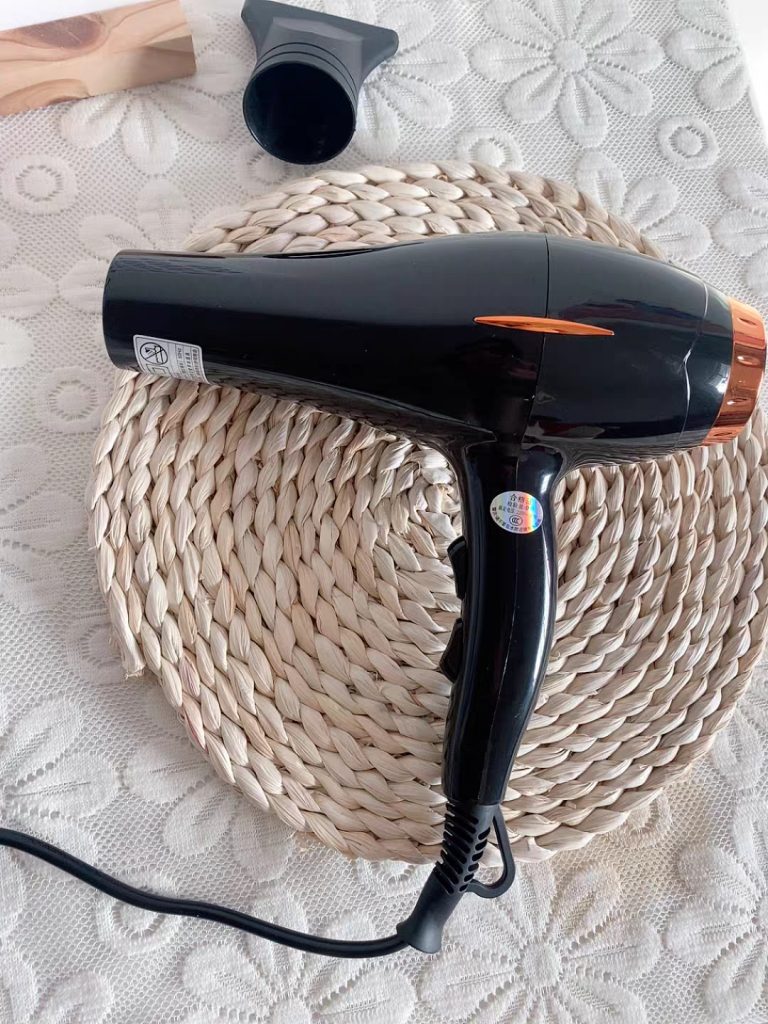
How to Find a Hair Dryer OEM Manufacturer in China
Finding a hair dryer supplier in China is relatively easy.
Finding an OEM manufacturer that can turn your product requirements into a repeatable commercial product is a different task.
A catalogue may show hundreds of hair dryers. A salesperson may tell you that almost everything can be customized. The difficult part begins when you ask for a specific motor, your own housing color, a custom package, a particular electrical configuration, and a production quantity that fits your launch plan.
This is where OEM sourcing becomes important.
For an international brand, the right Chinese hair dryer OEM manufacturer should not simply sell an existing product with a logo attached. The supplier should be able to understand your requirements, identify what can be modified, prepare samples, control production, and reproduce the approved configuration when you reorder.
This guide explains how to find and evaluate that type of manufacturer.
What Does Hair Dryer OEM Mean?
OEM usually refers to manufacturing a product according to a buyer’s specifications or branding requirements.
For hair dryers, OEM production can range from relatively simple private labeling to substantial product customization.
A basic OEM project might involve:
- Existing hair dryer model
- Customer logo
- Custom retail box
- Custom manual
- Different color
A more advanced project could involve:
- Modified housing
- Different motor
- Customized heating system
- New button arrangement
- Special airflow requirements
- Custom accessories
- New packaging
- Product-specific electrical configuration
The important point is that OEM does not always mean designing an entirely new hair dryer from zero.
Before contacting manufacturers, it helps to decide how much customization you actually need.
For a detailed comparison, see Hair Dryer OEM vs ODM: What Is the Difference for Buyers?.
Start With Your Product Requirements
One of the most common sourcing mistakes is looking for a factory before defining the product.
You might search for:
hair dryer OEM factory China
and contact twenty suppliers.
But if each supplier receives a different interpretation of your requirements, their quotations will not be directly comparable.
Before searching, prepare a basic product brief.
Include:
- Target market
- Expected quantity
- Voltage
- Frequency
- Plug
- Power range
- Motor requirements
- Heat settings
- Speed settings
- Special functions
- Color
- Logo
- Packaging
- Accessories
- Target delivery date
You do not need a 50-page specification.
A clear one-page product brief is often enough to begin a productive discussion.
Decide Whether You Need OEM or an Existing Platform
There are three practical approaches to consider.
Option 1: Existing Model + Branding
You select an existing factory model and customize:
- Logo
- Color
- Packaging
- Manual
This is usually simpler than developing a new product.
Option 2: Existing Platform + Technical Changes
You use an existing product platform but modify selected components or features.
For example:
- Different motor
- Different heating element
- Different switch
- Different housing color
- Additional accessory
This can provide more differentiation without requiring a completely new product.
Option 3: New Product Development
You want a substantially different design.
This may involve:
- Industrial design
- Engineering
- Tooling
- Prototypes
- Testing
- Multiple samples
- Production validation
The third approach can create a more distinctive product, but it requires more time, communication and development investment.
Search for Manufacturers by Capability, Not Only by Product Name
When searching for an OEM factory, do not look only at catalogue photos.
Two manufacturers may both advertise:
Hair Dryer Manufacturer
but have very different capabilities.
Look for evidence of:
- Hair dryer production
- Engineering capability
- OEM experience
- Assembly lines
- Component sourcing
- Testing
- Product development
- Packaging customization
- Quality control
A manufacturer with a large catalogue is not automatically the right manufacturer for your project.
The question is:
Can this supplier manufacture the particular product I need?
Use a Detailed OEM Search Brief
When contacting a manufacturer, send enough information for the factory to understand your project.
A useful first message could include:
Product: Hair Dryer
Target market: [Country/region]
Quantity: [Estimated quantity]
Voltage: [Requirement]
Plug: [Requirement]
Power: [Requirement]
Brand: [Your brand]
Customization: Logo + color + packaging
Special requirements: [Details]
Expected launch: [Date]
Then ask the manufacturer:
Please confirm whether your factory can manufacture this configuration and provide your MOQ, sample cost, sample lead time and estimated production lead time.
This is far more useful than sending:
“Please send your best price.”
Verify That the Manufacturer Actually Makes Hair Dryers
Once you receive responses, begin checking the manufacturers.
Do not assume that every company presenting itself as a factory owns the relevant production capability.
Ask:
Is this hair dryer manufactured in your own facility?
Then ask:
Which production facility manufactures the model you are quoting?
You can also request:
- Factory address
- Factory photographs
- Production-line video
- Production-line video call
- Product testing area
- Assembly area
- Packaging area
The objective is not simply to see a large building.
You want to establish a connection between the company you are communicating with and the product you intend to purchase.
For a deeper verification process, see How to Verify a Hair Dryer Manufacturer Before Placing an Order in China.
Ask About the Engineering Team
OEM production requires more than assembly.
Ask:
Do you have an in-house engineering team for hair dryer development?
Then ask what the engineering team handles.
For example:
- Product structure
- Electrical design
- Motor selection
- Heating system
- Housing design
- Mold modification
- Prototype development
- Product testing
The answers can help you distinguish a manufacturer that mainly assembles existing products from one capable of supporting product development.
Ask What Can Actually Be Customized
Never accept a general statement such as:
“Everything can be customized.”
Instead, ask the manufacturer to classify the possibilities.
Logo
Can the logo be:
- Printed?
- Laser marked?
- Embossed?
- Applied using another process?
Color
Can you choose:
- Existing colors?
- Custom colors?
- Multiple colors?
Housing
Can the existing housing be modified?
Motor
Can the motor specification be changed?
Heating System
Can the heating configuration be modified?
Controls
Can the button arrangement or controls be changed?
Accessories
Can the manufacturer develop custom attachments?
Packaging
Can the retail packaging be completely customized?
Specific questions produce much more useful answers.
Do Not Assume a Logo Makes a Product OEM
A product with your logo is not necessarily a deeply customized OEM product.
If you take an existing hair dryer, add a logo and put it into a custom box, you may have a private-label product.
That can be perfectly suitable for some brands.
But if your business needs a unique product, ask whether the manufacturer can modify the underlying product itself.
The distinction matters because development costs, MOQ, lead time and engineering requirements can change significantly.
Ask About Existing OEM Projects
You do not necessarily need confidential customer information.
Instead, ask:
What types of OEM hair dryer projects has your factory handled?
You can ask for examples involving:
- Custom colors
- Custom packaging
- Modified motors
- Professional salon models
- Travel models
- High-power models
- Special accessories
If the supplier can explain previous manufacturing work clearly, you can better understand its practical capabilities.
Compare the Factory’s Catalogue With Its OEM Capability
A large catalogue can be useful, but it should not be your main evaluation method.
Suppose Factory A shows 200 hair dryer models.
Factory B shows 20 models.
Factory A may appear stronger.
But if Factory B has:
- Better engineering support
- More flexible customization
- Better sample development
- Stronger quality control
- More suitable production capacity
then catalogue size alone tells you very little.
For OEM sourcing, capability matching is more important than catalogue size.
Ask About the Existing Product Platform
If you want to develop a customized hair dryer, ask whether the factory has an existing platform that can be adapted.
For example:
Can we use your existing housing and customize the internal configuration?
or:
Can you modify this existing model rather than developing a completely new product?
Using an existing platform may reduce development complexity.
It can also make the first commercial order easier to organize.
Discuss MOQ Before Developing Too Far
MOQ is one of the most important commercial questions.
A manufacturer might offer:
- Lower MOQ for standard products
- Higher MOQ for custom colors
- Higher MOQ for custom packaging
- Higher MOQ for custom components
- Much higher MOQ for new tooling
Therefore, do not ask only:
What is your factory MOQ?
Ask:
What is the MOQ for our exact OEM configuration?
You can also ask whether different colors or packaging designs require separate minimum quantities.
For more detail, see What MOQ Should You Expect When Buying Hair Dryers From a Chinese Supplier?.
Request a Sample Before Making a Large Commitment
A sample is where your project moves from conversation to physical product.
Ask the manufacturer to prepare a sample based on the intended production configuration.
Check:
- Appearance
- Weight
- Dimensions
- Motor performance
- Airflow
- Heat
- Controls
- Noise
- Accessories
- Logo
- Color
- Packaging
Do not evaluate the sample only by appearance.
A hair dryer can look excellent while having a configuration that does not match your commercial requirements.
A detailed inspection process is covered in How to Inspect Hair Dryer Samples Before Placing a Bulk Order.
Make Sure the Sample Represents Mass Production
This is one of the most important questions in OEM sourcing.
Ask:
Will the components and configuration used in the approved sample be the same as those used for mass production?
Then ask:
How will the approved sample be recorded as the production reference?
Ideally, the project should have a clear specification that records:
- Model
- Motor
- Heating system
- Power
- Voltage
- Plug
- Color
- Logo
- Accessories
- Packaging
Otherwise, “approved sample” can become too vague.
Ask About Component Changes
Components can become unavailable.
A supplier may therefore need to replace a component during a long-term production relationship.
Ask:
If a key component changes, will you notify us and obtain approval before mass production?
This is particularly important for:
- Motor
- Heating element
- PCB
- Switch
- Cable
- Plug
- Important structural components
A replacement should not simply happen without communication if it affects the agreed product.
Check Electrical Configuration Carefully
If you are importing hair dryers, electrical configuration must be discussed early.
Confirm:
- Voltage
- Frequency
- Plug
- Power
- Cable
- Applicable market requirements
For example, a hair dryer intended for one market may require a different electrical configuration from a product sold in another market.
Never allow the factory to “choose the standard version” unless that is actually what you want.
Ask Which Certifications and Documents Apply
Do not simply ask:
“Do you have CE?”
Ask:
Which compliance documents and test reports apply to the exact model and electrical configuration we are purchasing?
This is a much more useful question.
Depending on the destination market and product configuration, buyers may need different documentation.
The supplier should be able to identify the documents associated with the actual product rather than simply sending a generic certificate.
See also What Certifications Should a Hair Dryer Manufacturer Provide?.
Understand the Development Cost
If your project requires tooling or engineering work, ask for the costs separately.
For example:
Sample cost
Engineering/development cost
Tooling cost
Packaging development cost
Mass-production unit price
Separating these costs makes the quotation easier to understand.
It also prevents a buyer from assuming that a low unit price includes every development expense.
Ask Who Owns the Tooling
If new molds are required, ask:
Who owns the tooling after payment?
Also confirm:
- Tooling cost
- Tooling maintenance
- Storage
- Tooling life
- Transfer conditions
- Whether the tooling can be moved to another manufacturer
The exact commercial arrangement should be documented before production begins.
Ask About Production Capacity
A manufacturer may be capable of producing your first 500 units.
That does not automatically mean it can support 10,000 units later.
Ask:
What is the normal monthly production capacity for this model?
Then ask:
How does capacity change during peak season?
If your business expects rapid growth, discuss future volumes before choosing the supplier.
Evaluate the Factory’s Communication
OEM manufacturing involves many details.
Communication quality matters because a small misunderstanding can affect the finished product.
Watch how the supplier responds to questions.
Does the salesperson:
- Understand your requirements?
- Confirm technical details?
- Ask useful questions?
- Check with engineering?
- Send revised specifications?
- Clearly identify costs?
- Explain limitations?
A supplier that says “yes” to everything may actually be giving you less useful information than a manufacturer that clearly explains what cannot be done.
Compare Quotations on the Same Specification
Never compare:
Factory A: $8.20
Factory B: $7.60
Factory C: $9.10
without checking what each price includes.
Instead, compare:
| Requirement | Factory A | Factory B | Factory C |
|---|---|---|---|
| Exact model | |||
| Motor | |||
| Power | |||
| Voltage | |||
| Plug | |||
| Functions | |||
| Logo | |||
| Packaging | |||
| Accessories | |||
| MOQ | |||
| Sample cost | |||
| Production lead time | |||
| Testing documents |
Only then does the price comparison become meaningful.
For additional guidance, see How to Choose a Hair Dryer Manufacturer in China for Your Brand.
Do Not Choose a Factory Based Only on the Lowest Price
The lowest quotation may be attractive.
But your actual cost includes much more than the unit price.
Consider:
- Sample development
- Tooling
- Packaging
- Inspection
- Defective products
- Rework
- Shipping
- Delays
- Documentation
- Communication
- Repeat-order consistency
A slightly higher factory price may come with a different specification or service level.
The correct comparison is between complete offers for the same product.
Build a Small Supplier Shortlist
You do not need to contact hundreds of factories.
Start with a manageable group.
For each manufacturer, record:
Company
Factory location
Hair dryer experience
OEM capability
Main product types
MOQ
Sample lead time
Production lead time
Customization capability
Documentation
Communication
Quotation
Then remove suppliers that cannot meet your basic requirements.
Move From Salesperson to Engineering
Once you have identified a promising supplier, ask whether you can discuss the project with someone from engineering or product development.
This can be particularly useful when you need:
- Motor changes
- Heating modifications
- Housing changes
- New functions
- New tooling
- Custom accessories
A salesperson can discuss commercial terms.
An engineer can often tell you whether the requested product is technically practical.
Both perspectives matter.
Use a Sample Approval Process
For a customized product, avoid saying simply:
“Sample approved.”
Instead, create a short approval record.
Include:
- Sample date
- Model
- Version
- Motor
- Heating configuration
- Power
- Voltage
- Plug
- Color
- Logo
- Accessories
- Packaging
- Special requirements
Then identify this version as the reference for production.
This makes future discussions much clearer.
Confirm What Happens During Mass Production
Before placing the order, ask:
What quality-control stages are performed during production?
A practical production process may include checks at different stages rather than waiting until the end.
Ask how the factory handles:
- Incoming materials
- Assembly
- Electrical testing
- Functional testing
- Appearance inspection
- Final packing
The exact inspection process should match the product and your agreed quality requirements.
Consider a Pre-Shipment Inspection
For a larger OEM order, an inspection before shipment can provide an additional layer of control.
The inspection can compare the finished goods against agreed requirements such as:
- Model
- Quantity
- Appearance
- Function
- Packaging
- Accessories
- Electrical configuration
For larger commercial orders, define the inspection requirements before production rather than after the goods are ready.
Think About the Second Order Before the First Order
This is an overlooked part of OEM sourcing.
Your first order is a test of the supplier relationship.
Your second order tells you whether the manufacturing process is repeatable.
Ask:
Can you reproduce the same approved configuration for future orders?
Also ask how the factory records:
- Product version
- Component specifications
- Artwork
- Packaging
- Color
- Production instructions
A supplier relationship becomes much more valuable when the product can be reproduced consistently.
A Practical OEM Sourcing Workflow
A useful process looks like this:
1. Define the product
↓
2. Identify suitable Chinese manufacturers
↓
3. Confirm manufacturing capability
↓
4. Discuss OEM customization
↓
5. Compare MOQ and commercial terms
↓
6. Request samples
↓
7. Test and inspect samples
↓
8. Finalize technical specifications
↓
9. Approve artwork and packaging
↓
10. Confirm production schedule
↓
11. Place the order
↓
12. Monitor production
↓
13. Inspect finished goods
↓
14. Ship
↓
15. Record the final production version for reorders
This process is more reliable than choosing a factory from a catalogue and immediately placing a large order.
What Makes a Chinese Hair Dryer OEM Manufacturer Worth Considering?
Instead of looking for a manufacturer that claims to be “the best,” look for evidence that matches your project.
You want to understand:
- Can they manufacture the product?
- Can they customize the required parts?
- Can they produce a representative sample?
- Can they explain technical limitations?
- Can they provide relevant documentation?
- Can they meet your MOQ?
- Can they meet your production schedule?
- Can they control component changes?
- Can they reproduce the approved product?
- Can they communicate clearly throughout production?
Those questions are much more useful than a generic factory ranking.
Frequently Asked Questions
Can I find a hair dryer OEM manufacturer in China with a small order?
Some manufacturers may support relatively small OEM projects, especially when the customization is limited. However, MOQ can increase when you require custom colors, packaging, components or tooling.
Can a Chinese factory put my logo on an existing hair dryer?
Yes, many manufacturers offer branding on existing models. However, logo customization is only one level of OEM and should not be confused with full product development.
Do I need to develop a completely new hair dryer for my brand?
No. Many brands can begin with an existing product platform and customize selected elements such as color, logo, packaging, accessories or certain technical components.
How do I know whether a supplier is really an OEM manufacturer?
Ask which facility produces the exact model, request evidence of production capability, discuss engineering support, and ask detailed questions about customization and production.
Should I visit the factory?
A factory visit can be useful for a significant project, but it is not the only way to evaluate a manufacturer. A live video factory tour, documentation review, sample evaluation and production verification can also provide useful information.
How important is the sample?
Very important. The sample allows you to evaluate the physical product and confirm whether the manufacturer’s interpretation matches your requirements.
Should the sample and mass-produced product be identical?
The mass-produced product should follow the agreed specification and approved production reference. Any significant component or design change should be addressed before production.
How much customization can a hair dryer factory provide?
It depends on the manufacturer and product platform. Simple projects may involve branding and packaging, while advanced OEM projects can involve structural, electrical and functional modifications.
Final Thoughts
Finding a hair dryer OEM manufacturer in China is not simply a matter of finding a factory with attractive product photos.
The better approach is to start with your own product requirements and then find a manufacturer whose capabilities match them.
Ask specific questions.
Verify the production capability.
Understand what can actually be customized.
Request a representative sample.
Document the approved configuration.
Confirm the electrical requirements and documentation.
Then make sure the factory can reproduce the same product when your business grows.
For a brand planning to import hair dryers from China, the goal should not simply be to find a supplier willing to quote a low price.
The goal is to establish a manufacturing relationship in which the product you approve, the product you order and the product you receive are clearly connected by one documented specification.


No reply content