
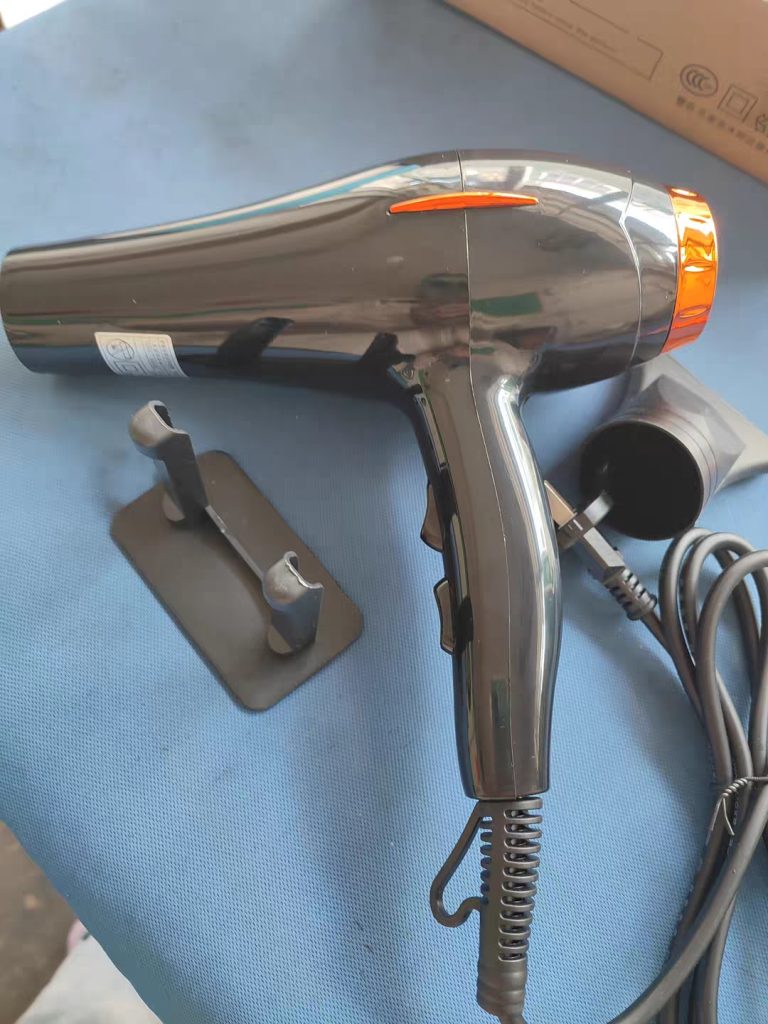
How to Inspect Hair Dryer Samples Before Placing a Bulk Order
Ordering a sample is one of the most important steps when buying hair dryers from a Chinese manufacturer.
A product may look good in photographs, have an attractive quotation, and meet your expected specifications on paper. However, the actual sample can reveal differences in airflow, heating performance, noise, weight, materials, accessories, packaging, and electrical configuration.
For importers, wholesalers, retailers, hotel suppliers, salon distributors, and private-label brands, the sample should therefore be treated as a technical reference rather than simply a product demonstration.
Before placing a large order, buyers should inspect the sample systematically and compare it with the quotation and agreed specifications.
This guide explains what to check when evaluating a hair dryer sample from a Chinese manufacturer.
Why Hair Dryer Sample Inspection Matters
A sample gives the buyer an opportunity to evaluate the physical product before committing to mass production.
This is particularly important when ordering:
- Wholesale hair dryers
- OEM hair dryers
- ODM hair dryers
- Hotel hair dryers
- Salon hair dryers
- Professional hair dryers
- Ionic hair dryers
- High-speed hair dryers
- Private-label products
The sample inspection can identify problems that are difficult to discover from product photographs or written specifications.
For example, two hair dryers may both be advertised as 2,000W models while having noticeably different airflow, noise levels, weight, controls, heating behavior, and construction.
This is why buyers should evaluate the complete product rather than focusing on one specification.
For more information about selecting a manufacturer, see Hair Dryer Manufacturer in China | OEM & ODM Hair Dryers.
Step 1: Confirm the Sample Model
Before testing the product, confirm that the sample is actually the model quoted by the manufacturer.
Check:
- Model number
- Product name
- Product color
- Housing design
- Motor configuration
- Rated power
- Voltage
- Frequency
- Plug
- Accessories
- Packaging
- Logo, if applicable
If you requested a customized sample, make sure the sample reflects the customization discussed with the manufacturer.
Do not approve mass production based only on a photograph of a different model.
Step 2: Check the Overall Appearance
Start with a visual inspection.
Look at the housing from different angles and check whether:
- Plastic surfaces are smooth
- Parts fit together correctly
- There are no obvious cracks
- There are no significant scratches
- Buttons are properly installed
- Seams are reasonably consistent
- The air inlet is correctly assembled
- The nozzle fits properly
- The handle feels secure
For private-label products, also inspect the logo.
Check whether the logo is:
- Correctly positioned
- Correctly sized
- Clearly printed or applied
- Resistant to normal handling
- Consistent with the approved artwork
Appearance problems may not affect basic operation, but they can become important when the product is sold under your own brand.
Step 3: Check the Weight
Weight is easy to overlook when comparing quotations.
However, it can strongly influence user experience.
A salon professional may hold a hair dryer repeatedly throughout the working day. A hotel guest may prefer a compact and lightweight product.
Record the actual sample weight.
If possible, compare it with the manufacturer’s specification.
If the quotation states one weight but the actual sample is significantly different, ask the supplier to explain the difference.
Also consider how the weight is distributed.
A hair dryer with reasonable total weight can still feel uncomfortable if most of the weight is concentrated toward the front.
Step 4: Test the Motor
The motor is one of the most important components of a hair dryer.
During sample testing, observe:
- Startup behavior
- Operating sound
- Airflow
- Speed changes
- Vibration
- Stability
- Response when switching settings
Listen for unusual sounds such as:
- Rattling
- Grinding
- Excessive vibration
- Irregular motor noise
A short test is useful, but commercial buyers should also consider repeated operation.
A product designed for salon or professional use may be exposed to much more frequent operation than a household hair dryer.
If the manufacturer provides motor information, compare the sample with the stated specification.
Step 5: Test Airflow
Airflow should be evaluated separately from wattage.
A higher rated power does not automatically mean stronger airflow.
Airflow can be affected by:
- Motor design
- Fan design
- Air inlet
- Internal air path
- Outlet design
- Nozzle design
- Heating system
- Overall engineering
Test every available speed setting.
Record whether the airflow changes clearly between settings.
For high-speed models, pay particular attention to whether the advertised performance is consistent with the actual sample.
If you are considering a high-speed product, see High Speed Hair Dryer Manufacturer China: OEM and Wholesale Buying Guide.
Step 6: Test Every Heat Setting
Do not test only the highest temperature.
Check every available heat setting.
Observe:
- Temperature change
- Heating speed
- Stability
- Control response
- Airflow consistency
The temperature should behave consistently with the product’s intended design.
If the hair dryer has multiple heat settings but the difference between settings is difficult to notice, ask the manufacturer to explain the expected performance.
For professional applications, temperature control can be particularly important.
Step 7: Test the Cool-Shot Function
If the model has a cool-shot function, test it separately.
Check:
- Whether the function activates immediately
- Whether the airflow remains stable
- Whether the air temperature changes as expected
- Whether the button or switch is easy to operate
- Whether the function continues working after repeated use
For a professional model, this function can be part of the normal styling workflow.
It should therefore be included in the sample inspection rather than treated as an optional feature.
Step 8: Check the Controls
Operate every switch and button repeatedly.
Check whether:
- The buttons are easy to press
- The switches feel stable
- Settings are clearly identifiable
- The controls accidentally change position
- The controls are comfortable during use
A product can have good internal components but still provide a poor user experience if the controls are difficult to operate.
For hotel products, simple controls may be more important than having many unnecessary functions.
For salon products, multiple speed and heat settings may be more useful.
The application should determine the control design.
Step 9: Check the Heating System
The heating system should be evaluated together with the airflow.
During testing, observe whether the temperature remains reasonably stable during continuous operation.
Pay attention to:
- Heating response
- Temperature consistency
- Heat distribution
- Thermal protection behavior
- Any unusual smell
- Abnormal noise
- Unexpected shutdown
Do not intentionally operate a sample outside the manufacturer’s instructions simply to stress the product.
The testing procedure should follow the intended operating conditions and applicable safety requirements.
Step 10: Check the Power Cable and Plug
The electrical configuration must match the destination market.
Check:
- Cable length
- Cable flexibility
- Cable connection
- Plug type
- Voltage marking
- Frequency marking
- Rated power
- Product label
A hair dryer manufactured for one market may require a different electrical configuration for another market.
Before mass production, make sure the sample matches the exact configuration required for the destination country.
For certification and market-compliance questions, see What Certifications Should a Hair Dryer Manufacturer Provide?.
Step 11: Check the Nozzle and Accessories
If the quotation includes accessories, inspect every item.
Possible accessories include:
- Concentrator nozzle
- Diffuser
- Comb attachment
- Wall holder
- Storage hook
- User manual
- Other accessories
Do not assume that an accessory shown in a supplier photograph is automatically included in the final order.
Write the accessories into the purchase specification.
For example:
1 × Hair Dryer
1 × Concentrator Nozzle
1 × Diffuser
1 × User Manual
This makes the final order easier to verify.
Step 12: Check an Ionic Hair Dryer Sample
If you are purchasing an ionic hair dryer, the inspection should include the ionic function.
Do not simply accept the statement:
“This is an ionic hair dryer.”
Ask the manufacturer for technical information about the ion-generation system.
Depending on the product, buyers may want to confirm:
- Type of ion generator
- Ion function
- Ion output information
- Location of the ion generator
- Whether the function is always active
- Whether the function can be switched on or off
- Relevant test information
For a detailed purchasing guide, see Ionic Hair Dryer Manufacturer China: Features, Applications and Buying Guide.
Step 13: Check the Noise Level
Noise can be important for several types of buyers.
A salon may operate multiple hair dryers at the same time.
A hotel hair dryer may be used in a bathroom where excessive noise can affect the guest experience.
During the sample test, compare the sound under similar operating conditions.
If the manufacturer provides a noise specification, record the test conditions rather than looking at the number alone.
For example, the measurement method, distance, operating speed, and environment can affect the result.
Step 14: Check Ergonomics
A hair dryer should be comfortable to hold.
Test:
- Handle shape
- Handle size
- Button position
- Weight distribution
- Grip comfort
- Balance
- Wrist position
Hold the sample for an extended period instead of testing it for only a few seconds.
This is particularly useful when evaluating professional models intended for salon use.
A specification sheet cannot fully describe how comfortable a product feels in actual use.
Step 15: Check the Air Filter
Inspect the air inlet and filter area.
Check whether:
- The air inlet is unobstructed
- The filter can be accessed if designed to be removable
- Cleaning is practical
- The filter is securely installed
- The housing around the inlet is properly assembled
For commercial products, maintenance requirements should be considered before placing a large order.
A hotel or salon may need to clean equipment regularly.
Step 16: Test Repeated Operation
One of the most useful sample tests is repeated operation under normal intended conditions.
A ten-second demonstration may not reveal problems that appear after repeated use.
Depending on the product and application, observe:
- Motor behavior
- Temperature stability
- Switch operation
- Housing temperature
- Cable behavior
- Noise
- Airflow consistency
- Thermal protection
The exact test duration and procedure should be determined according to the product design and applicable requirements.
For large commercial orders, buyers should discuss the manufacturer’s quality-control and testing procedures before approving production.
Step 17: Inspect the Packaging
The product should be inspected together with its packaging.
Check:
- Retail box
- Inner protection
- Carton
- User manual
- Labels
- Barcode
- Product information
- Accessories
- Warning information
Make sure the packaging information matches the actual product.
For example, the packaging should not show a different:
- Voltage
- Wattage
- Plug
- Product model
- Accessory package
- Brand name
For private-label products, packaging accuracy becomes especially important because the final customer sees the packaging before using the product.
Step 18: Compare the Sample With the Quotation
After testing the product, compare the physical sample against the quotation line by line.
Create a simple inspection sheet:
| Item | Quoted Specification | Sample Result | Status |
|---|---|---|---|
| Model | Confirmed model | Actual model | Check |
| Motor | Specified motor | Actual motor | Check |
| Power | Specified W | Actual marking | Check |
| Voltage | Specified V | Actual marking | Check |
| Frequency | Specified Hz | Actual marking | Check |
| Plug | Required type | Actual plug | Check |
| Speed | Required settings | Tested | Check |
| Heat | Required settings | Tested | Check |
| Cool Shot | Required | Tested | Check |
| Accessories | Listed items | Actual items | Check |
| Logo | Approved design | Sample | Check |
| Packaging | Approved design | Sample | Check |
This document can become the foundation of the final production specification.
Step 19: Confirm the Final Specification Before Mass Production
Once the sample has been approved, do not rely on memory or informal conversations.
Create a final specification document.
Include:
- Model number
- Product dimensions
- Weight
- Motor specification
- Rated power
- Voltage
- Frequency
- Plug
- Heating system
- Speed settings
- Heat settings
- Cool-shot function
- Ionic function if applicable
- Cable length
- Color
- Logo
- Accessories
- Packaging
- User manual
- Labels
- Certification requirements
The manufacturer should confirm that the mass-produced product will follow the approved specification.
This reduces the risk of misunderstandings between sample approval and production.
Step 20: Keep the Approved Sample
If possible, keep the approved sample as a reference.
For repeat orders, the buyer can compare the new production batch against the approved specification and reference sample.
This is particularly useful when ordering from the same manufacturer repeatedly.
If a component, color, packaging design, or electrical configuration changes, the change should be documented before production.
Sample Inspection for OEM Hair Dryers
OEM buyers should perform an even more detailed inspection because the product represents their own brand.
The sample should reflect the final requirements for:
- Logo
- Color
- Housing
- Product functions
- Motor
- Heating system
- Cable
- Plug
- Accessories
- Packaging
- Labels
- User manual
If you are developing an OEM product, the manufacturer should clearly identify which components are standard and which are customized.
For more information about manufacturer selection, see Best Hair Dryer Manufacturer in China for Wholesale and OEM Orders.
How Sample Inspection Affects the Final Cost
Sample inspection can also prevent unexpected costs.
Suppose a buyer approves a quotation based on a standard product but later requests:
- A different motor
- A different plug
- Custom packaging
- Additional accessories
- A new color
- A different heating system
- Additional testing
These changes may affect the final unit cost.
Therefore, sample approval should happen after the main product requirements have been confirmed.
For buyers comparing prices, How Much Does It Cost to Import Hair Dryers from China? explains why the final purchasing cost involves more than the factory unit price.
Sample Inspection and MOQ
A sample order and a bulk order are different purchasing stages.
The sample allows the buyer to evaluate the product.
The MOQ determines the minimum production quantity for the commercial order.
MOQ can change depending on:
- Standard model
- Logo
- Color
- Packaging
- Accessories
- Product modifications
- New tooling
- Special components
For more information, see What MOQ Should You Expect When Buying Hair Dryers from a Chinese Supplier?.
Common Mistakes When Inspecting Hair Dryer Samples
Mistake 1: Testing for only a few seconds
A short demonstration may not reveal problems that appear during repeated operation.
Mistake 2: Checking only the appearance
A good-looking housing does not prove that the motor, heating system, airflow and controls meet the required specification.
Mistake 3: Comparing only wattage
Wattage is only one part of the product specification.
Mistake 4: Ignoring the plug and voltage
The electrical configuration must match the destination market.
Mistake 5: Forgetting accessories
Every included accessory should be checked against the quotation.
Mistake 6: Approving production verbally
The final specifications should be documented.
Mistake 7: Changing specifications after approval
Late changes can affect cost, lead time, testing and production.
Mistake 8: Not keeping an approved reference
For repeat orders, a documented reference can help maintain consistency.
FAQ: Hair Dryer Sample Inspection
Should I order a sample before buying hair dryers in bulk?
For most customized, wholesale, private-label, hotel, salon, and commercial projects, evaluating a sample before a large order can help identify specification or quality issues before mass production.
What should I test on a hair dryer sample?
At minimum, check the model, appearance, weight, motor, airflow, heat settings, cool-shot function, controls, cable, plug, accessories and packaging. For specialized products, also check features such as ionic functionality.
Does a sample guarantee that every production unit will be identical?
No. A sample provides a reference, but mass-production quality depends on manufacturing controls and inspection. The final production specification should therefore be documented clearly.
How long should I test a hair dryer sample?
There is no single testing duration suitable for every product. The testing period should reflect the intended application and manufacturer’s instructions. Commercial buyers should discuss appropriate testing procedures with the manufacturer.
Should I test the packaging?
Yes. Packaging should be checked for protection, product information, accessories, labels and consistency with the actual product.
What if the sample does not match the quotation?
Do not automatically approve mass production. Ask the manufacturer to explain the difference and determine whether the quotation, sample, or product specification needs to be corrected.
Should OEM buyers inspect samples differently?
OEM buyers should pay particular attention to branding, product specifications, packaging, accessories, electrical configuration and any customized components because the final product will be sold under the buyer’s brand.
Final Checklist Before Placing a Bulk Hair Dryer Order
Before approving a large order, confirm:
- [ ] Correct model
- [ ] Correct motor
- [ ] Correct power
- [ ] Correct voltage
- [ ] Correct frequency
- [ ] Correct plug
- [ ] Correct airflow
- [ ] Correct heat settings
- [ ] Correct speed settings
- [ ] Cool-shot function tested
- [ ] Ionic function tested if applicable
- [ ] Cable checked
- [ ] Weight checked
- [ ] Controls checked
- [ ] Accessories confirmed
- [ ] Logo approved
- [ ] Packaging approved
- [ ] User manual approved
- [ ] Required documentation confirmed
- [ ] Sample approved
- [ ] Final specification documented
- [ ] MOQ confirmed
- [ ] Production lead time confirmed
- [ ] Final quotation confirmed
Conclusion
A hair dryer sample should be treated as an important purchasing checkpoint rather than a simple product demonstration.
The buyer should evaluate the complete product, including the motor, airflow, heating system, controls, electrical configuration, accessories, packaging, appearance, ergonomics and intended application.
For OEM and wholesale projects, the approved sample should be connected to a clear production specification so that the manufacturer understands exactly what needs to be produced.
A structured sample inspection can also make later quotation comparisons, quality control and repeat purchasing much easier.
For buyers sourcing hair dryers from China, the complete purchasing process can be considered in stages:
Manufacturer selection → Specification → Quotation → Sample → Inspection → Approval → Mass Production → Quality Control → Delivery
Following this process gives buyers a clearer basis for communicating with a Chinese hair dryer manufacturer and preparing a bulk order.


No reply content