
China Cable and Wire Manufacturing Co., Ltd.
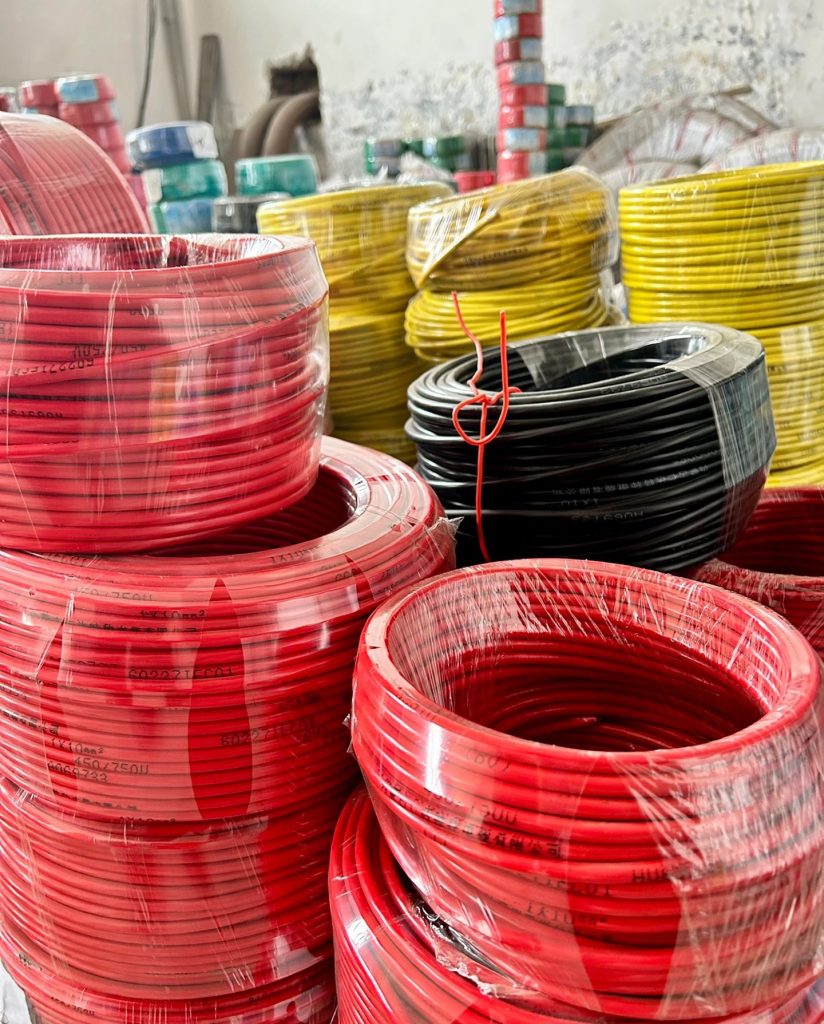
A buyer requests 2.5 mm² copper electrical wire from a manufacturer in China. The supplier sends a technical datasheet showing the conductor size, overall wire diameter, insulation thickness, and electrical resistance.
When reviewing the document, the buyer notices that the conductor diameter is not simply 2.5 mm.
Is the manufacturer quoting the wrong product?
Not necessarily.
The confusion often comes from treating conductor cross-sectional area and conductor diameter as if they were the same measurement. They are different properties, and understanding the distinction is important when purchasing electrical wire in bulk.
For importers, distributors, contractors, and electrical procurement teams, an incorrect interpretation of these measurements can lead to unnecessary quotation disputes, unsuitable product comparisons, or misunderstandings during inspection.
This article explains how cross-sectional area, conductor diameter, strand construction, insulation thickness, and electrical resistance relate to one another—and what buyers should verify before approving a copper wire specification.
1. What Does 2.5 mm² Actually Mean?
Electrical wire size is commonly expressed by the nominal cross-sectional area of its conductor.
The unit mm² means square millimeters.
For example:
-
1.5 mm²
-
2.5 mm²
-
4 mm²
-
6 mm²
-
10 mm²
-
16 mm²
These values describe the conductor’s nominal cross-sectional area, not the finished wire’s outside diameter.
The conductor is the metallic component that carries electrical current. The insulation surrounding it contributes to the overall outside diameter but is not included in the conductor’s nominal cross-sectional area.
This distinction matters when comparing quotations from different manufacturers.
A product identified as 2.5 mm² copper wire should be evaluated against the applicable conductor specification, not simply by measuring the outside of its insulation.
For an introduction to choosing conductor sizes for building projects, see How to Choose the Right Copper Wire Size for Building Electrical Projects.
2. How Cross-Sectional Area and Diameter Are Related
For a perfectly circular, solid conductor, cross-sectional area can be calculated from its diameter.
The formula is:
A = π × d² ÷ 4
Where:
-
A = cross-sectional area
-
d = conductor diameter
-
π ≈ 3.1416
Rearranging the formula:
d = √(4A ÷ π)
For a theoretical solid circular conductor with an area of 2.5 mm², the corresponding diameter is approximately 1.78 mm.
This is a mathematical relationship for an ideal circular conductor. It is not, by itself, a complete manufacturing acceptance specification.
Actual conductor requirements must be checked against the applicable product standard, conductor class, and agreed technical documents.
3. Why Stranded Copper Wire Is Different
Not every copper conductor is a single solid circular element.
A stranded conductor consists of multiple smaller wires arranged together.
For example, a stranded conductor may contain several copper strands, each with its own diameter.
The total metallic cross-sectional area can be calculated by adding the cross-sectional areas of the individual strands:
A total = A₁ + A₂ + A₃ + … + Aₙ
If the strands have the same diameter:
A total = n × π × d² ÷ 4
Where n is the number of strands.
However, the overall diameter of the assembled stranded conductor is not the same as the total metallic cross-sectional area expressed as a diameter.
The arrangement of the strands creates spaces between individual wires, and the geometry depends on the conductor construction.
This is why a buyer should not judge a stranded conductor’s nominal size using a simple outside-diameter measurement alone.
The required conductor class and construction should be stated in the purchase specification.
For additional background, see What Is 60227 IEC 01 Wire and Where Is It Commonly Used?.
4. Conductor Diameter Is Not the Same as Finished Wire Diameter
An insulated electrical wire contains more than the conductor.
A typical single-core insulated wire includes:
-
Copper conductor
-
Insulation surrounding the conductor
-
Printed identification or other markings, where applicable
The finished outside diameter depends on the conductor construction and insulation dimensions.
For example, a technical datasheet may specify:
Parameter |
Meaning |
|---|---|
Nominal conductor area |
Metallic conductor size designation |
Conductor construction |
Solid or stranded arrangement |
Conductor diameter |
Applicable dimensional measurement |
Insulation thickness |
Thickness of the insulating layer |
Finished outside diameter |
Overall dimension of the insulated wire |
Maximum DC resistance |
Electrical resistance limit under specified conditions |
These parameters should be reviewed separately.
A larger finished outside diameter does not automatically indicate a larger copper conductor. It may reflect differences in insulation dimensions or product construction.
Likewise, a smaller finished outside diameter does not automatically prove that a conductor is undersized.
The applicable product specification determines which dimensions and tolerances are acceptable.
5. Why Buyers Should Not Compare Wire Sizes by Appearance Alone
Two insulated copper wires can look almost identical while having different technical specifications.
Visual appearance may not reveal:
-
Exact conductor cross-sectional area
-
Conductor class
-
Copper electrical resistance
-
Insulation material properties
-
Insulation thickness
-
Compliance with the specified product standard
For wholesale purchasing, the product designation should be supported by an appropriate technical datasheet and relevant test documentation.
A buyer comparing two quotations should confirm that the suppliers are offering equivalent conductor construction and insulation requirements.
For more information, read How to Compare Copper Wire Quotations from Different Manufacturers.
6. How Conductor Size Affects Electrical Resistance
Conductor cross-sectional area is closely related to electrical resistance.
For a uniform conductor, the basic relationship is:
R = ρ × L ÷ A
Where:
-
R = electrical resistance
-
ρ = material resistivity
-
L = conductor length
-
A = cross-sectional area
Under comparable material and temperature conditions, increasing conductor cross-sectional area reduces resistance per unit length.
This is one reason conductor size is important in electrical engineering and procurement.
However, buyers should not use this simplified relationship as a substitute for the resistance requirements of the applicable wire standard.
The actual resistance measurement may depend on conductor material, construction, temperature, measurement method, and other specified conditions.
For a bulk purchase, ask the manufacturer to provide the applicable resistance specification and supporting test information.
7. Understanding Maximum DC Resistance
Electrical wire datasheets may state maximum DC conductor resistance at a specified reference temperature.
This is a useful purchasing parameter because it provides an electrical characteristic that can be checked against a defined requirement.
When reviewing resistance data, verify:
-
Nominal conductor size
-
Conductor material
-
Conductor class
-
Applicable standard
-
Reference temperature
-
Resistance unit
-
Whether the value is a maximum limit or measured result
For example, a resistance value expressed in Ω/km should not be compared directly with a value expressed in Ω/m without converting the units.
A buyer should also distinguish between a standard’s maximum permitted resistance and an individual test result.
For more information about conductor quality and testing, see How to Check Copper Purity and Conductor Quality Before Buying Copper Wire.
8. What Should Buyers Measure During Sample Inspection?
When evaluating a sample from a new Chinese manufacturer, buyers may need to examine several different characteristics.
The inspection method should match the product and agreed specification.
Conductor construction
Check whether the conductor is solid or stranded and whether the construction corresponds to the approved datasheet.
Conductor dimensions
Use suitable measuring equipment and the measurement method specified by the applicable standard.
For stranded conductors, do not assume that measuring the assembled conductor’s outside diameter directly establishes its nominal metallic cross-sectional area.
Insulation dimensions
Where required, check insulation thickness and relevant finished dimensions using the agreed test method.
Electrical resistance
For technical verification, use appropriate equipment and test procedures.
Product identification
Confirm that the sample’s product markings and identification match the quotation and approved technical documents.
A visual examination can identify obvious differences, but it cannot independently establish full compliance with an electrical wire standard.
9. How to Write the Correct Conductor Requirement in an RFQ
An electrical wire inquiry should avoid vague descriptions such as:
“Copper wire, approximately 2.5 mm thick.”
This wording may be interpreted differently by the buyer and supplier.
A more useful specification would identify the required product and conductor characteristics.
Example RFQ specification
Product: PVC-insulated copper building wire
Conductor material: Copper
Nominal cross-sectional area: 2.5 mm²
Conductor construction: Solid or stranded, as required
Conductor class: As specified by the applicable standard
Rated voltage: 450/750V, if applicable to the selected product
Insulation: PVC
Color: Blue
Quantity: 20,000 meters
Packaging: 100-meter coils
Required documents: Technical datasheet and agreed test documentation
Destination: Buyer’s country and port
The manufacturer should confirm the proposed construction and applicable technical specification before the buyer approves production.
For a complete purchasing inquiry structure, see How to Request an Electrical Wire Quotation from a Chinese Manufacturer.
10. Questions Buyers Should Ask a Cable Manufacturer
Before confirming a bulk order, consider asking the manufacturer:
-
Is the stated conductor size a nominal cross-sectional area?
-
Is the conductor solid or stranded?
-
Which conductor class is supplied?
-
Which product standard applies?
-
What is the specified maximum conductor resistance?
-
What are the relevant conductor and insulation dimensions?
-
Can the manufacturer provide a technical datasheet?
-
Are relevant test records available for the proposed product?
-
Will the same approved specification be used for the production batch?
-
How will product identification and batch traceability be maintained?


No reply content