
How Much Does It Cost to Import EV Chargers from China?
China is an important sourcing market for EV charging equipment, including AC wallbox chargers, commercial AC chargers, DC fast chargers, charging stations, and OEM products.
For international buyers, the cost of importing EV chargers from China is not determined by the factory unit price alone. The final procurement cost can also include packaging, inland transportation, export procedures, shipping, customs clearance, taxes, installation-related requirements, and other project expenses.
This guide explains the main costs buyers should consider when importing EV chargers from China.
1. Start With the EV Charger Unit Price
The first cost is the price quoted by the manufacturer.
The unit price can vary significantly depending on:
- AC or DC charging
- Charging power
- Connector type
- Number of charging ports
- Display
- Communication functions
- OCPP support
- Protection features
- Housing design
- Cable configuration
- Certification requirements
- OEM customization
- Order quantity
A basic AC wallbox and a high-power DC fast charger are very different products, so buyers should not compare their prices without comparing specifications.
When requesting a quotation, provide the manufacturer with the exact product requirements.
2. AC EV Charger Import Cost
AC chargers are generally simpler than high-power DC charging systems, but the final cost still depends on the configuration.
Common AC charging power options include:
- 7kW
- 11kW
- 22kW
The quotation may change according to the connector, cable length, display, communication functions, enclosure, protection system, and OEM requirements.
For example, a buyer ordering a private-label 22kW AC charger with customized packaging and communication functions should not compare the quotation directly with a standard 7kW charger.
The product specification must be compared first.
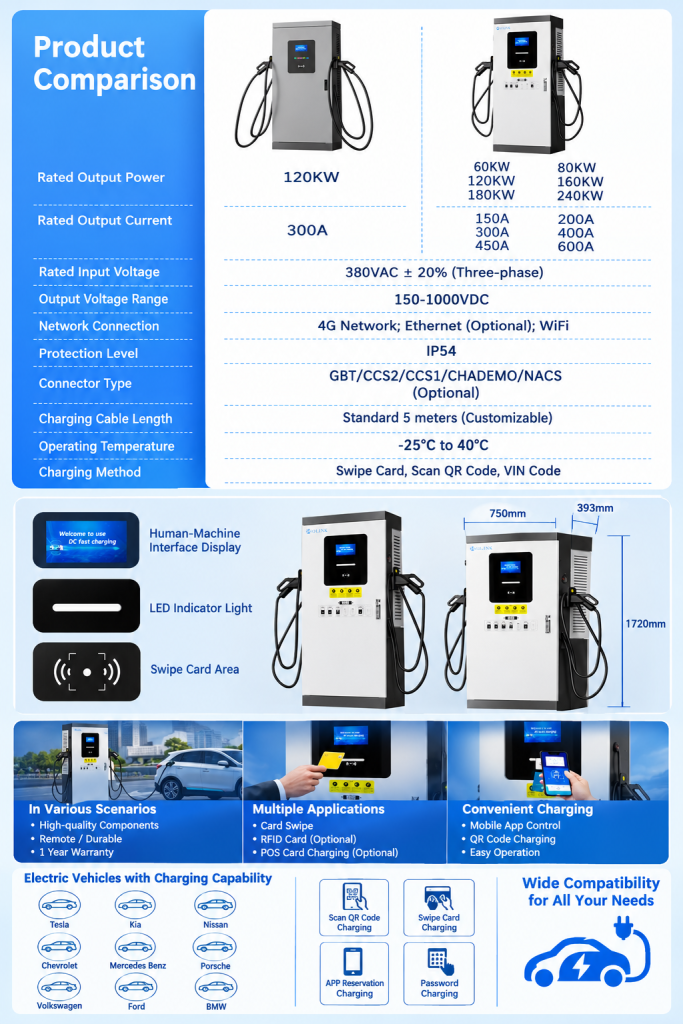
3. DC Fast Charger Import Cost
DC fast chargers normally involve more complex electrical and cooling systems.
Commercial buyers may encounter power configurations such as:
- 30kW
- 60kW
- 120kW
- 180kW
- 240kW
- 360kW
The unit cost can depend on:
- Output power
- Number of charging guns
- Connector type
- Charging module configuration
- Cooling system
- Display
- Payment system
- Network communication
- OCPP support
- Cabinet design
- Protection system
- OEM requirements
A higher-power DC charger may also create additional project costs because the installation can require greater electrical capacity and more substantial site infrastructure.
4. OEM and Private-Label Costs
If you are purchasing EV chargers for your own brand, the factory quotation may include additional customization costs.
Possible OEM requirements include:
- Logo printing
- Customized product color
- Housing design
- Product labels
- Packaging
- User manuals
- Software interface
- Display interface
- Cable configuration
- Custom nameplate
- Customized accessories
Some factories may have minimum quantities for certain customizations.
Before placing an order, ask the manufacturer which customization items are included in the unit price and which require additional charges.
5. Packaging Costs
EV chargers need appropriate packaging for international transportation.
Depending on the product, packaging may include:
- Cartons
- Foam protection
- Pallets
- Wooden cases
- Protective film
- Customized packaging
DC charging equipment can be substantially larger and heavier than AC wallbox chargers, so packaging and handling requirements may also be different.
Buyers should confirm whether the quoted price includes standard export packaging.
6. Inland Transportation in China
After production, the goods normally need to be transported from the factory to the export warehouse, port, airport, or freight forwarder’s facility.
The inland cost can depend on:
- Factory location
- Warehouse location
- Shipment size
- Number of cartons
- Weight
- Trucking distance
- Loading requirements
If the supplier is located far from the export port, inland transportation can become a meaningful part of the logistics cost.
For large commercial projects, buyers should ask whether factory delivery or domestic transportation is included in the quotation.
7. Export and Documentation Costs
International shipments may involve export-related documentation and procedures.
Depending on the transaction structure, costs can include:
- Export documentation
- Customs declaration
- Commercial invoice
- Packing list
- Shipping documents
- Certificate-related documents
- Other destination-specific documentation
The exact requirements depend on the shipment, trade terms, product, and destination market.
Buyers should clarify which export services are included in the supplier’s quotation.
8. International Shipping Cost
International freight is another major component of the landed cost.
The shipping method may include:
- Sea freight
- Air freight
- Express
- Other specialized transportation arrangements
Sea freight may be suitable for larger commercial orders, while air transportation can be considered for samples or urgent shipments.
The final freight cost can depend on:
- Origin
- Destination
- Gross weight
- Cargo volume
- Number of packages
- Shipping method
- Season
- Carrier
- Destination charges
For a large EV charger order, buyers should obtain a freight quotation based on the actual packing dimensions and weight rather than estimating freight from the product’s net weight alone.
9. Import Duties and Taxes
Import duties and taxes depend on the destination country.
The buyer should confirm:
- Applicable HS classification
- Import duty
- Import VAT or sales tax
- Customs clearance requirements
- Import permits, if applicable
- Local compliance requirements
These costs cannot be accurately determined simply by knowing the factory price.
Before ordering, check the applicable import requirements in the destination country or work with a qualified customs broker or freight forwarder.
10. Destination Charges
International buyers sometimes focus only on the China factory price and international freight.
However, destination charges may also affect the final landed cost.
Depending on the shipment and destination, these may include:
- Port handling
- Terminal charges
- Customs clearance
- Documentation charges
- Local delivery
- Warehouse handling
- Inspection-related charges
- Storage
- Other destination services
The actual charges depend on the destination and shipping arrangement.
11. Installation and Electrical Infrastructure
For commercial EV charging projects, the charger itself may only be one part of the total project cost.
Additional costs may include:
- Electrical cables
- Distribution equipment
- Circuit protection
- Transformers
- Mounting structures
- Pedestals
- Grounding
- Civil works
- Network connection
- Installation labor
High-power DC charging projects can require significantly more electrical infrastructure than small AC charging installations.
Therefore, the total project budget should be considered separately from the charger purchase price.
12. Software and Network Costs
Networked EV chargers may require software or backend services.
Depending on the system, buyers may need:
- Charging management software
- Backend platform
- Mobile application
- Payment integration
- SIM or network connection
- OCPP integration
- Remote monitoring
The cost structure varies between suppliers and software providers.
If your project already has a charging management platform, confirm compatibility before purchasing the chargers.
13. Warranty and After-Sales Considerations
The lowest purchase price is not necessarily the lowest long-term cost.
Buyers should understand the manufacturer’s warranty and after-sales arrangements before placing a large order.
Ask about:
- Warranty period
- Covered components
- Technical support
- Spare parts
- Remote troubleshooting
- Replacement procedures
- Firmware updates
- Service response
For commercial charging networks, equipment downtime can affect revenue and customer experience, so after-sales support should be considered when comparing suppliers.
14. How to Calculate the Landed Cost
A simple way to estimate the total import cost is:
Landed Cost = Product Cost + OEM Cost + Packaging + China Inland Transportation + Export Costs + International Freight + Insurance + Import Duty + Taxes + Destination Charges
For a commercial project, the overall project cost may additionally include:
Total Project Cost = Landed Equipment Cost + Installation + Electrical Infrastructure + Software/Network + Local Services
The exact calculation depends on the transaction terms and destination country.
15. FOB, CIF and Other Trade Terms
When requesting quotations from Chinese EV charger manufacturers, buyers should understand the trade term used in the quotation.
For example:
EXW
The buyer generally takes responsibility for transportation and export arrangements from the agreed factory location.
FOB
The seller generally handles the goods until the agreed port loading point under the applicable FOB terms. The buyer normally arranges the main international transportation.
CIF
The seller arranges the main transportation and insurance to the named destination port under the applicable CIF terms.
These terms do not mean that all destination costs are included.
Always ask the supplier or freight forwarder to clearly identify which costs are included and which are excluded.
16. Request a Complete Quotation
When contacting a China EV charger manufacturer, do not ask only:
“What is your price?”
A better RFQ should include:
- Product model
- Charging power
- Quantity
- AC or DC
- Connector
- Cable length
- Display requirements
- OCPP requirements
- OEM requirements
- Destination country
- Preferred trade term
- Packaging requirements
- Certification requirements
You can then ask the supplier to provide:
- Unit price
- Customization cost
- Packaging cost
- Production lead time
- Estimated gross weight
- Package dimensions
- Shipping information
- Warranty
- Available documentation
This makes it easier to compare different manufacturers on the same basis.
17. Sample Before Bulk Order
For a new supplier, purchasing a sample before a large order can reduce procurement risk.
A buyer can use the sample to evaluate:
- Product quality
- Charging performance
- Connector compatibility
- OCPP communication
- User interface
- Installation method
- Packaging
- Documentation
If the equipment will be connected to a third-party charging platform, backend integration should also be tested.
After the sample is approved, the buyer can move toward bulk production with a clearer specification.
18. Questions to Ask a China EV Charger Manufacturer
Before placing an order, consider asking:
- What EV charger models do you manufacture?
- What AC and DC power ratings are available?
- Which charging connectors are available?
- Does the charger support OCPP?
- Which OCPP version is supported?
- Can the charger integrate with our backend?
- Can you provide OEM/private-label production?
- What certifications and technical documents are available for our market?
- What is the production lead time?
- What is the package size and gross weight?
- What warranty is provided?
- Can you provide a sample before bulk production?
- Which trade terms can you offer?
- Can you provide export documentation?
- What after-sales technical support is available?
Frequently Asked Questions
Is importing EV chargers from China cheaper than buying locally?
China can offer competitive manufacturing options, but the final cost depends on product specifications, order quantity, freight, taxes, compliance requirements, and local installation costs. Buyers should compare the complete landed cost rather than only the factory price.
What is the biggest cost when importing EV chargers?
There is no single cost that is always the largest. For AC chargers, the product price may represent a large portion of the total cost. For large DC charging projects, equipment, electrical infrastructure, transportation, and installation can all have significant costs.
Can I buy one EV charger from China as a sample?
Many manufacturers can provide samples, but availability, customization options, and sample pricing vary by supplier.
Should I choose FOB or CIF?
The appropriate trade term depends on your logistics arrangements and destination. Buyers should compare the total cost under each option and clearly confirm which charges are included.
Do I need a freight forwarder when importing EV chargers?
A freight forwarder can help coordinate transportation, export procedures, and destination logistics. For commercial shipments, professional logistics support can make international procurement easier, particularly when the buyer is unfamiliar with the destination import process.
How can I reduce the cost of importing EV chargers?
Possible approaches include selecting an appropriate power rating, optimizing packaging and shipment quantities, comparing multiple manufacturers, consolidating orders where practical, and choosing specifications based on the actual project rather than buying unnecessary features.
Conclusion
The cost of importing EV chargers from China involves much more than the manufacturer’s unit price.
International buyers should consider the complete purchasing and logistics chain, including:
- Product price
- OEM customization
- Packaging
- Inland transportation
- Export procedures
- International freight
- Insurance
- Import duties
- Taxes
- Destination charges
- Installation
- Electrical infrastructure
- Software and network services
- After-sales support
A detailed RFQ is one of the best ways to obtain comparable quotations from different manufacturers.
Before placing a bulk order, confirm the charger specifications, connector, power rating, OCPP compatibility, certification requirements, packaging, trade terms, delivery arrangements, and warranty.
For buyers sourcing EV charging equipment from China, VLEFOOENA provides a platform for discovering China-based suppliers and comparing products for wholesale, commercial, OEM, and international sourcing projects.
You can also read our related guides:
How to Choose an EV Charger Manufacturer in China
How to Choose a 7kW, 11kW, or 22kW AC EV Charger
How to Choose a DC Fast Charger for Commercial EV Charging
What Is OCPP and Why Is It Important for EV Chargers?
How to Choose an EV Charger for Commercial Projects: Power, Connector, OCPP and Installation Guide


No reply content