
How to Compare Fishing Rod Samples from Different Chinese Manufacturers
For fishing tackle importers, wholesalers, distributors, and private-label brands, requesting samples from several Chinese manufacturers is one of the most useful steps before placing a bulk fishing rod order.
However, receiving several samples is only the beginning.
If every supplier provides a different rod length, material, power, action, guide configuration, handle, packaging, or product specification, simply comparing the appearance or quotation can lead to a misleading purchasing decision.
A professional sample comparison should evaluate the products against the same specification and separate technical performance from appearance, components, customization, packaging, and commercial terms.
This guide explains how international buyers can compare fishing rod samples from different Chinese manufacturers.
1. Why Compare Samples From Multiple Suppliers?
A single supplier’s sample may look acceptable, but that does not necessarily mean it is the best product for your market.
Comparing samples can help buyers identify differences in:
- Rod construction
- Material
- Length
- Power
- Action
- Weight
- Guides
- Reel seat
- Handle
- Finish
- Branding
- Packaging
- Overall consistency
It can also help determine whether suppliers have understood the same product requirements.
The key is to compare equivalent specifications.
2. Do Not Compare Samples Before Standardizing the Specification
This is one of the most important rules.
Suppose three manufacturers send samples:
| Specification | Supplier A | Supplier B | Supplier C |
|---|---|---|---|
| Rod type | Spinning | Spinning | Spinning |
| Length | Different | Different | Different |
| Material | Carbon fiber | Carbon fiber | Fiberglass |
| Power | Medium | Medium Heavy | Medium |
| Action | Fast | Moderate | Fast |
| Guides | Different | Different | Different |
These are not equivalent products.
A buyer cannot reasonably conclude that Supplier B is better or cheaper without first standardizing the specifications.
Before requesting samples, prepare a product specification sheet.
3. Confirm the Basic Rod Specifications
Start with the fundamental specifications:
- Rod type
- Rod length
- Number of sections
- Material
- Power
- Action
- Lure rating
- Line rating
- Rod weight
- Collapsed length where applicable
These specifications create the foundation for sample comparison.
For a detailed specification framework, buyers can refer to:
How to Prepare a Fishing Rod Specification Sheet for a China Supplier
4. Compare Rod Length
Measure the physical sample rather than relying only on the supplier’s product description.
Record:
- Total rod length
- Individual section length
- Collapsed length
- Handle length where relevant
For telescopic rods, collapsed length can be particularly important.
For multi-piece rods, check whether the section dimensions correspond with the agreed specification.
Small differences may be acceptable depending on the product design and manufacturing tolerance, but buyers should define the required specification before production.
5. Compare Rod Weight
Weight is an important factor for many fishing rod products.
Use the same measurement method for every sample.
Record:
| Supplier | Stated Weight | Measured Weight | Difference |
|---|---|---|---|
| Supplier A | |||
| Supplier B | |||
| Supplier C |
Do not compare one supplier’s rod weight without considering the complete product configuration.
A heavier rod may have different components or construction.
The objective is not simply to choose the lightest sample, but to determine whether the weight matches the intended product specification.
6. Compare Power and Action
Power and action should be evaluated separately.
Power
Power describes the rod’s resistance to bending under load.
Common descriptions include:
- Ultralight
- Light
- Medium Light
- Medium
- Medium Heavy
- Heavy
Action
Action describes where the rod bends when loaded.
Common descriptions include:
- Fast
- Moderate
- Slow
Different manufacturers may use these terms differently.
Therefore, buyers should confirm the supplier’s specifications and compare physical samples where appropriate.
Related guides:
How to Choose Fishing Rod Action: Fast, Moderate, and Slow Action Explained
How to Choose Fishing Rod Length, Power and Action for Different Markets
7. Examine the Blank
The blank is one of the most important parts of a fishing rod.
Inspect the sample for:
- Straightness
- Surface finish
- Visible defects
- Taper
- Section fit
- Finish consistency
- Weight
- General construction
For carbon fiber rods, buyers should also check whether the product matches the material specification agreed with the supplier.
Do not rely solely on phrases such as “high carbon” or “100% carbon.”
Request the manufacturer’s actual product specification.
8. Compare Guides
Guides can have a significant effect on the overall product design.
Compare:
- Number of guides
- Guide size
- Guide alignment
- Frame
- Insert
- Attachment
- Spacing
- Finish
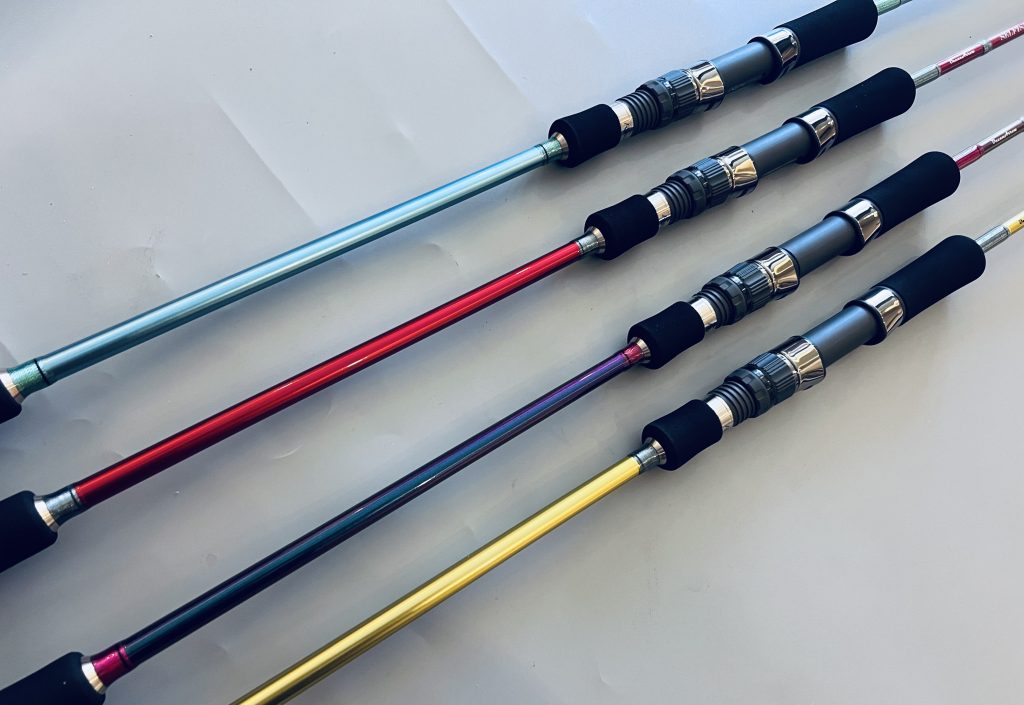
Place the samples next to each other and compare the guide arrangement visually.
Then check the alignment from the rod tip toward the handle.
A sample with attractive guides is not automatically better if the configuration does not match the intended application.
For more information:
How Fishing Rod Guides, Reel Seats, and Handles Affect Product Quality
9. Check the Reel Seat
For spinning or casting rods, the reel seat should be checked carefully.
Inspect:
- Reel compatibility
- Fit
- Locking mechanism
- Alignment
- Surface finish
- Material
- Overall assembly
If possible, use the same reel when comparing samples.
This creates a more consistent evaluation.
For an OEM project, the reel seat should also be included in the approved product specification.
10. Compare the Handles
Handle design affects appearance, handling, and product positioning.
Depending on the rod, compare:
- Handle material
- Length
- Diameter
- Shape
- Finish
- Grip
- Decorative components
- Rear section
- Alignment
Common handle materials may include EVA, cork, and other composite or synthetic materials.
The buyer should select the handle based on the target market rather than simply choosing the most attractive sample.
11. Check the Finish and Appearance
Appearance is particularly important for private-label products.
Compare:
- Blank color
- Paint
- Graphics
- Printing
- Logo
- Decorative patterns
- Surface finish
- Component colors
- Overall consistency
For OEM projects, the buyer should distinguish between:
Supplier standard design
and
Buyer-customized design
A standard sample may not represent the final appearance of the customized product.
12. Evaluate the Product Balance
A fishing rod can meet the length and weight specifications but still feel different during use.
Where practical, buyers should compare:
- Overall balance
- Handle position
- Grip
- Reel compatibility
- General handling
The same reel can be installed on different samples to make the comparison more meaningful.
This is especially useful when selecting products for a fishing technique where rod handling is an important selling point.
13. Compare Lure and Line Specifications
If the product uses lure and line ratings, record them in the comparison sheet.
| Specification | Supplier A | Supplier B | Supplier C |
|---|---|---|---|
| Lure range | |||
| Line range | |||
| Power | |||
| Action | |||
| Length |
Do not automatically assume that identical-looking rods have identical operating ranges.
The final specifications should be confirmed with the manufacturer and validated against the approved product.
14. Check Section Connections
For multi-piece fishing rods, inspect the connections between sections.
Check:
- Fit
- Alignment
- Smoothness
- Connection length
- Surface condition
- Stability
For telescopic rods, inspect the telescopic sections and their movement.
The rod should extend and collapse smoothly without obvious abnormal movement.
This is one reason physical samples are important during supplier selection.
15. Compare Packaging
Packaging should not be ignored when comparing samples.
Record:
- Individual packaging
- Rod sleeve
- Box or tube
- Product label
- Logo
- Instructions
- Carton configuration
For international buyers, packaging can also affect shipping dimensions and freight costs.
A recent VLEFOOENA guide covers packaging, cartons, protective materials, and export considerations:
Wholesale Fishing Rod Buying Guide: MOQ, Samples, Quality Control and Packaging
16. Separate Product Quality From Supplier Service
A supplier may have a good product but weak communication.
Another supplier may communicate well but provide a sample that does not meet the technical specification.
Evaluate both separately.
Product Evaluation
- Specification accuracy
- Construction
- Components
- Finish
- Sample quality
- Packaging
Supplier Evaluation
- Communication
- Understanding of requirements
- Response to technical questions
- Ability to customize
- Sample revision process
- Production communication
- Documentation
This creates a more balanced supplier evaluation.
17. Compare OEM Capabilities
If the project is for a private-label fishing brand, compare customization capabilities.
Ask each supplier whether they can provide:
- Custom logo
- Blank graphics
- Custom colors
- Handle customization
- Reel seat customization
- Guide options
- Packaging
- Labels
- Product instructions
Do not assume that because a supplier can add a logo, it can manufacture a completely customized fishing rod.
OEM capability should be evaluated based on the specific customization requirements.
18. Create a Sample Comparison Scorecard
A simple scorecard can make the decision more objective.
| Category | Weight | Supplier A | Supplier B | Supplier C |
|---|---|---|---|---|
| Specification compliance | ||||
| Blank quality | ||||
| Weight | ||||
| Power/action | ||||
| Guides | ||||
| Reel seat | ||||
| Handle | ||||
| Finish | ||||
| Packaging | ||||
| OEM capability | ||||
| Communication | ||||
| Overall result |
The weighting should reflect the buyer’s priorities.
For example, a premium fishing brand may give more importance to product construction and customization, while an entry-level distributor may place more emphasis on overall commercial positioning.
19. Do Not Choose the Cheapest Sample Automatically
The cheapest sample is not necessarily the best purchasing option.
Consider the complete product:
Product specification + quality + customization + packaging + supplier capability + commercial terms
A supplier offering a higher quotation may provide a product closer to the buyer’s required specification.
The comparison should therefore be based on equivalent products.
20. Request Sample Revisions Before Bulk Production
If a sample is close to the required product but not correct, ask the supplier whether revisions are possible.
Potential revisions may include:
- Length
- Power
- Action
- Handle
- Guides
- Reel seat
- Logo
- Graphics
- Packaging
- Product label
Document every approved change.
The final sample should reflect the actual configuration intended for mass production.
21. Use the Approved Sample as the Production Reference
Once the buyer selects a supplier, the final approved sample should be clearly identified.
The purchase documentation should contain the relevant specifications.
Important information may include:
- Model number
- Product specification
- Material
- Dimensions
- Components
- Branding
- Packaging
- Quality requirements
If the product changes after approval, the buyer should confirm the change before mass production.
For a broader production inspection process, see:
Fishing Rod Quality Inspection During Mass Production: A Practical Guide for Buyers
22. Sample Comparison Checklist
Before selecting a supplier, review the following checklist.
Product
- [ ] Rod type
- [ ] Length
- [ ] Sections
- [ ] Material
- [ ] Power
- [ ] Action
- [ ] Lure rating
- [ ] Line rating
- [ ] Weight
Components
- [ ] Guides
- [ ] Reel seat
- [ ] Handle
- [ ] End cap
- [ ] Other components
Appearance
- [ ] Color
- [ ] Finish
- [ ] Graphics
- [ ] Logo
- [ ] Printing
Packaging
- [ ] Individual packaging
- [ ] Protective materials
- [ ] Retail packaging
- [ ] Carton configuration
Supplier
- [ ] OEM capability
- [ ] Communication
- [ ] Sample revision
- [ ] Production capability
- [ ] Quality control
Frequently Asked Questions
How many fishing rod suppliers should I compare?
There is no universal number. For a new product, comparing several qualified suppliers can help buyers understand differences in product construction, customization, and commercial terms.
Should all suppliers receive the same RFQ?
Yes. Using the same specification makes supplier quotations and samples much easier to compare.
Is the lightest fishing rod always the best?
No. Weight is only one factor. Buyers should also evaluate construction, power, action, components, balance, intended application, and target market.
Should I compare samples before discussing price?
Ideally, buyers should first make sure the samples are based on comparable specifications. Price can then be evaluated together with the confirmed product configuration.
Can a supplier change the sample before mass production?
A supplier may be able to make revisions depending on the product and manufacturing capability. Any changes should be agreed and documented before production.
Should the approved sample be kept as a production reference?
Yes. For OEM and wholesale projects, maintaining a clearly identified approved sample and written specification can help reduce misunderstandings during mass production.
Conclusion
Comparing fishing rod samples from different Chinese manufacturers should be a structured purchasing process rather than a simple visual comparison.
International buyers should:
- Define the product specification.
- Send the same RFQ to each supplier.
- Request comparable samples.
- Measure the samples.
- Inspect the blank and components.
- Compare power and action.
- Evaluate finish and branding.
- Check packaging.
- Assess OEM capabilities.
- Compare supplier communication.
- Request revisions when necessary.
- Approve the final sample before mass production.
The objective is not simply to find the cheapest fishing rod.
The objective is to identify the supplier that can consistently deliver the required product for the intended market.
For wholesalers, importers, distributors, and private-label fishing brands, a structured sample comparison can make supplier selection more objective and reduce the risk of approving a product that does not match the original purchasing requirements.
Request a Fishing Rod Wholesale or OEM Inquiry
When contacting a Chinese fishing rod supplier, provide your target market, rod type, length, power, action, material, estimated quantity, branding requirements, packaging requirements, and destination.
Providing a complete specification allows the supplier to evaluate the project more accurately and prepare a more useful quotation and sample proposal.
Guangzhou Fishing Tackle Co., Ltd. is listed on VLEFOOENA as a China-based fishing tackle supplier focusing on spinning rods, casting rods, telescopic rods, and carbon fiber fishing rods, with OEM/ODM and wholesale inquiries supported.


No reply content