
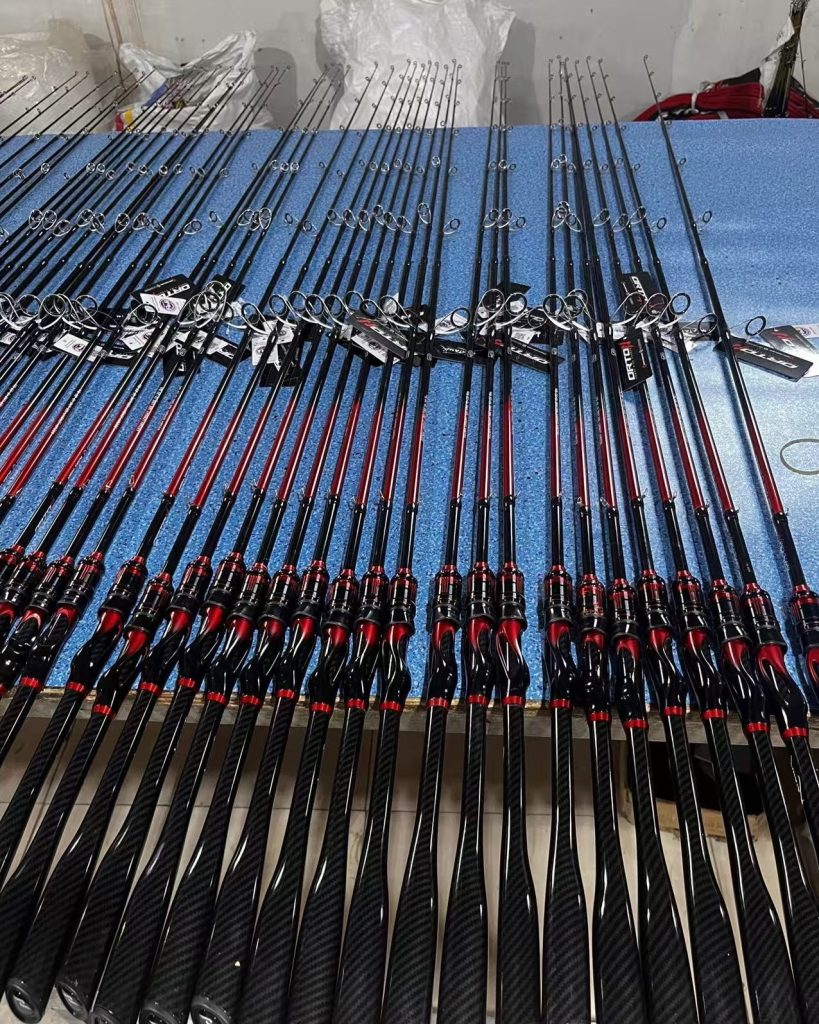
What Fishing Rod Specifications Should Buyers Check Before Ordering?
When buying fishing rods from China for wholesale, distribution, retail, or OEM projects, product specifications should be confirmed before discussing the final bulk order.
A fishing rod may look similar to another model, but differences in length, power, action, sections, blank construction, guides, reel seat, handle, and other components can significantly change the product’s intended use.
For international buyers, the most important objective is not simply to find a fishing rod at a low price.
It is to make sure the supplier understands exactly what product the buyer expects to receive.
This guide explains the main fishing rod specifications buyers should check before placing a wholesale or OEM order.
1. Start With the Intended Fishing Application
Before choosing technical specifications, define how the fishing rod will be used.
Consider:
- Target fish species
- Freshwater or saltwater use
- Fishing environment
- Shore or boat fishing
- Lure fishing or other techniques
- Beginner or experienced users
- Target market
- Retail price positioning
The intended application can influence almost every other specification.
For example, a lightweight rod designed for smaller fish will have different requirements from a heavier rod intended for larger species.
Therefore, buyers should explain the intended use to the supplier instead of simply sending a product photograph.
2. Fishing Rod Length
Rod length is one of the most visible specifications.
Different lengths can provide different combinations of casting distance, control, portability, and handling.
When requesting a quotation, specify the required length rather than simply saying “long fishing rod” or “short fishing rod.”
The supplier should also clarify how the length is measured.
For example:
- Overall assembled length
- Length of each section
- Collapsed length for telescopic rods
For travel and telescopic products, collapsed length can be particularly important because it affects packaging, storage, and transportation.
For wholesale buyers, it is also useful to consider whether the selected length is appropriate for the target market and intended fishing application.
3. Number of Sections
Fishing rods can be produced in different section configurations.
Common arrangements include:
- One-piece
- Two-piece
- Multi-section
- Telescopic
The number of sections can affect:
- Transport
- Storage
- Portability
- Rod action
- Joint construction
- Packaging
- Shipping dimensions
Buyers should specify the number of sections when requesting quotations.
For a two-piece rod, for example, the supplier should clearly identify the assembled length and section dimensions.
For multi-section or travel rods, collapsed length should also be confirmed.
4. Rod Power
Rod power describes the rod’s general resistance to bending under load.
Buyers may encounter descriptions such as:
- Ultra Light
- Light
- Medium Light
- Medium
- Medium Heavy
- Heavy
- Extra Heavy
The exact classification can vary between products and manufacturers.
Therefore, buyers should not rely only on the word “Medium” or “Heavy.”
Ask the supplier to provide the applicable product specification and, where relevant, the recommended line and lure range.
For wholesale buyers, this is important because the same power label may not provide enough information to compare two different products.
5. Rod Action
Rod action describes where the rod tends to bend under load and how quickly it returns toward its original position.
Common descriptions include:
- Fast
- Moderate Fast
- Moderate
- Slow
Action affects the fishing characteristics of the rod.
However, buyers should be careful when comparing action labels from different suppliers because terminology and testing methods may not always be identical.
If action is important to your product, ask the supplier to specify it clearly and evaluate a physical sample where possible.
This is especially important for OEM projects where the buyer wants to maintain a consistent product specification between production batches.
6. Line Rating
Line rating indicates the line range for which the rod is designed.
The exact rating depends on the rod model and intended fishing application.
Buyers should ask the supplier to provide the recommended line range rather than relying on a generic product description.
For example, the specification sheet can include:
Recommended Line: [Supplier specification]
If your target market uses different measurement systems, confirm how the supplier presents the information so that the final packaging and product information are consistent.
7. Lure Rating
For lure fishing rods, lure rating can be an important specification.
It helps buyers understand the intended lure weight range for the product.
When developing a private-label fishing rod, the lure rating should be confirmed before the packaging artwork is finalized.
This is because the information printed on the retail package should match the approved product specification.
If you are ordering customized fishing rods, it is better to confirm the specification first and create packaging artwork afterward.
8. Blank Material
Blank construction is another major consideration.
Common fishing rod materials include carbon fiber, fiberglass, and composite constructions.
However, simply writing “carbon fishing rod” does not completely define the product.
Buyers may need to clarify:
- Material type
- Construction
- Intended performance
- Weight requirements
- Flexibility
- Target application
- Finish
For carbon fiber fishing rods, buyers can also read:
How to Choose a Carbon Fiber Fishing Rod for Wholesale and OEM Projects
The guide explains the main considerations when selecting carbon fiber fishing rods for wholesale and OEM projects.
Buyers should avoid making purchasing decisions based solely on a material name.
The finished rod’s construction and manufacturing quality also matter.
9. Fishing Rod Guides
Guides are important components that control the fishing line along the rod.
When requesting a quotation, buyers should clarify the guide configuration where it is relevant to the product.
Questions can include:
- How many guides are used?
- What guide configuration is required?
- What frame or insert is specified?
- Is the guide layout part of the standard model?
- Can the guide configuration be customized?
For a standard wholesale product, the supplier’s existing configuration may be suitable.
For an OEM product, however, buyers should clearly document the required configuration before production.
10. Reel Seat
The reel seat connects the reel to the fishing rod.
Its design should be compatible with the intended reel type and rod application.
When comparing two fishing rods, buyers should not assume that similar-looking reel seats have identical specifications.
For OEM projects, specify whether the supplier should use:
- Existing standard reel seat
- Buyer-selected component
- Customized component
If a particular component is required, include it in the technical specification sheet.
11. Handle Material and Design
The handle can affect both comfort and the overall appearance of the fishing rod.
Common materials can include:
- EVA
- Cork
- Other synthetic materials
Buyers should specify the handle requirements if they are important to the product.
Consider:
- Handle material
- Handle length
- Grip shape
- Color
- Finish
- Rear grip
- Decorative elements
For a private-label fishing rod, the handle can also become part of the product’s visual identity.
12. Rod Weight
Rod weight can be an important specification for buyers targeting lightweight fishing products.
A lighter rod may be desirable for particular applications, but buyers should not judge product quality solely by weight.
When comparing suppliers, make sure the rods are measured under comparable conditions.
Ask whether the stated weight includes:
- Complete assembled rod
- Components
- Tip protection
- Packaging
The product specification should clearly define what the weight refers to.
13. Collapsed Length
Collapsed length is particularly important for telescopic and travel fishing rods.
It can influence:
- Packaging
- Warehouse storage
- Shipping
- Airline or luggage considerations
- Retail presentation
For international wholesale buyers, this specification can have commercial importance because transportation costs can be affected by package dimensions.
Ask the supplier to provide both:
Assembled Length
and
Collapsed Length
when applicable.
14. Finish and Appearance
The visual finish should also be included in the product specification for customized projects.
Possible requirements include:
- Base color
- Decorative color
- Gloss finish
- Matte finish
- Printing
- Logo
- Decorative wraps
- Other visual elements
A simple product photograph should not be treated as the final production specification.
If the buyer wants a specific appearance, provide artwork or written requirements and approve a sample before mass production.
15. Logo and Branding
Private-label buyers should specify exactly where the logo should appear.
For example:
- Rod blank
- Handle
- Reel seat area
- Packaging
- Product label
- Carton
The logo itself should also be supplied in an appropriate format.
Before mass production, confirm:
- Logo size
- Logo position
- Logo color
- Printing method
- Packaging artwork
A physical sample or approved digital proof can help prevent branding mistakes.
For private-label projects, see:
How to Develop a Private Label Fishing Rod with a Chinese OEM Factory
16. Packaging Specifications
Packaging should be considered part of the product specification rather than a separate issue.
Buyers may require:
- Individual bags
- Protective sleeves
- Retail boxes
- Printed boxes
- Tubes
- Inner cartons
- Master cartons
- Shipping marks
Confirm:
- Package dimensions
- Number of products per carton
- Gross weight
- Net weight
- Packaging materials
- Label requirements
For long fishing rods, packaging design can have a significant impact on transportation and storage.
17. Quality Requirements
Technical specifications should be accompanied by quality requirements.
For example, buyers can define inspection points for:
- Rod dimensions
- Section joints
- Guide alignment
- Reel seat
- Handle
- Surface finish
- Printing
- Logo placement
- Packaging
Do not wait until production is finished to decide what constitutes an acceptable product.
Before placing the bulk order, agree on the important quality requirements with the supplier.
You can use this guide as a reference:
How to Inspect Fishing Rod Quality Before Placing a Bulk Order
18. Create a Fishing Rod Specification Sheet
For professional purchasing, a specification sheet is one of the easiest ways to reduce misunderstandings.
A basic specification sheet can look like this:
| Specification | Requirement |
|---|---|
| Rod Type | Spinning |
| Length | [Required] |
| Sections | [Required] |
| Power | [Required] |
| Action | [Required] |
| Line Rating | [Required] |
| Lure Rating | [Required] |
| Material | [Required] |
| Guides | [Required] |
| Reel Seat | [Required] |
| Handle | [Required] |
| Rod Weight | [Required] |
| Color | [Required] |
| Logo | Yes / No |
| Packaging | Standard / Custom |
| Quantity | [Required] |
The supplier can then review the specification and confirm which requirements are available.
19. Do Not Change Specifications After Sample Approval Without Documentation
One common purchasing problem occurs when the buyer approves a sample but later changes some specifications during mass production.
For example:
- Different handle
- Different guide
- Different color
- Different logo position
- Different packaging
- Different rod length
Any changes should be documented.
For OEM projects, the approved sample and written specification should become the production reference.
This makes it easier for both the buyer and supplier to understand what should be produced.
20. How Specifications Affect the Wholesale Quotation
Product specifications and price are closely connected.
Changing the following can affect the quotation:
- Material
- Length
- Sections
- Components
- Handle
- Guides
- Finish
- Logo
- Packaging
- Quantity
Therefore, buyers should finalize the important specifications before comparing supplier prices.
For a broader explanation of total purchasing costs, read:
How to Calculate the Total Cost of Buying Fishing Rods from China
21. Specifications and MOQ Are Connected
Customization can also influence MOQ.
For example, a standard fishing rod may be available as an existing product, while a completely customized rod may require a different production arrangement.
Buyers should therefore ask about MOQ after providing the product requirements.
See:
Fishing Rod MOQ in China: What Wholesale Buyers Should Know
This is more useful than asking for a generic MOQ without explaining the product.
22. What Should Be Included in an RFQ?
A professional fishing rod request for quotation can include:
Product Type:
Spinning / Casting / Telescopic / Other
Length:
[Required]
Sections:
[Required]
Power:
[Required]
Action:
[Required]
Material:
[Required]
Line Rating:
[Required]
Lure Rating:
[Required]
Quantity:
[Required]
Logo:
Standard / Custom
Packaging:
Standard / Custom
Destination:
[Country / City]
Sample:
Required / Not required
Then ask the supplier to confirm:
- Product price
- MOQ
- Sample cost
- Customization cost
- Packaging cost
- Production lead time
- Shipping options
This gives the supplier a much clearer basis for preparing a quotation.
Frequently Asked Questions
What is the most important fishing rod specification?
There is no single specification that is most important for every product. Length, power, action, material, sections, line rating, lure rating, and components should be considered according to the intended fishing application.
What information should I provide when asking a Chinese supplier for a fishing rod quotation?
At minimum, provide the rod type, approximate specifications, quantity, customization requirements, packaging requirements, and destination. The more specific the requirements, the easier it is to compare quotations.
Does carbon fiber automatically mean a higher-quality fishing rod?
No. Carbon fiber is a material category, not a complete quality guarantee. Blank construction, design, components, manufacturing quality, and intended application also matter.
Should I approve a sample before bulk production?
For a new supplier or customized project, a sample is generally useful. It allows the buyer to check the physical product against the agreed specifications before committing to a larger production order.
Can fishing rod specifications be customized?
Many suppliers offer some level of customization, but available options depend on the supplier and product. Buyers should confirm customization scope, MOQ, pricing, and production requirements before ordering.
Should the specification sheet include packaging?
Yes. For wholesale and OEM projects, packaging dimensions, materials, labeling, and carton configuration can affect both product presentation and logistics costs.
Fishing Rod Specification Checklist for Buyers
Before placing a bulk order, confirm:
- [ ] Rod type
- [ ] Length
- [ ] Number of sections
- [ ] Power
- [ ] Action
- [ ] Line rating
- [ ] Lure rating
- [ ] Blank material
- [ ] Guides
- [ ] Reel seat
- [ ] Handle
- [ ] Rod weight
- [ ] Color
- [ ] Finish
- [ ] Logo
- [ ] Packaging
- [ ] Quantity
- [ ] MOQ
- [ ] Sample approval
- [ ] Quality requirements
- [ ] Production lead time
- [ ] Shipping arrangement
Once these details have been confirmed, supplier quotations become much easier to compare.
Conclusion
A professional fishing rod purchasing project should begin with a clear product specification rather than a price request.
Buyers should define the intended application and then confirm:
Length → Sections → Power → Action → Line Rating → Lure Rating → Material → Guides → Reel Seat → Handle → Weight → Finish → Branding → Packaging
The more clearly these requirements are documented, the lower the risk of receiving a product that does not match the buyer’s expectations.
For wholesale buyers, distributors, and private-label brands, the specification sheet can also become the foundation for sample approval, quality inspection, production, packaging, and future repeat orders.
Instead of asking a supplier only:
“How much is this fishing rod?”
a better purchasing request is:
“Here are the specifications, quantity, branding, packaging, and destination requirements. Please confirm whether you can produce this product and provide the corresponding quotation.”
That approach creates a much more reliable basis for comparing Chinese fishing rod suppliers.
Contact a China Fishing Rod Supplier
If you are sourcing fishing rods from China for wholesale, retail, distribution, or an OEM/private-label project, you can contact:
Guangzhou Fishing Tackle Co., Ltd.
When sending an inquiry, include your required fishing rod type, specifications, estimated quantity, logo requirements, packaging requirements, sample requirements, and destination country.
A complete specification helps the supplier understand your project and provide a more relevant response.
Related Fishing Rod Buying Guides
How to Choose a Carbon Fiber Fishing Rod for Wholesale and OEM Projects
Fishing Rod MOQ in China: What Wholesale Buyers Should Know
How to Compare Fishing Rod Suppliers in China
How to Inspect Fishing Rod Quality Before Placing a Bulk Order
How to Develop a Private Label Fishing Rod with a Chinese OEM Factory


No reply content