
Guangzhou Fishing Tackle Co., Ltd
China
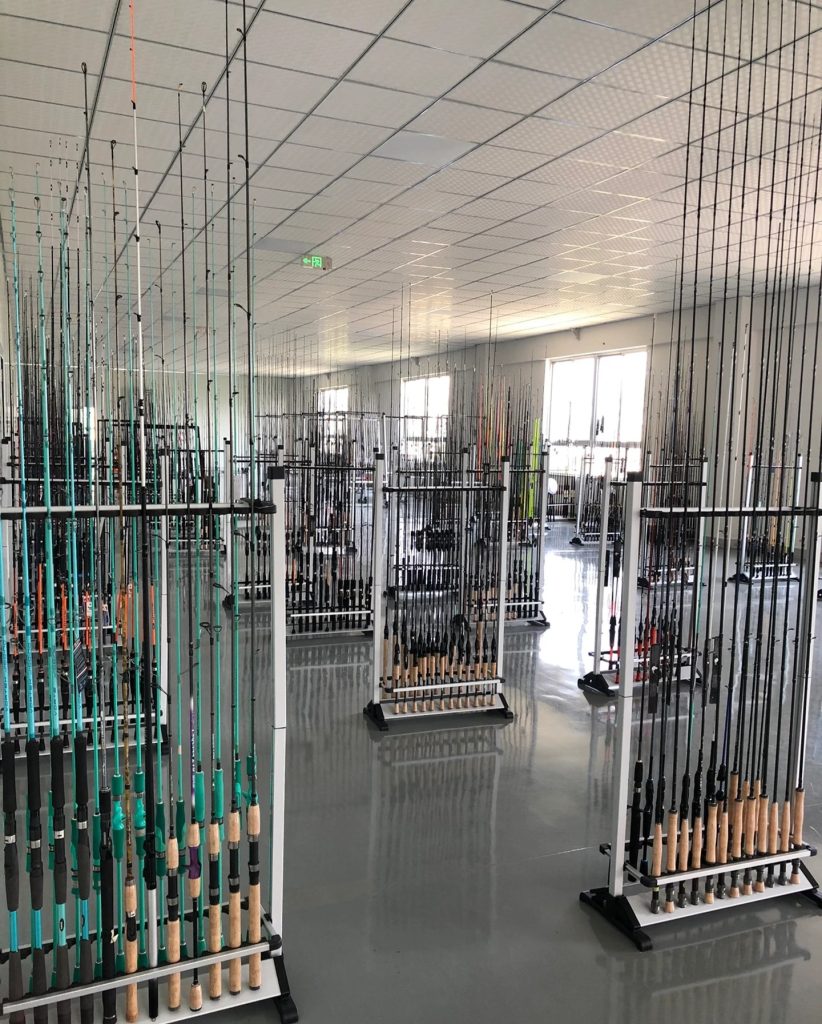
Fishing rod power and action are two specifications that wholesale buyers should understand before ordering fishing rods from China.
They are often mentioned together, but they describe different characteristics.
Rod power generally refers to how much force is required to bend the rod, while rod action describes where and how the rod bends.
For wholesalers, distributors, retailers, and private-label fishing tackle brands, understanding these two specifications is important because they influence product positioning, target users, lure selection, line selection, and the overall fishing experience.
A supplier may offer the same fishing rod model in different power and action combinations. Choosing the wrong configuration can make the product unsuitable for the target market even if the manufacturing quality is good.
This guide explains how buyers can evaluate fishing rod power and action before placing a wholesale or OEM order.
1. What Does Fishing Rod Power Mean?
Fishing rod power describes the general amount of force required to bend a rod.
Common descriptions include:
-
Ultra Light
-
Light
-
Medium Light
-
Medium
-
Medium Heavy
-
Heavy
-
Extra Heavy
These labels are useful for communicating the general characteristics of a rod, but they should not be treated as a universal measurement system.
Different manufacturers may have slightly different interpretations of the same power classification.
For this reason, buyers should ask the supplier for the complete product specification rather than relying only on the word “Medium” or “Heavy.”
A professional quotation should ideally include the intended line and lure range where applicable.
2. What Does Fishing Rod Action Mean?
Rod action describes how the rod bends when pressure is applied.
Common descriptions include:
-
Fast
-
Moderate Fast
-
Moderate
-
Slow
A fast-action rod generally bends closer to the upper section, while a slower action involves more of the rod blank.
However, the exact behavior depends on the rod design, blank construction, materials, taper, and manufacturer.
This means that two rods both described as “Fast Action” may not feel exactly the same.
For wholesale purchasing, action should therefore be treated as one part of the overall product specification rather than a complete description of rod performance.
3. Power and Action Are Different
One of the most common mistakes made by new fishing tackle buyers is treating power and action as the same specification.
They are not.
For example, a fishing rod can be:
Medium Power + Fast Action
or:
Medium Power + Moderate Action
The two rods may have similar overall power but different bending characteristics.
Another rod might be:
Heavy Power + Fast Action
which is a substantially different product.
When requesting a quotation, buyers should specify both power and action whenever these characteristics are important to the intended application.
4. Why Power Matters to Wholesale Buyers
Power helps define the type of fishing application for which a rod is intended.
A lighter-power rod may be positioned for lighter tackle and smaller fish, while heavier-power rods may be designed for applications requiring more resistance and control.
The correct choice depends on:
-
Target fish
-
Fishing environment
-
Lure weight
-
Line selection
-
Fishing technique
-
User experience
-
Target market
A retailer selling beginner fishing equipment may need a different product mix from a specialist fishing tackle distributor.
Therefore, buyers should define the intended customer before selecting the rod specification.
5. Why Action Matters to Wholesale Buyers
Action can influence how the rod loads, casts, and responds during fishing.
Different actions may be preferred for different fishing techniques.
However, buyers should avoid making broad assumptions such as:
Fast action = better
or
Slow action = lower quality
Neither statement is correct.
The appropriate action depends on the intended use.
A wholesale buyer should therefore select action according to the target fishing technique and customer requirements.
6. How Power and Action Work Together
Power and action should be evaluated together.
For example:
Power |
Action |
General Product Positioning |
|---|---|---|
Light |
Fast |
Light tackle applications |
Medium Light |
Moderate Fast |
Versatile lighter applications |
Medium |
Fast |
General-purpose applications |
Medium |
Moderate |
More progressive bending |
Medium Heavy |
Fast |
Heavier applications |
Heavy |
Fast |
Stronger applications |
This table is only a general purchasing framework.
The actual performance of a fishing rod depends on its complete construction and should be confirmed through the supplier’s technical specification and, when appropriate, physical samples.
7. Do Not Select Power Only From a Product Photograph
Product photographs are useful for evaluating appearance.
They cannot reliably tell a buyer:
-
Exact rod power
-
Exact action
-
Blank construction
-
Actual weight
-
Line rating
-
Lure rating
-
Guide configuration
This is why professional purchasing should combine photographs with technical specifications and physical samples.
If you are comparing several suppliers, use the same specification for each quotation.
You can read more about supplier comparison here:
How to Compare Fishing Rod Suppliers in China
8. Check the Line Rating
Power and line rating are closely related, but they are not the same specification.
When purchasing fishing rods, ask the supplier for the recommended line range where applicable.
For example:
Recommended Line: [Supplier specification]
The exact value should come from the product specification.
Do not copy a line rating from another rod simply because both products have the same power classification.
This is especially important when developing a private-label product.
The line rating printed on the packaging should match the approved product specification.
9. Check the Lure Rating
For lure fishing rods, lure rating is another important specification.
The lure rating indicates the range of lure weights the rod is intended to handle.
Buyers should confirm:
-
Minimum lure weight
-
Maximum lure weight
-
Unit of measurement
-
Packaging information
-
Product label information
If your target market uses a particular measurement system, make sure the supplier can provide consistent information for the product packaging and marketing materials.
10. Consider Rod Length Together With Power and Action
Power and action should not be evaluated independently of rod length.
A fishing rod’s length can influence:
-
Casting distance
-
Control
-
Handling
-
Portability
-
Product positioning
For example, two rods may have the same power and action but different lengths.
They may therefore offer different user experiences.
When requesting an OEM quotation, provide all three specifications where relevant:
Length + Power + Action
You can use the specification framework from:
What Fishing Rod Specifications Should Buyers Check Before Ordering?
This helps prevent suppliers from interpreting the product requirements differently.
11. Consider the Blank Construction
Power and action are also influenced by the rod blank.
Buyers should consider:
-
Blank material
-
Blank taper
-
Construction
-
Wall characteristics
-
Reinforcement
-
Overall design
Carbon fiber fishing rods are often selected for applications where weight, responsiveness, and stiffness are important.
However, “carbon fiber” alone does not define the rod’s power or action.
A buyer should still specify the desired power and action separately.
For carbon fiber purchasing considerations:
How to Choose a Carbon Fiber Fishing Rod for Wholesale and OEM Projects
12. Match Power and Action to the Target Customer
A wholesale buyer should begin with the customer rather than the factory.
Ask:
Who will buy this fishing rod?
Possible target groups include:
-
Beginners
-
Recreational anglers
-
Experienced anglers
-
Tournament-oriented users
-
Saltwater anglers
-
Freshwater anglers
-
Retail customers
-
Professional fishing guides
Different customers may expect different product characteristics.
A distributor serving a broad market may need several power/action combinations instead of a single universal model.
13. Build a Product Range Instead of One Model
For retailers and distributors, a product range can be more useful than trying to make one fishing rod suitable for every customer.
For example, a product line could contain:
-
Light / Fast
-
Medium Light / Moderate Fast
-
Medium / Fast
-
Medium Heavy / Fast
-
Heavy / Fast
The actual models should be selected according to market demand and fishing applications.
The purpose is to give customers clear choices without creating unnecessary product complexity.
Too many variations can increase inventory requirements, packaging complexity, and MOQ considerations.
14. Power and Action Affect Product Inventory
For wholesalers, each power/action combination can become a separate SKU.
This matters because adding more combinations may increase:
-
Inventory
-
Packaging variations
-
Product labels
-
Product photography
-
Stock management
-
MOQ requirements
-
Purchase complexity
Before developing a large fishing rod range, estimate expected demand for each model.
If you are working with a Chinese supplier, also confirm whether MOQ is calculated separately for each model.
See:
Fishing Rod MOQ in China: What Wholesale Buyers Should Know
15. Ask the Supplier for a Complete Specification
When requesting a quotation, do not write only:
Medium Fast Fishing Rod
That description is incomplete.
A better request might include:
Rod Type: Spinning Rod
Length: [Required length]
Sections: [Required number]
Power: Medium
Action: Fast
Line Rating: [Required]
Lure Rating: [Required]
Material: [Required]
Quantity: [Required]
Logo: Custom
Packaging: Custom / Standard
The supplier can then confirm whether the requested configuration is available.
16. Request Samples for Important OEM Projects
For a private-label fishing rod, the sample should be treated as an important part of the approval process.
Check whether the sample matches:
-
Length
-
Power
-
Action
-
Line rating
-
Lure rating
-
Weight
-
Guides
-
Reel seat
-
Handle
-
Finish
-
Logo
-
Packaging
If the sample does not match the specification, resolve the difference before approving mass production.
More quality-control guidance is available here:
How to Inspect Fishing Rod Quality Before Placing a Bulk Order
17. Document the Approved Power and Action
For repeat orders, product consistency is important.
Once a buyer approves a fishing rod model, the specifications should be recorded.
For example:
Model: ABC-210M-F
Length: 2.1 m
Sections: 2
Power: Medium
Action: Fast
Line Rating: [Approved specification]
Lure Rating: [Approved specification]
The exact format can be adapted to the buyer’s product management system.
The important point is that the supplier should have a clear production reference.
18. Power and Action Should Match the Packaging
Private-label buyers should make sure the technical information printed on packaging matches the actual product.
Check:
-
Rod label
-
Retail box
-
Product insert
-
Website listing
-
Product catalog
-
Online marketplace listing
If the rod is changed after packaging artwork has been approved, update the product information accordingly.
This avoids creating inconsistencies between the physical product and the marketing material.
19. Do Not Use Power and Action as the Only Quality Indicators
A fishing rod with the correct power and action can still have quality problems.
Buyers should also check:
-
Blank finish
-
Section joints
-
Guide alignment
-
Reel seat
-
Handle
-
Printing
-
Assembly
-
Packaging
-
Overall consistency
Power and action describe product characteristics.
They do not replace quality inspection.
For a broader inspection process, see:
How to Inspect Fishing Rod Quality Before Placing a Bulk Order
20. How Power and Action Affect the Wholesale Cost
Power and action alone do not determine the price.
The final quotation can also depend on:
-
Material
-
Length
-
Components
-
Blank construction
-
Guides
-
Reel seat
-
Handle
-
Finish
-
Logo
-
Packaging
-
Quantity
Therefore, buyers should not expect every Medium/Fast rod to have the same wholesale price.
For a broader cost calculation:
How to Calculate the Total Cost of Buying Fishing Rods from China
21. How to Compare Power and Action Between Suppliers
When comparing suppliers, send exactly the same specification.
For example:
Supplier A
Medium / Fast
2.1 m
2 sections
Specified line range
Specified lure range
Supplier B
Medium / Fast
2.1 m
2 sections
Same requested line range
Same requested lure range
Then compare the samples and quotations.
Do not compare:
Supplier A: Medium/Fast
against
Supplier B: Medium/Moderate
and assume the lower quotation is better.
The products have different specifications.
22. A Simple Buyer Specification Sheet
A wholesale buyer can use the following format when contacting suppliers:
Item |
Required Specification |
|---|---|
Rod Type |
Spinning / Casting |
Length |
[ ] |
Sections |
[ ] |
Power |
[ ] |
Action |
[ ] |
Line Rating |
[ ] |
Lure Rating |
[ ] |
Material |
[ ] |
Guides |
[ ] |
Reel Seat |
[ ] |
Handle |
[ ] |
Weight |
[ ] |
Color |
[ ] |
Logo |
[ ] |
Packaging |
[ ] |
Quantity |
[ ] |
This gives the supplier a clear technical starting point.
23. Questions to Ask a Fishing Rod Supplier
Before ordering, ask:
-
What power options are available?
-
What action options are available?
-
What line range is recommended?
-
What lure range is recommended?
-
Can power and action be customized?
-
Can the same specification be reproduced for future orders?
-
What is the rod weight?
-
What is the assembled length?
-
What is the collapsed length if applicable?
-
What is the MOQ for each configuration?
-
Can a sample be provided?
-
Can the logo and packaging be customized?
These questions help buyers move from a general product search to a specific purchasing specification.
Frequently Asked Questions
Is medium power suitable for every fishing application?
No. Medium power is only one general classification. The appropriate power depends on the target fish, fishing technique, lure, line, and intended use.
Is fast action better than moderate action?
Not necessarily. Different actions are suitable for different fishing applications. The correct choice depends on the intended use and target customer.
Can the same fishing rod have different power and action combinations?
Yes. Depending on the design and supplier’s product range, similar rod designs may be offered in different power/action configurations.
Should I specify both power and action when ordering from China?
Yes, if these characteristics are important to the intended product. Providing both specifications reduces ambiguity during supplier quotation and sample development.
Can a supplier customize power and action for an OEM fishing rod?
Some suppliers may be able to support customized specifications, while others may only offer existing models. Confirm feasibility, MOQ, sample requirements, and production conditions before ordering.
Does rod power determine the price?
Not by itself. Price can also depend on material, length, components, quantity, customization, packaging, and other production requirements.
Power and Action Checklist for Wholesale Buyers
Before approving a fishing rod specification, confirm:
-
[ ] Target fishing application
-
[ ] Rod length
-
[ ] Number of sections
-
[ ] Power
-
[ ] Action
-
[ ] Line rating
-
[ ] Lure rating
-
[ ] Blank material
-
[ ] Guides
-
[ ] Reel seat
-
[ ] Handle
-
[ ] Rod weight
-
[ ] Sample
-
[ ] Logo
-
[ ] Packaging
-
[ ] MOQ
-
[ ] Quality requirements
-
[ ] Production specification
Once these details are confirmed, the product becomes much easier to quote, sample, manufacture, inspect, and reorder.
Conclusion
Power and action are two important fishing rod specifications, but they should never be considered in isolation.
For wholesale and OEM buyers, the correct selection should be based on:
Target application → Rod length → Power → Action → Line rating → Lure rating → Blank construction → Components → Sample → Quality requirements
The same power or action label can represent somewhat different products between manufacturers, so buyers should always review the complete specification and, for important projects, evaluate a physical sample.
A clear specification also makes supplier comparison easier.
Instead of asking:
“Can you supply a Medium fishing rod?”
a professional buyer can provide the complete requirements and ask:
“Can you produce this specific length, power, action, line rating, lure rating, component configuration, quantity, and packaging?”
That gives the supplier a much clearer basis for preparing a quotation and sample.
Contact a China Fishing Rod Supplier
For buyers sourcing fishing rods from China for wholesale, distribution, retail, or private-label projects, you can contact:
Guangzhou Fishing Tackle Co., Ltd.
When sending an inquiry, include:
-
Rod type
-
Length
-
Sections
-
Power
-
Action
-
Line rating
-
Lure rating
-
Quantity
-
Logo requirements
-
Packaging requirements
-
Destination country
-
Sample requirements


No reply content